The Ultimate Guide to Local Marketing for Renovation Contractors
By Editorial Team
Updated on July 23, 2026

Local marketing helps renovation contractors reach homeowners within a defined city, neighbourhood, or service area. As fall and winter approach, it becomes especially important to prepare for seasonal demand by reviewing your schedule, updating your marketing, and making sure your equipment and team are ready for busier periods.
A strong local marketing strategy can help contractors fill their calendars, promote seasonal services, and improve operations after the holiday slowdown. This guide covers practical ways to strengthen your local presence, attract qualified leads, and prepare your business for the months ahead.
Why Local Marketing Matters for Renovation Companies

Source: Reno Quotes
Most renovation companies depend on customers within a limited service area. Broad advertising may generate attention, but local business marketing is more likely to reach homeowners who can realistically hire your company.
An effective strategy can help you:
Reach target customers in your service area
Generate more relevant calls and quote requests
Build recognition within nearby communities
Establish trust through reviews and local projects
Adapt campaigns to regional consumer behaviours
Use your marketing budget more efficiently
Local marketing also allows smaller contractors to compete based on reputation, proximity, and community knowledge rather than advertising budget alone.
Building a Local Marketing Strategy

Source: Groupe Excavel inc.
A local marketing strategy should begin with clear goals and a realistic understanding of your market. Avoid investing in every platform at once. Instead, identify where your ideal customers search for contractors and which channels are most likely to support your objectives.
Define Your Local Audience and Service Area
Start by identifying your target customers and geographical area. A renovation company may serve one city, several suburbs, or a wider region depending on the project type and travel requirements.
Create basic customer profiles based on factors such as:
Location
Property type
Renovation needs
Approximate project budget
Homeownership stage
Preferred communication channels
Review past leads and completed projects for additional data insights. This information can reveal which neighbourhoods, services, and customer profiles produce the strongest opportunities.
Match Each Channel to a Business Goal
Different marketing channels support different objectives.
Lead generation: Google Business Profile, local SEO, pay-per-click advertising, Google Local Services Ads where available, and referral programs.
Local awareness: Facebook, Instagram, TikTok, local sponsorships, community events, local media, and direct mail campaigns.
Trust building: Customer reviews, testimonials, customer stories, project photos, local partnerships, and community involvement.
Customer retention: A local email list, localized email campaigns, maintenance reminders, and SMS updates.
Begin with a small number of channels, establish key performance indicators, and expand based on measurable results.
Google Business Profile and Local Listings

Source: Reno Quotes
A Google Business Profile is one of the most important local marketing tools for a renovation contractor. Previously called a Google My Business listing, it controls how eligible business information may appear on Google Search and Maps.
Claim and Verify Your Profile
Create or claim your Google Business Profile and complete the required business verification. Available verification methods vary and may include video, phone, email, or mail.
Use the real business name that appears on your signage, invoices, and website. Contractors operating as service-area businesses should enter accurate service areas and hide their address when customers are not served at that location.
Complete Every Relevant Field
Add accurate and current information, including:
Business name
Primary business category
Secondary categories
Phone number
Website
Hours of operation
Service areas
Services offered
Business description
Project photos
Choose the fewest categories needed to describe the company’s main activities accurately. Categories can affect local search visibility, so avoid adding unrelated services simply to appear in more searches.
Keep the Profile Active
Regularly add photos of completed renovations, team members, work in progress, and local projects. Publish updates about seasonal services, company news, events, or exclusive local promotions.
An active profile gives potential customers more information when comparing contractors. It also supports Google My Business optimization without relying on repetitive keywords.
Manage Local Listings and NAP Information
Your name, address, and phone number are commonly referred to as NAP information. Keep these details consistent across your website, Google Business Profile, social media accounts, chamber of commerce profile, and local directories.
Directory management platforms such as BrightLocal or Yext can help businesses monitor local listings and citations across several platforms. These tools may be useful for companies with many locations, although smaller contractors can often manage their main listings manually.
Relevant local directories may include:
Yellow Pages
Yelp
Local chambers of commerce
Municipal or regional business directories
Trade association directories
Relevant contractor platforms
Local listings should be accurate and useful. Registering on a large number of low-quality directories is unlikely to provide the same value as maintaining a smaller group of credible profiles.
Maximizing Customer Reviews and Reputation Management
Source: Soluo
Customer reviews are a cornerstone of local marketing. For renovation companies, they provide reassurance during a high-value purchasing decision and can improve credibility across local search results.
Ask for Reviews at the Right Time
Do not leave review requests to chance. Establish a consistent process and ask when the customer is most likely to be satisfied.
Good opportunities include:
After the final walkthrough
When the customer compliments the work
After resolving a concern successfully
In a project-completion email
Shortly after the final invoice
A personalized request can be simple:
"Thank you for choosing [business name]. Would you be willing to share your experience on Google? Your feedback helps homeowners in your area make an informed decision."
You can request a genuine review, but do not offer a discount, prize, or payment in exchange for positive feedback. Avoid asking only customers you believe will leave five-star reviews.
Yelp advises businesses not to ask customers directly for reviews on its platform. Follow the rules of each review site rather than applying the same process everywhere.
Respond to Positive and Negative Feedback
Thank customers who leave positive reviews. Keep the response brief and personalize it when possible.
When responding to a negative review:
Reply calmly and professionally
Acknowledge the customer’s concern
Avoid discussing private project details
Offer to continue the conversation offline
Explain the next step when appropriate
A professional response shows future customers that feedback is taken seriously.
Promote Customer Testimonials
With permission, repurpose strong reviews and customer testimonials across your marketing channels.
They may appear on:
Service pages
Geo-specific landing pages
City pages
Social media posts
Quote packages
Email campaigns
Printed materials
Testimonials are especially persuasive when they mention a specific renovation service, neighbourhood, or city.
Local SEO Strategies

Source: Lafontaine & Fils Inc.
Local SEO helps search engines understand what your company offers and where it operates. It includes Google Business Profile optimization, local keyword targeting, citations, online reviews, localized content, and a clear website structure.
Create Service and City Pages
Build useful pages for the services and locations that matter most to your company. Examples include:
Kitchen Renovations in Laval
Bathroom Renovations in Longueuil
Basement Finishing in Gatineau
Home Additions in Ottawa
Each page should provide original and locally relevant information. Avoid creating near-identical pages that simply replace one city name with another.
Useful elements include:
Services available in the area
Local project examples
Original photos
Customer testimonials
Common project questions
Regional housing considerations
A clear quote-request form
Geo-specific landing pages can support both organic search and geo-targeted ads.
Use Local Keywords Naturally
Research the terms local customers use when searching for renovation companies. Examples include:
Kitchen renovation contractor in Laval
Bathroom remodeler in Trois-Rivières
Basement finishing company in Ottawa
Renovation contractor near me
Use these phrases naturally in headings, title tags, descriptions, page copy, and image descriptions. Local keyword targeting should improve clarity rather than produce repetitive or awkward language.
Improve Site Structure and Internal Linking
Organize the website so visitors can move easily between services, project galleries, and location pages.
For example, a main kitchen renovation page can link to kitchen renovation pages for Laval, Montréal, and Longueuil. A Laval location page can link back to the kitchen, bathroom, basement, and home addition services offered in that area.
A clear site structure supports navigation, search visibility, and mobile optimization.
Publish Localized Content
Create blog posts centred around local topics and homeowner questions. Useful subjects may include:
Renovation considerations for older homes in Montréal
Basement moisture concerns in a specific region
Local permit considerations
Seasonal renovation planning
Recent community projects
Regional material or design trends
Local blogs, regional FAQs, local news connections, and detailed customer stories can strengthen relevance without creating unnecessary city pages.
Build Local Backlinks
A local backlink strategy focuses on earning links from credible websites in your community or industry.
Potential sources include:
Local chambers of commerce
Suppliers and manufacturers
Community organizations
Local media
Trade associations
Event websites
Business partners
Guest posting opportunities
Focus on legitimate relationships and useful content rather than purchasing large numbers of low-quality links.
Prepare for Mobile and Voice Search
Many homeowners search for contractors from a mobile device. Pages should load quickly, display clearly, and make it easy to call or request a quote.
Voice search readiness largely depends on clear, conversational content. Answer practical questions directly, such as "Who renovates kitchens in Laval?" or "How do I find a bathroom contractor near me?" Avoid creating unnatural text solely for voice search.
Local Paid Advertising

Source: Reno Quotes
Paid advertising can place your company in front of homeowners actively searching for nearby renovation services. It can also support awareness in selected neighbourhoods.
Use Geographic Targeting Carefully
Google Ads and paid social platforms allow advertisers to target cities, postal codes, defined areas, or a radius around a location. Review the geographic targeting settings carefully to avoid paying for clicks from areas you do not serve.
Radius targeting and postal-code targeting can help create hyper-targeted audiences. However, targeting should remain large enough to generate meaningful campaign data.
Use Pay-Per-Click Advertising for High-Intent Searches
Pay-per-click advertising can target searches such as "kitchen renovation contractor Laval" or "bathroom renovator near me."
Send each ad to a relevant service or location page. A homeowner searching for basement finishing in Gatineau should not be sent to a generic homepage when a focused landing page is available.
Useful Google Ads features may include:
Call assets, previously called call extensions
Location assets, previously called location extensions
Sitelinks
Promotion assets, previously called promotion extensions
Clear calls-to-action
Call assets make it easier for mobile users to contact the business directly. Location assets can display business or service-area information where eligible.
Consider Google Local Services Ads
Google Local Services Ads, or LSAs, are available only for eligible service categories and locations. Availability and requirements can vary, so contractors should confirm whether their trade and region qualify before including LSAs in their strategy.
These ads are designed to generate direct leads rather than website traffic. Compare lead quality and cost per acquisition with standard search campaigns.
Use Paid Social Advertising
Paid social advertising on Facebook and Instagram can promote project photos, videos, testimonials, and localized incentives. It is often better suited to awareness and remarketing than to immediate high-intent searches.
Use remarketing to reach people who previously visited a service page or quote form, provided the campaign and tracking practices comply with applicable privacy requirements.
Control Budgeting and ROI Analysis
Set a defined budget and track results by campaign, service, and location. Do not judge a campaign only by clicks.
Compare:
Click-through rates
Conversion rates
Cost per acquisition
Leads generated
Quote appointments
Projects sold
Return on ad spend
Hyperlocal PPC advertising can be effective, but a narrow audience does not automatically guarantee better results. Test locations, ad copy, and landing pages before expanding the budget.
Social Media Marketing for Local Audiences

Source: Reno Quotes
Social media can humanize a renovation company and strengthen its community presence. The strongest organic social media strategies connect the company’s work to real places, projects, and people.
Create Locally Relevant Visual Content
Showcase completed projects in nearby cities and neighbourhoods. Before-and-after photos, short videos, project walkthroughs, and customer stories can demonstrate the quality and range of your work.
Useful content ideas include:
Recent renovation projects
Team introductions
Behind-the-scenes videos
Material comparisons
Community events
Seasonal renovation tips
Customer testimonials
Interactive polls
Use town hashtags, location tags, and neighbourhood references when relevant. Avoid adding long groups of unrelated hashtags.
Participate in Local Community Groups
Local community groups can help contractors understand homeowner concerns and local consumer behaviours. Participate helpfully rather than posting repetitive promotions.
Answer questions, explain common renovation issues, and share useful information when group rules permit it. Promotional posts should be transparent and appropriate for the group.
Combine Organic and Paid Social
Organic content builds familiarity over time. Paid social can extend the reach of important posts, promote a local offer, or support remarketing.
More advanced formats such as live streaming, shoppable posts, or augmented reality may suit certain businesses, but they should not replace clear project photos, useful advice, and strong calls-to-action.
For most renovation companies, practical visual content will provide more value than adopting every new platform feature.
Localized Content Marketing

Source: Reno Quotes
Localized content marketing connects broader renovation expertise to the needs of a particular community.
Tell Local Customer Stories
A detailed customer story can explain:
The homeowner’s objective
The property type
The project location
The main renovation challenge
The solution selected
The final result
Remove private information and obtain permission before identifying customers or sharing photos of their homes.
Connect Content to Local News and Events
Create content around relevant community events, seasonal conditions, housing trends, and regional concerns. A contractor may discuss preparing a home for winter, renovating older housing stock, or planning work around a local home show.
The connection should be useful and natural. Avoid forcing unrelated local news into promotional content.
Encourage User-Generated Content
Invite customers to share photos or posts about a completed project, provided participation is voluntary and privacy is respected. User-generated content can strengthen credibility and expand local reach.
Interactive polls can also help identify audience preferences, such as popular kitchen styles, flooring options, or renovation priorities.
Collaborate With Local Partners
Work with interior designers, architects, suppliers, real estate professionals, or other complementary businesses on:
Videos
Local guides
Guest posts
Workshops
Project features
Social media collaborations
Local partnerships can expose the company to a relevant audience while producing more useful content.
Email and SMS Marketing for Local Audiences
Source: Reno Quotes
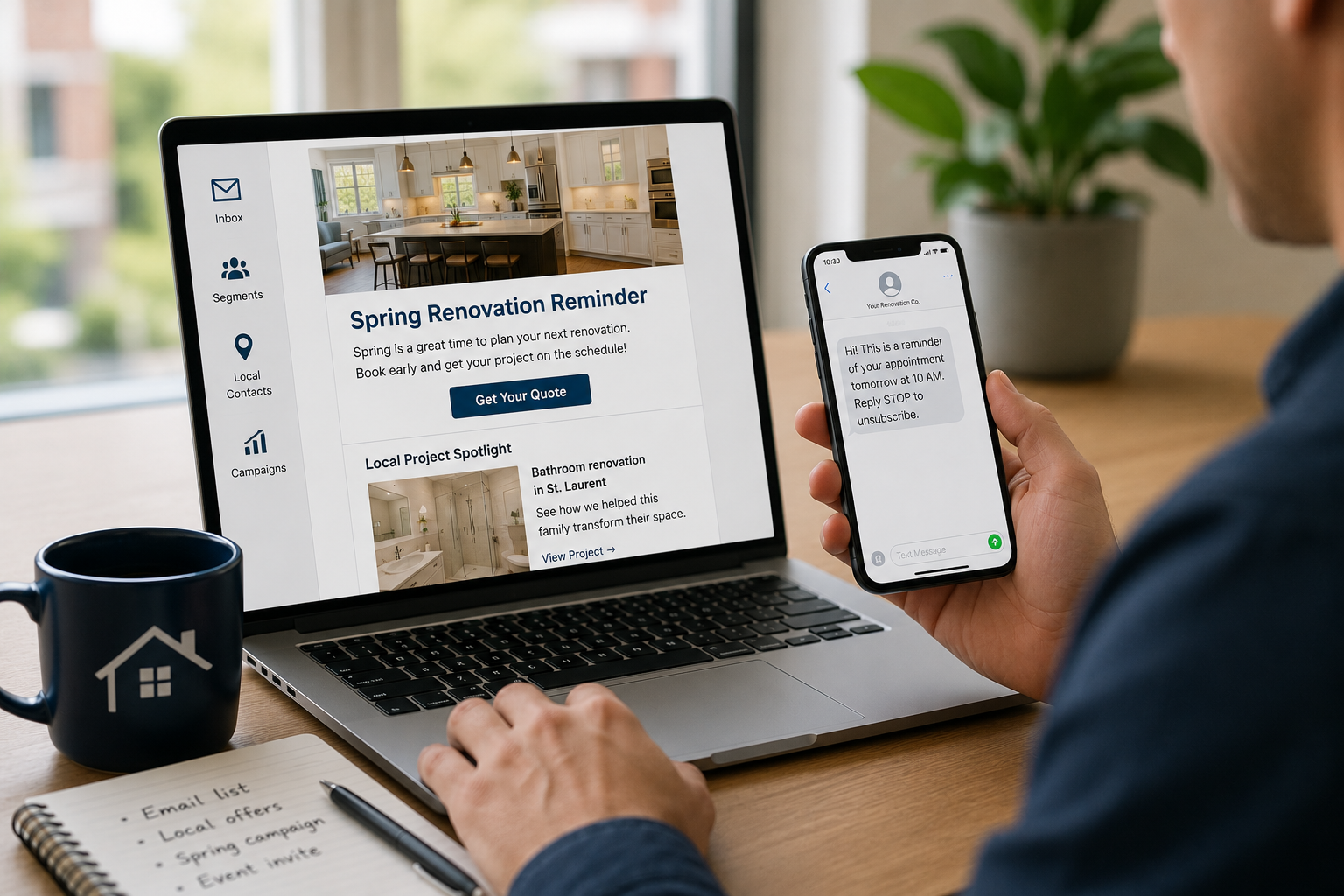
Email and SMS marketing can help contractors communicate directly with prospects, past customers, and local contacts.
Build and Segment a Local Email List
Collect email addresses and phone numbers through:
Website forms
Quote requests
Events
In-store sign-ups
Contests
Project follow-ups
Newsletter subscriptions
Segment the list by city, postal code, service interest, project stage, or customer history. Geo-segmentation makes it possible to send localized email campaigns rather than identical messages to every contact.
Examples include:
Neighbourhood-specific updates
Seasonal renovation reminders
Local project announcements
Event invitations
Exclusive local promotions
Maintenance advice
Personalization should go beyond inserting a first name. Messages should reflect the recipient’s likely needs, location, or stage in the renovation process.
Use SMS Selectively
SMS is useful for time-sensitive communication such as:
Appointment reminders
Schedule changes
Event reminders
Real-time SMS alerts
Limited local promotions
Keep messages brief and include a clear call-to-action. Excessive promotional texts can quickly lead to unsubscribes.
Mobile geo-fencing strategies may allow advertisers to reach devices associated with a defined area. However, these campaigns require careful targeting, transparent data practices, and compliance with applicable privacy and advertising rules. They are not necessary for every local contractor.
Follow Canada’s Anti-Spam Rules
Commercial emails and text messages sent in Canada are generally subject to Canada’s Anti-Spam Legislation. Businesses must have an appropriate form of consent, identify themselves clearly, and provide a working unsubscribe mechanism.
Maintain records of consent and respect unsubscribe requests. Do not add contacts to a local email list simply because you have their business card or phone number.
Offline and Community-Based Marketing

Source: Lafontaine & Fils Inc.
Offline marketing tactics remain valuable, especially in smaller cities, suburbs, and regions where community relationships strongly influence contractor selection.
Get Involved in the Community
Participate in events such as:
Farmer’s markets
Home shows
Local festivals
Sports tournaments
School fundraisers
A local charity event
Neighbourhood cleanups
Contractors can also organize workshops, demonstrations, or open houses to explain renovation planning, materials, or seasonal maintenance.
Community involvement supports trust when it is genuine and consistent. Avoid treating every event as a direct sales opportunity.
Build Strategic Local Partnerships
Identify complementary businesses that serve similar customer profiles. Examples include:
Interior designers
Cabinet suppliers
Flooring installers
Architects and technologists
Hardware stores
Real estate professionals
Property managers
Partnerships may include shared educational content, cross-promotions, joint events, referral arrangements, or exclusive local promotions.
Use Local Sponsorships
Local sponsorships can increase recognition through sports teams, community organizations, cultural events, or local media. Choose opportunities that align with your target audience and service area.
Track the results through dedicated landing pages, promotional codes, or questions on your quote form.
Combine Direct Mail With Digital Marketing
Direct mail can work well when targeted to neighbourhoods with suitable housing, renovation activity, or previous customer referrals.
A direct mail campaign may include:
Postcards
Door hangers
Seasonal service flyers
Project showcases
Neighbourhood-specific offers
Include a QR code, campaign phone number, or dedicated landing page to connect offline interactions with digital measurement.
Vehicle lettering, local newspapers, community boards, and printed project signs can also support a multi-faceted marketing approach.
Encouraging Word-of-Mouth and Referrals
Word-of-mouth remains an important source of renovation leads. Satisfied customers already understand your process and may refer homeowners with similar expectations.
Create a simple referral program and explain how it works. A customer may receive a gift card, service credit, or another appropriate thank-you when a referral becomes a qualified lead or signed project.
Keep referral rewards separate from public reviews. A customer should never feel required to leave positive feedback to receive an incentive.
Encourage social sharing by inviting customers to post a completed project or tag the company, provided they are comfortable doing so.
Analytics and Performance Measurement

Source: Reno Quotes
Local marketing should be measured by the business results it produces, not only by traffic, views, or follower counts.
Establish Key Performance Indicators
Select key performance indicators that reflect each campaign’s objective.
Useful KPIs include:
Website visits by city
Google Business Profile interactions
Calls
Form submissions
Quote requests
Leads generated
Click-through rates
Conversion rates
Response rates
Engagement metrics
Foot traffic, when relevant
Cost per acquisition
Projects sold
Revenue by channel
Google Business Profile performance data can show interactions such as calls, website clicks, and direction requests, depending on the available features.
Use Google Analytics and Campaign Tracking
Google Analytics can help identify how visitors reach the website and which pages contribute to important actions. Configure quote submissions, contact clicks, and other valuable actions as key events.
Use campaign tracking links for:
Email campaigns
Paid social
Directories
Partner websites
QR codes
Digital advertisements
Record the source of each lead in a customer relationship management platform or lead-tracking spreadsheet. Ask new customers how they found the company, as tracking tools do not capture every offline interaction.
Compare ROI and Return on Ad Spend
ROI analysis considers the total return produced by a marketing investment. Return on ad spend focuses more specifically on the revenue generated from advertising costs.
Monitor:
Advertising spend
Leads generated
Qualified leads
Cost per acquisition
Estimates completed
Contracts signed
Average project value
Revenue attributed to the campaign
A channel that generates fewer leads may still be valuable if those leads have stronger conversion rates and higher project values.
Run A/B Testing
A/B testing compares two versions of an advertisement, email, call-to-action, or landing page. Change one major element at a time, such as:
Headline
Project image
Offer
Form length
Call-to-action
Service-area wording
Use enough data before selecting a winner. Google Analytics can help interpret experiment results, although the test itself may require an advertising platform or third-party testing tool.
Review Performance Regularly
Analyze local marketing results monthly or quarterly. Compare performance by:
Channel
City
Service
Campaign
Audience
Landing page
Increase spending on strategies that produce qualified leads and sustainable revenue. Reduce or revise channels with poor conversion rates, high acquisition costs, or weak return on ad spend.
A Practical Local Marketing Action Plan

Source: Reno Quotes
A renovation company can strengthen its local presence with the following steps:
Define the target customers and geographical area
Claim, verify, and optimize the Google Business Profile
Correct NAP information across major local listings
Establish a consistent customer review process
Create useful service and city pages
Publish localized project and community content
Test paid search and social advertising in selected areas
Build a segmented local email list
Combine digital marketing with local partnerships and offline tactics
Measure leads, conversion rates, acquisition costs, and revenue each month
Successful local marketing does not require a presence on every available platform. Contractors should choose the channels that match their services, audience, location, and budget, then use reliable data to improve their strategy over time.
A balanced approach combining local SEO, Google Business Profile, customer reviews, paid advertising, localized content, social media, email, referrals, and community involvement can create lasting visibility and a more consistent source of qualified renovation leads.
Looking for something else?
Related articles
The latest industry news, interviews, technologies, and resources.

Editorial Team
•20 Sep 2024
In Quebec, as tradition will have it, summer only ever really kicks off towards the end of July, when the construction holiday is set to start. This yearly break, which was legislated during collective agreements, offers workers a period of welcomed time off following months of hard labour. While the construction holiday is duly deserved, from a logistical standpoint, said period does have its fair share of downsides. What first comes to mind is how to ensure worksite safety and security during this brief hiatus.

Editorial Team
•08 Nov 2023
Fibre-reinforced concrete was a definite turning point in the construction industry. Designed to offset the brittleness of standard concrete and with a low-tensile strength, fibre-reinforced concrete sets a new record. As a result, some mixtures allow for fewer rebar use on construction sites since this material can withstand tensile forces of 2,300 MPa, compared to standard concrete’s 500 MPa.

Cynthia Pigeon
•05 Dec 2025
A common question among those renovating their bathroom is whether to opt for a bathtub or shower. While the initial focus is often on space constraints, there are other factors that come into play when making the final decision. So, what exactly are these factors? Keep reading to find out!

Editorial Team
•26 Aug 2025
In the construction industry, sharing knowledge and mentoring new talent are essential to ensure a wave of succession and to promote the industry. Given this perspective, virtual mentorships prove to be a promising solution. On account of technological breakthroughs and the onset of custom platforms, you can now benefit from remote expert advice.

Editorial Team
•08 Nov 2023
Regardless of the size of your home renovation project, it likely isn’t an easy undertaking. A lot of planning, time and energy go into a renovation and for this reason, you’re probably looking for a way to make things just a little bit easier.