Whether for interior or exterior work, knowing how to pour a concrete slab is vital for anyone wanting to carry out major home renovations. This process can be a bit tricky, especially since you have to follow certain steps to a T, otherwise, the slab could crack prematurely.
Note that, to lay a concrete slab, you don’t need a concrete mixer, you can mix it manually. However, don't hesitate to call in a professional who'll be able to master both techniques to guarantee high-quality work.
Planning to pour a concrete slab on your property and wondering how to go about it? RenoQuotes.com sums up the process in 5 easy steps!
The 5 Fundamentals of Pouring a Concrete Slab
1. Prepare the yard for the concrete

Source: Canva
First, you'll need to clear the area where you want to pour the concrete. To ensure your slab will stand the test of time, the ground on which it's poured must be solid and stable. Therefore, make sure to remove anything that could hinder the concrete from properly setting, such as shrubs, grass, or pebbles. You should also make sure that the ground is completely exposed.
Next, measure the area and mark out the spot where the concrete will be poured. This step is done by staking each corner of the designated area and then connecting each picket with a string line.
2. Dig the ground

Source: Canva
The second step in creating your concrete slab is to dig up the ground on which it'll lay. If you need to dig a relatively small area, you can do so using a shovel. However, if you're planning on excavating a larger piece of land, you'll need to get ahold of the right equipment first. But, keep in mind that in order to dig out a relatively deep section, you'll need to pour a layer of gravel into the excavated area before pouring the concrete.
Generally, if you plan on laying a wire mesh to reinforce your slab, it is recommended that you add a roughly 8- to 10-cm-thick layer of gravel. You'll also need to gauge the depth of your mesh and to that, consider the concrete layer that’ll be subsequently poured atop. Basically, a concrete slab of 15 cm in depth is best, so once you’ve made the necessary calculations, you'll know how deep to dig.
Are you looking for experts to pour a concrete slab?
Fill out our form to receive quotes from certified contractors!
3. Set the concrete slab’s formwork
Source: Canva
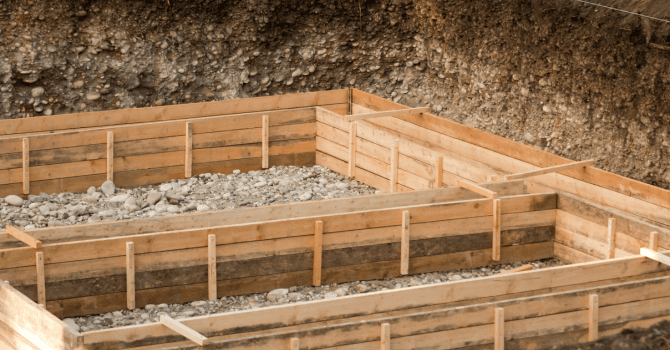
The formwork is neither more nor less than the lining that defines the slab and holds the concrete in place until it's completely dry. Typically, the formwork is made of wood. It's fastened with nails, which are hammered into place around the area that’ll be cast. This formwork will also serve as a reference when pouring your concrete thereafter.
As for the formwork itself, a few things should be verified: the corners of your formwork should meet at right angles and the wooden planks used should be at least 27 mm thick so that they can withstand the pressure generated by the concrete when poured. The planks should also be level with the surface of the concrete slab.
In the event that your concrete slab won't be covered by anything, you'll have to consider rainwater runoff. Therefore, the formwork will have to have a slight slope to allow water to run off. In the same way, it'll be important to think about temperature fluctuations, which cause concrete to swell. Therefore, to prevent the concrete slab from expanding, it's best to install expansion joints, and these should be aligned on the same level as the formwork.
4. Lay down a wire mesh
Source: Canva
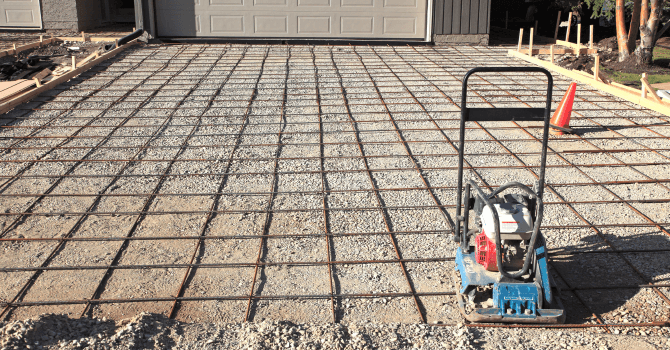
If your structure is designed to be load-bearing, you'll definitely have to reinforce your concrete with wire mesh or iron. If your structure isn't going to be load-bearing, then you can skip this step. Check with a contractor to be sure of the proper procedure. As for the mesh, it should be elevated. In most cases, there should be a clearance of at least 3 cm between the formwork and the mesh.
Note that the mesh is designed to prevent cracks from forming. And, it also reduces the chances of the concrete expanding. The wire mesh is laid down in a way to ensure that the concrete is kept in place in every direction, given that it'll considerably support the weight of the slab and, in turn, reinforce it. If you want to know how to repair a crack in your concrete foundation, check out our article: How to Repair Cracked Foundation Walls.
5. Prep and pour the concrete
Source: Canva
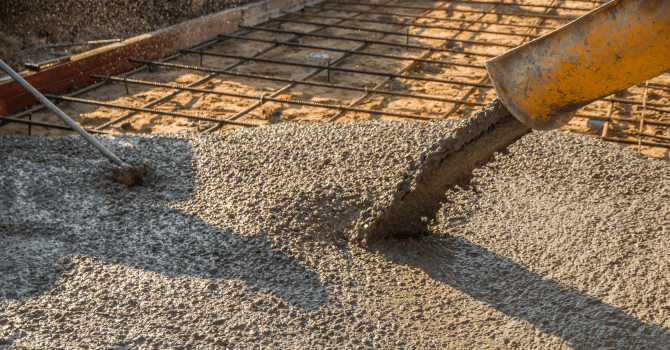
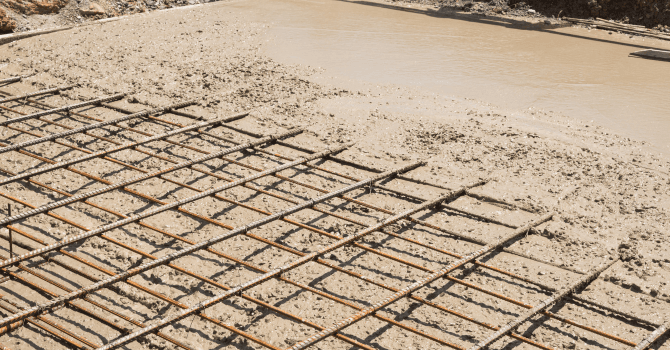
Concrete is made from a combination of cement, sand, and aggregates. Good quality concrete should contain one part cement, two parts sand, and three parts aggregates. Once added, mix a half-part of water to bind all these elements together.
You can mix your concrete either in a wheelbarrow or in a concrete mixer, assuming you have access to one. When pouring your concrete into the centre of your marked area, spread it with a rake. We then recommend that you level the concrete with a large 2-metre straightedge by dragging it across the formwork planks.
Then continue pouring and levelling the concrete as you go. Once the concrete is poured and levelled, smooth it out with a concrete float, making sure to do so in circular motions.
Wait at least 24 hours before walking on your slab. Before applying any kind of coating, you'll most likely have to wait several months. Also, don't forget about maintenance, as regular care will help maintain your slab over the years. To restore the surface every now and then, use water and a concrete-specific soap for surfaces. This’ll help restore its lustre.
You can also add colour to your concrete slab to match your home and the surrounding landscape. Note that the dye should be mixed in at the same time as the water is added.
Get 3 quotes for your concrete slab project
RenoQuotes.com can help you get quotes to pour a concrete slab. By submitting your project, we’ll put you in contact with top-rated contractors. Fill in the form on the homepage (it only takes a few minutes), and you will get estimates from trusted professionals.
Dial 1-844 828-1588 to speak with one of our customer service representatives.
Looking for something else?
Related articles
The latest industry news, interviews, technologies, and resources.

Editorial Team
•31 May 2025
One of the best ways to enjoy the sunshine during the summer is to have an outdoor living space. Decks and patios are two types of common constructions for that matter. However, it’s especially important to differentiate them from one another to figure out which one will work best in your backyard. Over the course of this article, learn all the must-know deck- and patio-building facts.

Amanda Harvey
•23 Jul 2026
As we all know too well, renovating your house or home can be extremely costly. Not everyone is able to spend the necessary funds on projects they may want or need to carry out.

Editorial Team
•08 Aug 2025
Social networks are among the most effective marketing tools available today. Utilising these platforms has become paramount for any company aiming to increase its visibility.

Editorial Team
•31 Mar 2025
A prime contractor, also known as a general contractor, is one of the pivotal forces in the construction industry. Their primary responsibility is to ensure every project to which they’re appointed runs smoothly and meets the project owner’s expectations. Said trade professional is responsible for supervising the entirety of the project, from the initial design stage all the way to the finish line. During which stages of the project are they needed? How can you ensure quality, safety, and on-time project deliveries? What factors should you consider to choose the best prime contractor for the job at hand? Learn more about the ins and outs of this trade!

Amanda Harvey
•08 Nov 2023
Every single winter, homeowners like yourself know how difficult it is to leave the driveway successfully. Between the constant build-up of ice and snow and the energy it takes to shovel, we all find cold weather exhausting. Many have turned to hiring someone to frequently clear their driveway, but this is a costly affair. So, is there a middle ground to consider that’ll solve this problem? Enter heated asphalt.