Backwater Valve: How It Works, What It Costs, and Why You Need One
By Editorial Team
Updated on September 29, 2026
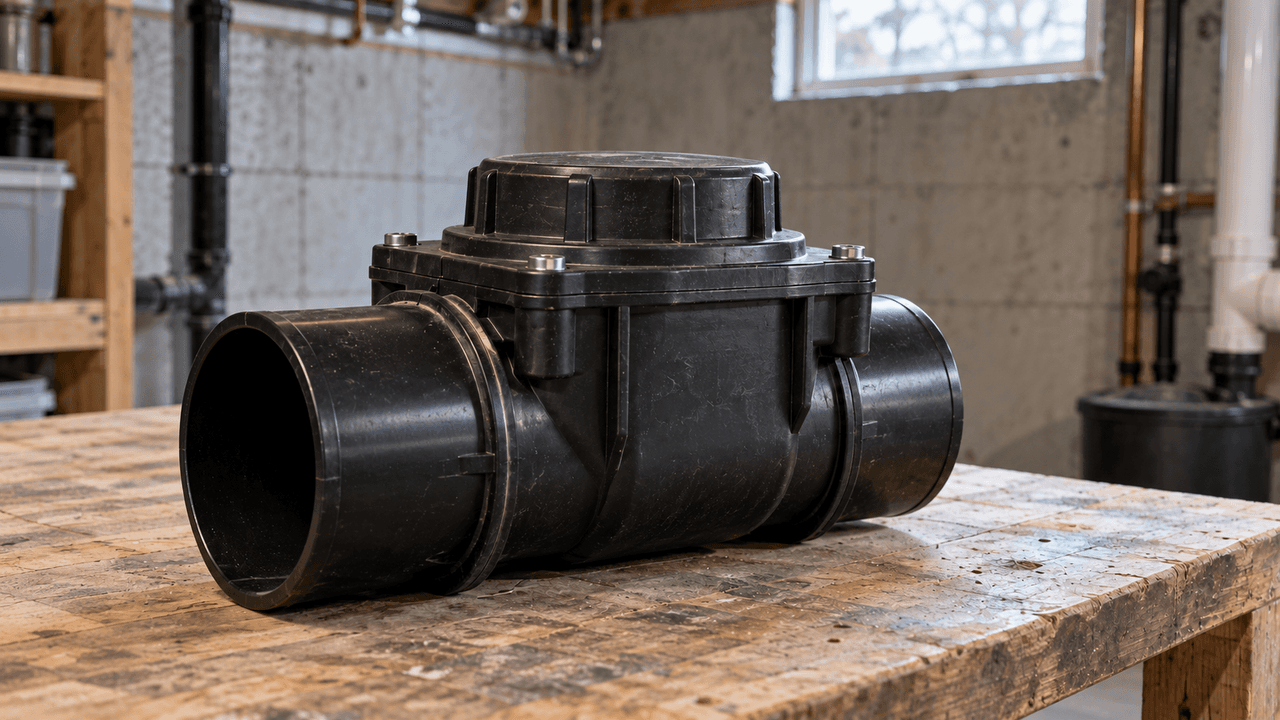
A backwater valve is a one-way gate on the sewer line leaving your house, and installing one costs $1,000 to $4,800 across Canada. When the municipal sewer surcharges during a storm and wastewater tries to flow backward toward your home, the valve closes and keeps it out of your basement.
Against that cost, the average basement flood in Canada runs between $40,000 and $80,000, and many major municipalities subsidize part of the installation. This guide covers how the device works, what it costs in your region, which rebate programs apply, and how to tell whether your home needs one.
How a Backwater Valve Works
Source: Reno Quotes
The Mechanism
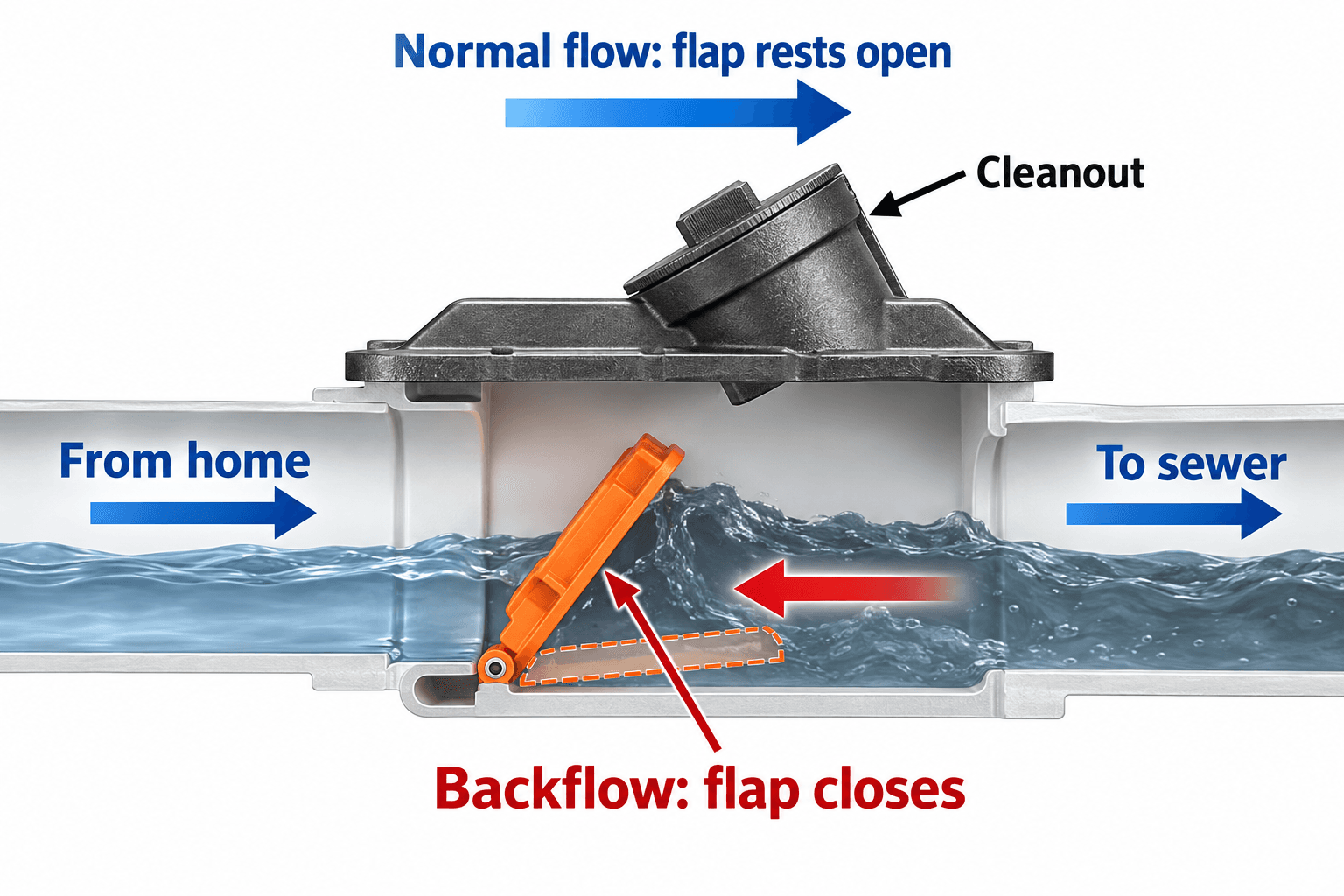
A backwater valve is a simple mechanical device with no power supply and no moving parts beyond a hinged flap.
Under normal conditions, wastewater flows from your building drain out through the lateral to the municipal sewer. The flap hangs open, held out of the way, and water passes freely beneath it.
When the city sewer surcharges, reverse flow pushes water back toward your house. That pressure catches the flap and swings it shut against a seal, closing the pipe. Sewage backup stops at the valve rather than emerging through your floor drain.
Once pressure equalizes, the flap drops back open and normal drainage resumes automatically.
What It Protects Against
Municipal sewer backups happen when the system takes on more volume than it was designed to carry. Heavy rain, rapid snowmelt, or a blockage downstream can all cause it.
In cities with a combined sewer system, where stormwater and wastewater share the same pipe, the risk is considerably higher. Older sections of Toronto, Montreal, Winnipeg, Calgary and Halifax all have combined systems, and a summer thunderstorm can overwhelm them in minutes. The excess has to go somewhere, and the nearest low opening is your basement floor drain.
What It Doesn't Protect Against
A backwater valve stops water coming from the sewer. It does nothing about groundwater seeping through foundation cracks, water entering through basement windows, or water collected by your weeping tile.
That's the sump pump's job. Many Canadian homes need both, and the two devices address entirely different pathways into the basement.
What a Backwater Valve Costs in Canada

Source: Reno Quotes
Installation Cost
Installation type | Cost |
Interior, through the basement slab | $1,000 to $3,500 |
Exterior, excavated from outside | $2,400 to $4,800 |
The job includes the valve itself, cutting the concrete, excavating to the sewer line three to five feet below the basement floor, installing the valve in the correct orientation, backfilling, restoring the slab, and coordinating the permit and inspection.
Interior installation is the most common and the less expensive of the two. Exterior installation costs more because of the excavation involved, but it's sometimes the only option depending on how your lateral runs.
Cost by Region
Market | Typical installed cost |
Vancouver and Lower Mainland | $2,200 to $4,800 |
Toronto and GTA | $2,000 to $4,500 |
Ottawa | $1,800 to $3,800 |
Montreal | $1,500 to $3,500 |
Calgary | $1,200 to $2,800 |
Winnipeg | $1,200 to $2,500 |
The spread reflects labour rates and, in older cities, how deep the lateral sits. A typical Toronto job averages around $2,800, while the same work in Edmonton commonly comes in at $1,000 to $2,000.
Additional cost | Amount |
Building permit | $100 to $300 depending on municipality |
Home plumbing assessment | $300 to $600 |
Annual professional inspection | $100 to $200 |
Concrete and floor restoration | usually included, confirm |
Budget 15% to 20% contingency. Older homes routinely present surprises once the slab is open.
Municipal Subsidy Programs
Many Canadian municipalities subsidize backwater valve installation, because preventing residential flooding costs them far less than the sewer upgrades and emergency response it replaces.
Amounts and eligibility vary enormously, and some cities offer nothing at all. The figures below are a starting point, not a guarantee.
What's Available Across Canada
Municipality | Backwater valve subsidy | Notes |
Toronto | 80% up to $1,600 per valve, 2 valves max | Within $6,650 total per property, expanded May 2026 |
Halton Region (incl. Oakville) | 50% up to $1,600 | Interior valves only, once per property |
Peel Region (Brampton, Mississauga, Caledon) | 60% up to $1,500 including tax | One rebate per residence every 10 years |
Windsor | 100% up to $1,450 | Within a $3,500 lifetime cap for all flood work |
Ottawa | $1,000 interior valve, $2,500 exterior storm valve | Permit fee reimbursed at 100% |
Winnipeg | 60% up to $1,000 | Up to $2,000 more for a sump pump |
Edmonton (EPCOR) | Up to $800 | Home must predate 1989, prior flooding required |
Vaughan | 50% up to $750 | Includes labour, materials, permit and taxes |
Strathcona County | Varies | Home must predate 1989 |
Richmond Hill | Varies | Downspouts must be disconnected to qualify |
London, Markham, and others | Varies | Check municipal water or wastewater department |
Calgary | None for homeowners | Stormwater incentives apply to developers of 3+ unit properties only |
Quebec municipalities including Montreal, Laval and Gatineau run periodic grant programs, though availability changes year to year.
Calgary is worth singling out because its combined sewer neighbourhoods carry real backup risk while the City offers residential homeowners no rebate. Calgary homeowners pay the full installation cost, which makes the case for doing it anyway rest entirely on the $40,000 to $80,000 avoided.
Confirm directly with your city's water or wastewater department before assuming a rebate exists.
The Toronto Program
Toronto's is the most generous in the country and was expanded on May 1, 2026, nearly doubling the previous cap. The expanded amounts apply retroactively to eligible work completed on or after November 12, 2025.
Eligible work | Subsidy |
Backwater valve | 80% of cost, max $1,600 per device, up to 2 devices |
Sump pump | up to $2,250 |
Sump pump battery backup | up to $300 |
Foundation drain severance and capping | 80% up to $400 |
Home plumbing assessment | 80% of cost, up to $500 |
Those five components together reach the $6,650 per-property maximum.
On a typical $2,800 interior installation, the 80% rule caps at the $1,600 maximum, bringing the net cost to roughly $1,200.
The home plumbing assessment is optional, not a precondition. It's subsidized at 80% up to $500 and worth doing if you're unsure what your drainage configuration looks like, but a valve installed under a valid permit by a licensed plumber and passing inspection qualifies without one.
If you see an article citing $1,250 or a $3,400 program cap, it predates the May 2026 expansion.
The Edmonton Program
EPCOR delivers Edmonton's subsidy on behalf of the City, and eligibility is considerably narrower than Toronto's.
To qualify, your home must have been built before 1989 — the year Edmonton bylaws began requiring backwater valves in new construction — must have experienced prior basement flooding from a sanitary sewer backup or sit in a section of the city with previous neighbourhood flooding, and must not already have a valve.
EPCOR offers free flood inspections and recommends arranging one, though the subsidy application itself is submitted after installation. You'll need the City of Edmonton green sticker with the permit number, a professional installation invoice showing the valve model and the contractor's business licence or GST number, and a completed application form.
The subsidy pays up to $800 by cheque to the homeowner. Funding is first-come, first-served with no guarantee.
Strathcona County runs a comparable program with the same pre-1989 rule, for properties serviced directly by county sewers.
What These Programs Have in Common
A licensed plumber is required. DIY installation disqualifies you everywhere.
A building permit must be obtained, and in most programs before work begins.
An inspection is mandatory, and the valve cannot be covered before it happens.
Funding is first-come, first-served in most programs, and annual budgets run out. Applying early in the calendar year improves your odds.
Repairs and replacements are generally excluded. Ottawa states this explicitly, and most programs follow the same logic: they fund new protection, not maintenance.
Downspout disconnection is often a condition. Peel requires an acknowledgement form if you decline, and Richmond Hill requires disconnection outright.
One valve per dwelling unit. Under the Ontario Building Code, a backwater valve can only serve a single dwelling unit, so a basement apartment needs its own.
How to Claim
Check your municipality's program before doing anything else. Search your city's name plus "basement flooding rebate" or "protective plumbing program," and use the official municipal page rather than a contractor's summary.
Ask whether pre-approval or an inspection is required first. Requirements differ, and starting work too early forfeits the rebate in some programs.
Hire a licensed plumber and have them complete any required assessment form.
Obtain a building permit before work begins.
Have the valve installed by the licensed plumber.
Request the municipal inspection once installation is complete.
Do not enclose or cover the valve before the inspection happens. This is the most common way homeowners lose the subsidy.
Submit the application with paid invoices, the permit, photos and proof of ownership, within the program's deadline. Ottawa allows 12 months from permit issue; other programs vary.
Processing takes several weeks to several months. Toronto typically runs 8 to 16 weeks.
Backwater Valve vs Backflow Preventer
Source: Reno Quotes
These two devices are frequently confused, and the distinction matters because they solve unrelated problems on opposite sides of your plumbing.
Backwater valve | Backflow preventer | |
Installed on | The sewer line side | The water supply side |
Protects against | Sewage entering the home | Drinking water contamination |
Typical location | Basement floor, near the service entry | Near the water meter, or at an irrigation connection |
Triggered by | Municipal sewer surcharge | Cross-connection risk |
Common on | Any home with basement fixtures | Irrigation systems, boilers, commercial buildings |
The Backwater Valve
Installed on the drainage side, on the pipe carrying wastewater away from your home. It's about keeping sewer backup out of your basement.
The Backflow Preventer
Installed on the potable water system, on the incoming side. It stops water that has left your clean supply from flowing back into it.
The classic scenario is an irrigation system: a sprinkler head sitting in a puddle of fertilizer-treated water, and a pressure drop in the municipal main creating suction. Without a backflow preventer, that contaminated water can be drawn back into the drinking supply.
Municipal by-laws typically require a backflow preventer on any irrigation connection, and often on landscape drainage systems tied into the potable supply. They carry a small pressure loss penalty, which is normal and designed in.
If you have an in-ground sprinkler system, you likely need both devices — a backflow preventer on the supply and a backwater valve on the drain. They're separate installations, and in some municipalities different trades handle each.
Signs You Need a Backwater Valve
Warning Signs in Your Home
Gurgling from toilets or drains, particularly during or after heavy rain. That's air being pushed back through the system by rising water in the sewer.
Your basement smells like sewage intermittently, especially in wet weather.
Floor drains backing up, even slightly, during storms.
Slow drainage in laundry area drains or a basement bathroom when it rains but not otherwise.
Water appearing around the floor drain rather than seeping through walls, which points to the sewer rather than groundwater.
Risk Factors
Some homes carry elevated sewer backup risk regardless of whether symptoms have appeared yet.
An older home. Properties built before the mid-2000s in most Canadian cities were not required to have a backwater valve. Edmonton began requiring them in new construction in 1989, and many homes built after 2006 elsewhere include one as standard.
Low basement fixtures. A basement bathroom, laundry sink or floor drain sits below the street-level sewer, which makes it the first place backed-up water emerges.
A prior flooding history, on your property or on the street.
Neighbouring properties that have flooded. Sewer surcharge is a neighbourhood-level problem, not a house-level one.
A combined sewer system, common in older parts of most established Canadian cities.
A finished basement, where the cost of a single backup far exceeds the cost of prevention.
A basement apartment, which requires its own valve under the Ontario Building Code and is usually the lowest fixture in the house.
Do you already have one?
Check the lowest level of your basement, typically near the front foundation wall where the main sewer line exits the house.
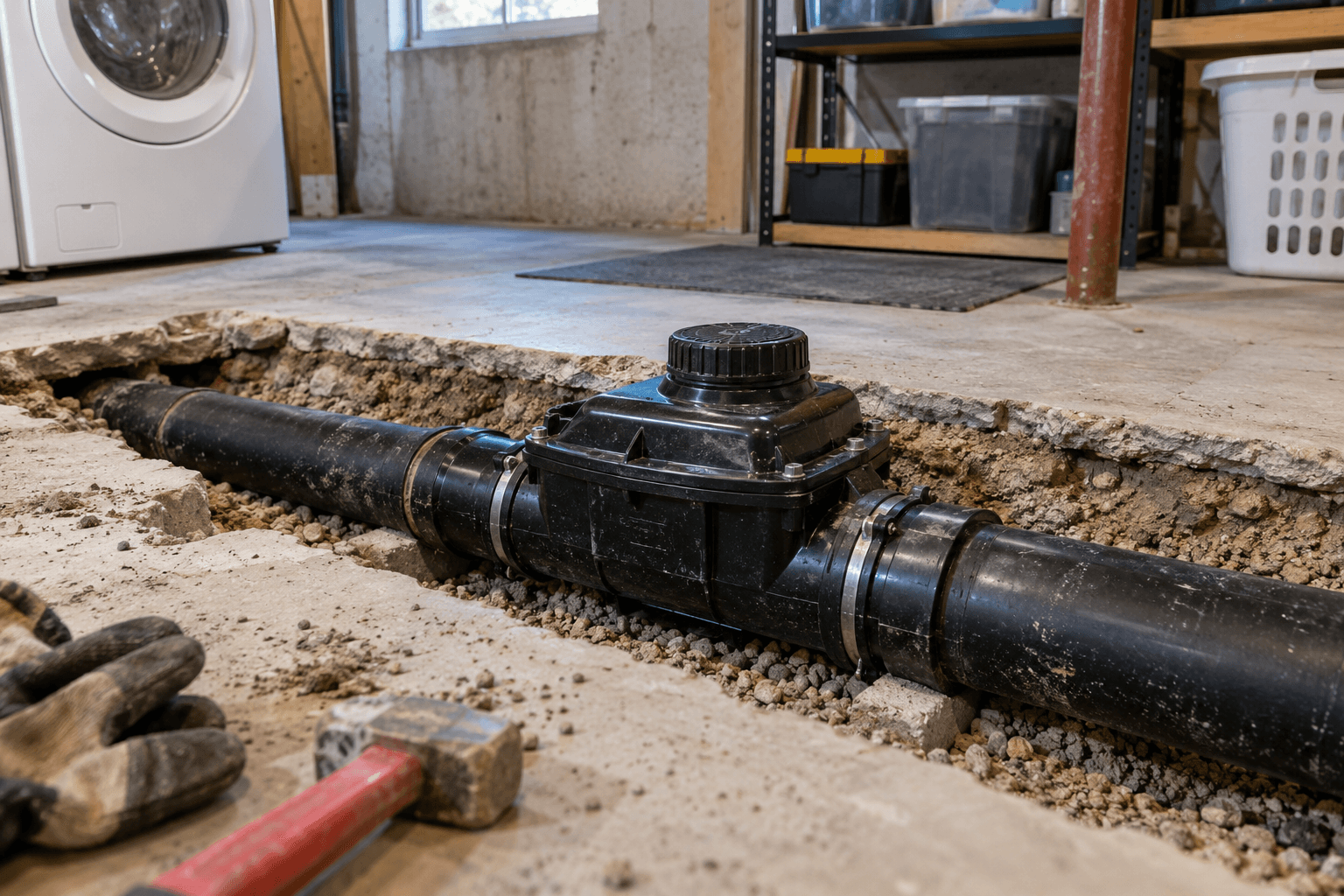
Look for a circular plastic access lid flush with the concrete floor, often with a transparent cover. Opening it lets you see the internal flap mechanism.
If you can't find one, a licensed plumber can run a camera inspection or perform a home plumbing assessment to determine your drainage configuration. Several municipal programs subsidize that assessment, and EPCOR offers free flood inspections in Edmonton.
Benefits of Installing a Backwater Valve
The Financial Case
The average basement flood in Canada costs between $40,000 and $80,000 in total damage. A backwater valve costs $1,000 to $4,800 installed, and often far less after a municipal rebate.
That arithmetic doesn't require much elaboration. Property protection at this ratio is among the clearest value propositions in home maintenance, and it holds even in cities like Calgary where no rebate is available.
Insurance Implications
Sewer backup coverage is typically an optional rider on Canadian home insurance, not standard coverage. Some insurers now require a backwater valve for full coverage eligibility, and others offer premium reductions once one is installed.
Ask your insurer directly. A documented installation with a permit and inspection is what they'll want to see.
Protecting What's Downstairs
Sewage entering your home is not the same as a water leak. Contaminated water means the finished flooring, drywall, insulation and anything porous in its path comes out rather than being dried.
That's why floodwater backing up through a floor drain into a finished basement produces such large restoration bills. A valve prevents the category of damage, not just the volume.
Long-Term Peace of Mind
The less quantifiable benefit, but real: a backwater valve operates automatically and needs no intervention during a storm. You don't have to be home, awake, or aware that the sewer is surcharging.
Subsidy programs exist precisely because municipalities have run the same arithmetic. Preventing residential flooding costs a city far less than the sewer capacity upgrades and emergency response it replaces.
Installation and Legal Requirements
Source: Reno Quotes
Where It Goes
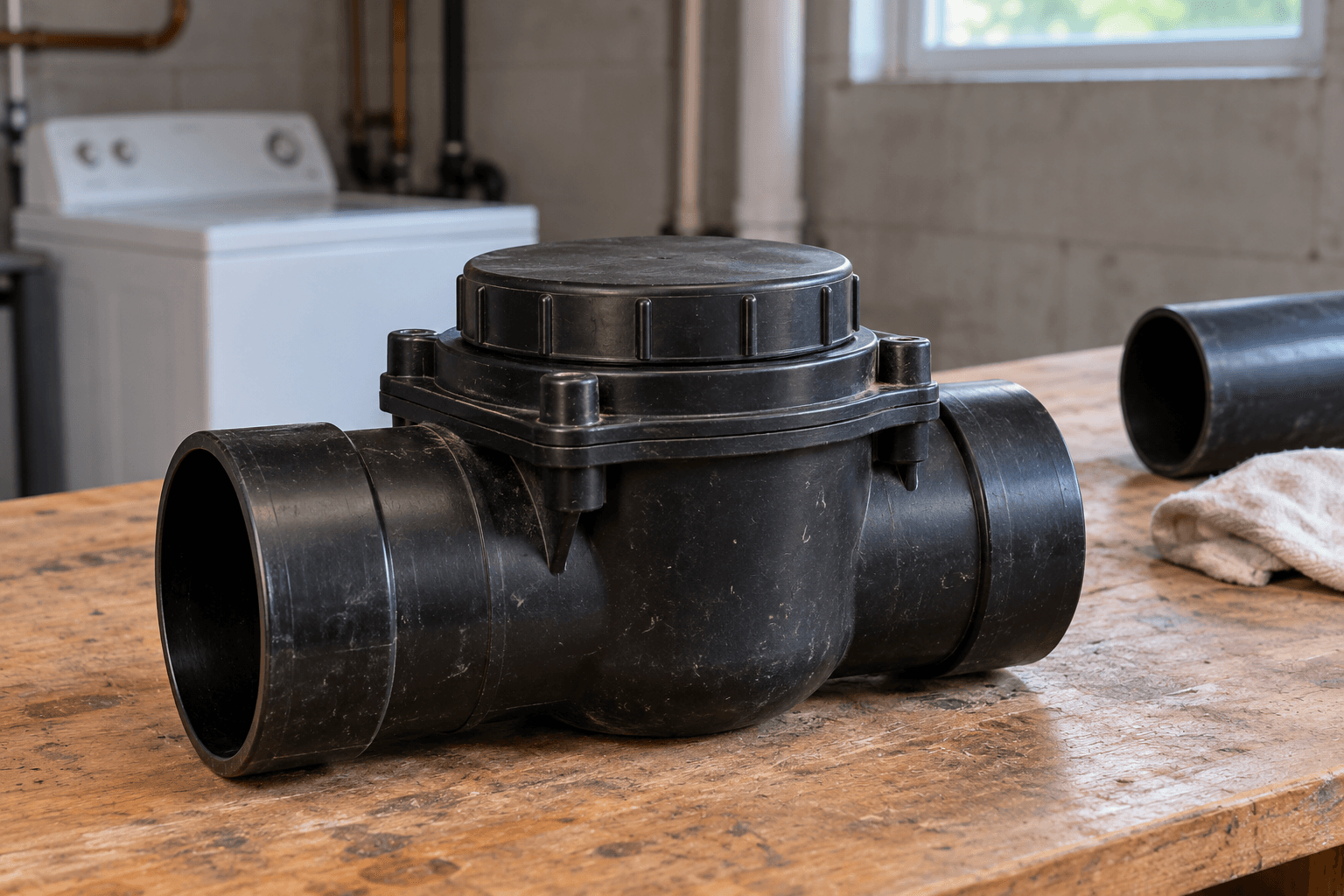
The valve installs on the building drain, on the main sewer line where it exits the house, downstream of every fixture it protects.
Placement matters. A valve installed in the wrong position protects only part of the house, leaving fixtures downstream of it exposed. The plumbing layout determines the correct location, which is one reason a home plumbing assessment often precedes the work.
Shutoff access is mandatory. The valve requires an accessible cover for inspection and maintenance, and it cannot be buried under finished flooring.
Permits and Code
Installation requires a building permit in virtually every Canadian municipality. Provincial plumbing codes, including the Ontario Building Code and its equivalents in other provinces, treat this as work affecting the drainage system.
DIY installation is not permitted in most cities, and it disqualifies you from every municipal subsidy program. Beyond the legal requirement, an incorrectly installed valve creates liability if it fails and allows a backup.
Municipal requirements vary by property type. Most programs cover single-family homes, duplexes, triplexes and fourplexes, with different rules for larger multi-unit buildings. Some, like Halton Region's, require the valve to be installed inside the home to qualify.
Under the Ontario Building Code, a backwater valve can only serve one dwelling unit. A property with a basement apartment needs a separate valve for each unit.
Check your local water by-laws before starting. Some municipalities now mandate backwater valves on new construction, and a few require them on specific renovation triggers.
Downspouts and Weeping Tile
Several programs tie the backwater valve rebate to related work. Peel Region strongly recommends disconnecting all downspouts from the sanitary sewer and requires an acknowledgement form from applicants who decline. Richmond Hill makes disconnection a condition of its subsidy outright.
The logic is straightforward: a downspout draining into the sanitary system contributes directly to the surcharge your valve is protecting against. On older combined systems, Richmond Hill also requires the storm weeping tile to be disconnected from the sanitary line and routed to a sump pump.
Disconnection is often subsidized alongside the valve. Toronto pays 80% up to $400 for foundation drain severance and capping.
Winterization and Exterior Installations
An exterior valve installed in an accessible chamber needs consideration for frost, which matters more in the Prairies and northern regions than on the coast. The chamber should be insulated and the access cover rated for the load it will carry if it sits in a driveway or walkway.
Interior installations avoid this entirely, which is one of several reasons they're the default choice and the only option under some rebate programs.
Common Backwater Valve Problems
A backwater valve is mechanically simple, which means the failure modes are few and predictable.
A Clogged Valve
The most common problem. Debris, grease and sediment accumulate around the flap over time, and eventually it can't seat properly against the seal.
A valve that can't close doesn't protect anything, and you won't know until the moment you need it. This is the entire argument for annual inspection.
Flap Failure
The internal rubber flap or PVC flap degrades with age. It can crack, warp, or lose the flexibility it needs to seal. Some valve designs also include internal springs and seals that wear over time.
Replacement flaps are inexpensive and a plumber can swap one in a single visit, provided the access cover is reachable.
A Damaged or Buried Access Cover
A damaged backwater valve cover compromises the seal and lets sewer gas escape into the basement.
More often, the problem is that the cover has been buried. Homeowners finishing a basement routinely tile or carpet over the access point, which makes inspection impossible and maintenance a demolition job.
If you're renovating your basement, tell your contractor exactly where the valve sits.
Maintenance
Inspect the valve at least once a year, and ideally twice: in spring before heavy seasonal rains and again in late autumn. Checking before a forecasted heavy rainfall is also worthwhile. If your valve has a clear viewing window, this takes a minute.
Open the access cover, check that the flap moves freely, and clear any visible debris. Look for cracking or deformation in the flap material.
An annual check by a plumbing professional costs $100 to $200 and produces documentation your insurer may want. Many homeowners bundle it with annual drain cleaning of the lateral, which also addresses scale and root intrusion.
Note that most municipal rebate programs do not fund maintenance, repair or replacement of an existing valve, only new installations.
Is a backwater valve worth it?
For most Canadian homes with basement fixtures, yes, and the math isn't close. Installation runs $1,000 to $4,800 depending on your city, and municipal rebates cover anywhere from nothing to $1,600 of that. A single sewer backup into a finished basement averages $40,000 to $80,000 in restoration.
Two things decide whether it's urgent for your property. Do you have fixtures below street level — a basement bathroom, laundry, or floor drain? And has your street or neighbourhood flooded before? If both answers are yes, this is overdue rather than optional.
Check your municipality's program before getting quotes. Amounts range from nothing at all to $1,600 per valve, several cities require a permit or inspection before work begins, and funding is first-come, first-served in most programs.
Frequently Asked Questions
How much does a backwater valve cost to install?
$1,000 to $3,500 for an interior installation through the basement slab, and $2,400 to $4,800 for an exterior excavated installation. Costs vary by city: Alberta commonly runs $1,000 to $2,800, while a typical Toronto job averages $2,800.
Is there a rebate for backwater valve installation?
In many Canadian cities, but not all. Toronto offers up to $1,600 per valve within a $6,650 property total, Halton Region 50% up to $1,600, Peel Region 60% up to $1,500, Windsor up to $1,450, Ottawa $1,000 for an interior valve, Winnipeg 60% up to $1,000, and Edmonton up to $800. Calgary offers homeowners no residential rebate. Confirm directly with your city's water department.
Does Calgary have a backwater valve rebate?
No. The City of Calgary provides no residential rebate for homeowner backwater valves or sump pumps. Its stormwater incentive program applies only to developers constructing properties with three or more primary units. Calgary homeowners pay the full installation cost, typically $1,200 to $2,800.
What's the difference between a backwater valve and a backflow preventer?
A backwater valve sits on your sewer line and stops sewage backing into your basement. A backflow preventer sits on your water supply and stops contaminated water entering your drinking water, typically on an irrigation connection. They're different devices solving different problems.
Do I already have a backwater valve?
Check the lowest level of your basement near the front foundation wall, where the main sewer line exits. Look for a circular plastic access lid flush with the floor, often with a clear cover. Edmonton homes built after 1989 and many Canadian homes built after 2006 include one as standard.
Can I install a backwater valve myself?
No. A building permit is required in virtually every Canadian municipality, and the permit requires a licensed plumber. DIY installation also disqualifies you from every municipal subsidy program and creates liability if the valve fails.
Do I need approval before starting the work?
It depends on your municipality. Most programs require the building permit before work begins, and some require a pre-approval inspection as well. Edmonton's subsidy is applied for after installation, but the permit and inspection still have to be in order. Check your city's specific sequence first, since starting early can forfeit the rebate.
Does my basement apartment need its own valve?
Yes, in Ontario. Under the Ontario Building Code, a backwater valve can only be installed on the sanitary lateral serving one dwelling unit, so a basement apartment requires a separate valve. Check your provincial code elsewhere.
How often does a backwater valve need maintenance?
Inspect it at least once a year, ideally twice — in spring before heavy rain and in late autumn — and before any forecasted major storm. Budget $100 to $200 for an annual professional inspection, which also produces documentation for your insurer. Rebate programs generally don't fund maintenance.
Does a backwater valve replace a sump pump?
No. A backwater valve stops sewage backing up from the city sewer. A sump pump removes groundwater collected by your weeping tile. They address different water pathways, and many Canadian homes need both. Several municipal programs cover both.
Will a backwater valve lower my insurance premium?
Sometimes. Sewer backup coverage is usually an optional rider, and some insurers now require a backwater valve for full coverage eligibility while others offer premium reductions. Ask your insurer, and keep your permit and inspection documentation.
What happens if my backwater valve fails?
The most common failure is debris preventing the flap from sealing, which means the valve won't close when it needs to. You typically won't discover it until a backup occurs, which is why regular inspection matters more on this device than on most.
Can I finish my basement over the valve?
Not over the access cover. The valve must remain accessible for inspection and maintenance, and burying it turns routine maintenance into a demolition job. Tell your renovation contractor where it sits before flooring goes down.
Looking for something else?
Related articles
The latest industry news, interviews, technologies, and resources.
Editorial Team
•28 Jan 2026
In this home adaptation financial guide, we’ll explore the expenses associated with essential home improvements, enhancing accessibility and functionality. How much should you budget to install a wheelchair ramp or upgrade a bathroom? What factors affect the cost of home adaptations? This guide addresses these questions and more, helping you plan your project as efficiently as possible.
Collaboration
•16 Jul 2026
Unlike instantaneous heaters, these systems store heated water in an insulated tank, ensuring that hot water is always on tap, day or night. The appeal of electric storage systems lies in their straightforward installation, user-friendly operation, and the promise of consistent hot water availability.

Editorial Team
•06 Aug 2024
The digital realm has evolved exponentially over the years, and home automation systems are following suit. A home automation system allows you to remotely control a myriad of devices and equipment in your home thanks to technology such as the Internet of Things (IoT) and artificial intelligence (AI). However, while these systems offer unprecedented connectivity, they also present some downsides.

Editorial Team
•03 Jun 2025
Underpinning is a technique that is essential to ensure the stability of a building whose solidity is compromised due to a natural disaster, upper floor renovations with excessive added weight to support, or due to a foundation being poorly adapted to the ground where it is set.
Editorial Team
•12 Aug 2026
When comparing cellulose vs fibreglass insulation, there is no single winner for every Canadian home. Cellulose generally provides a higher R-value per inch and fills irregular spaces effectively, while fibreglass offers strong fire resistance, broad availability, and several installation formats.