What is the minimum slope for a French drain in Quebec?
By Editorial Team
Updated on February 17, 2026
Standards in Quebec
The installation of foundation drainage systems must comply with the Quebec Construction Code as well as the requirements of the Régie du bâtiment du Québec (RBQ). In practice, professionals also refer to standards from the Bureau de normalisation du Québec (BNQ) for material selection and installation methods.
Technical standards and guidelines specify, among other things:
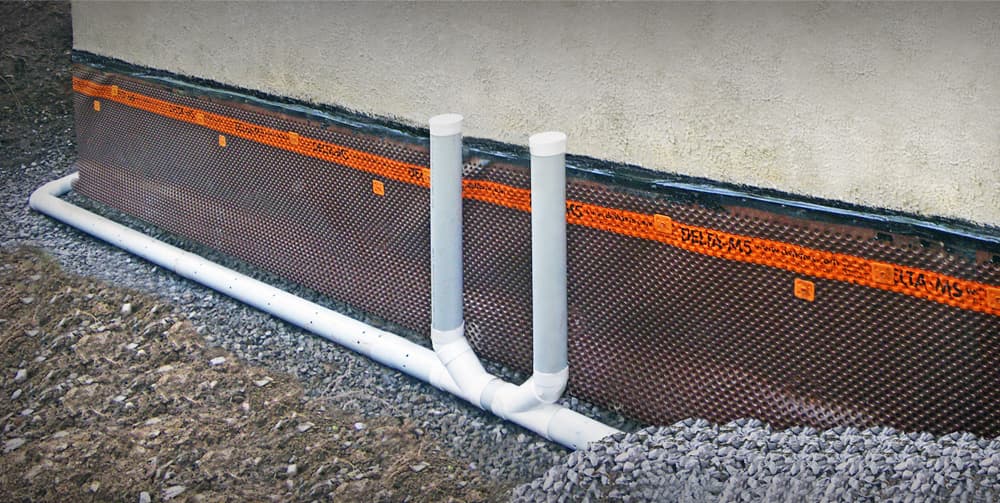
The minimum drain diameter (generally 100 mm)
The presence of a bedding layer and crushed stone covering
The position of the drain relative to the footing and slab
The use of certified materials for the drain and aggregates
Although technical documents do not always state in black and white a single mandatory slope for foundation drains, most professionals aim for approximately 1% slope to ensure proper gravity flow.
The 1% Slope Requirement
While some technical manuals mention a minimum tolerance of 0.5% (5 mm per meter) in extremely flat and controlled site conditions, best practice in Quebec remains a minimum 1% slope.
The idea that 0.5% may be acceptable in very specific situations (very flat land, rigorous control) sometimes appears in technical literature on drainage piping, but it is not a clearly published standard tolerance for residential French drains in Quebec based on publicly available sources.
Why such strictness? Because a 1% slope ensures water flows fast enough to avoid stagnation. In our climate, standing water in a drain can encourage fine soil deposits or, worse, freeze if the drain is not installed below the frost line or if backfill is inadequate.
Why BNQ Certification Is Crucial
The pipe itself must bear the BNQ certification mark. These pipes are designed to withstand backfill compression while providing calibrated perforations that allow water in without letting excessive sediment enter.
For added protection, many experts also recommend installing a waterproof membrane on the footing and foundation wall before laying the drain.
Why Precise Slope Is Crucial
Precision leveling does more than move water — it actively protects the system’s longevity against two major enemies: sediment and iron ochre.
1. Sediment Removal
Even with clean stone backfill and a geotextile membrane, fine soil particles inevitably infiltrate the drain over decades. A 1% slope creates sufficient flow velocity to carry these particles toward the discharge pit instead of allowing them to accumulate at the bottom of the pipe.
Without proper slope, the drain can become clogged, reducing drainage capacity by up to 50% within just a few years.
2. Iron Ochre Prevention
In several regions of Quebec (such as Montreal’s South Shore or the Laurentians), soil contains iron-oxidizing bacteria. These bacteria produce a gelatinous orange sludge known as iron ochre.
The risk: Iron ochre develops particularly quickly in stagnant, oxygenated water.
The solution: A consistent and sufficient slope limits water stagnation, making bacterial colonization more difficult. If your property is in a high-risk area, a 1% slope is the strict minimum for acceptable durability.
How to Calculate and Verify Slope During Installation
Installing a French drain is precision work that does not tolerate improvisation. Here is how professionals ensure compliance:
Using a Laser Level
Forget a manual bubble level for a full foundation perimeter. Contractors use a rotating laser level.
A reference point is established (the highest point of the drain, often opposite the outlet to the sewer or sump pit).
The total perimeter distance is calculated. For a 40-foot side (about 12 meters), the total drop should be 12 cm.
Elevation markers are set on foundation walls or wooden stakes to guide installation at each stage.
Step-by-Step Verification
It is essential to verify the slope before and after adding crushed stone. A simple shift in the pipe during backfilling can cancel out the slope.
A final water flow test (running water through the drain) confirms that water reaches its destination without creating dead zones.
The Importance of the Crushed Stone Bedding
The drainage pipe must never rest directly on soil or directly on the footing without support.
3/4” Clean Stone: The Absolute Standard
Only 3/4-inch (20 mm) clean crushed stone should be used. “Clean” means washed and free of stone dust or sand.
Bedding layer: A 2–4 inch layer of stone must be installed and leveled to the desired slope before placing the pipe.
Encasement: Once the pipe is laid, it must be covered with at least 6–12 inches of clean stone.
Using stone dust is a critical mistake — it compacts and becomes impermeable, preventing water from reaching the drain.
Common Leveling Errors on Quebec Job Sites
Even with good intentions, certain mistakes frequently occur during excavation:
Low point (“belly”) in the trench: If the trench bottom is uneven, the pipe can sag. Water becomes permanently trapped, creating stagnant pools prone to odors and tree root intrusion.
Installation above the footing: The top of the drain should never exceed the top of the footing. If installed too high, water will accumulate under the concrete slab before entering the pipe.
Forgetting geotextile: Although clean stone filters water, it must be wrapped in a quality geotextile membrane to prevent surrounding soil from clogging the stone voids.
Expert note: According to the Régie du bâtiment du Québec, improper surface and foundation water management is one of the leading causes of hidden defect claims during property sales.
Connection to Sewer or Sump Pit
Once water has traveled along the 1% slope, it must be discharged away from the house. In Quebec, two main methods are used depending on topography and municipal regulations:
1. Gravity Connection
If the site allows (natural slope toward the street or a ditch), the drain connects directly to the municipal storm sewer. A backwater valve is mandatory to prevent municipal water from backing up toward your foundation during heavy rainfall or snowmelt.
2. Sump Pit (Sump Pump System)
In many Quebec municipalities, direct connection is prohibited or impossible. Water is directed to a sump pit located inside the basement or outside.
A submersible sump pump then discharges the water away from the walls or toward a ditch.
Installing a battery backup system is strongly recommended in case of power failure during a storm.
Mistakes to Avoid and Installation Advice
To explore the topic further and avoid costly errors that could compromise your construction warranty, consult our complete guide on common French drain mistakes and best practices for successful installation.
Looking for something else?
Related articles
The latest industry news, interviews, technologies, and resources.

Cynthia Pigeon
•23 Apr 2026
In 2026, replacing a home’s exterior siding in Canada typically costs between $12 and $40 per sq. ft. installed—a significant investment that directly impacts your home’s durability. In a climate shaped by freeze-thaw cycles, not all materials perform equally. The right choice can protect your home for decades, while the wrong one can lead to early and costly repairs. Here’s what you need to know to make the right decision.

Editorial Team
•03 Jun 2025
Underpinning is a technique that is essential to ensure the stability of a building whose solidity is compromised due to a natural disaster, upper floor renovations with excessive added weight to support, or due to a foundation being poorly adapted to the ground where it is set.
Editorial Team
•08 Nov 2023
Regardless of the season, the temperature outside is almost always going to have an impact on the temperature inside your home. During those warm summer months, we try our best to keep things cool, while in the winter we want our interiors to be a warm and cozy break from the frigid air.

Équipe éditoriale
•06 Dec 2025
When you think about taking on a home renovation project, you might consider all of the difficult aspects: cost, time, energy and so on. However, not every renovation has to be large-scale and overly time-consuming.