Your kitchen countertop has a tough job to do, it is required to stand up against a multitude of things including weight, heat and moisture. If you notice any signs of wear, tear, cracks or mould, it’s probably time for an upgrade. Replacing your kitchen counters isn’t too difficult, it just requires time, patience and a few basic carpentry skills.
Regardless if your surface is stone, ceramic or laminate, replacing your kitchen counter can be completed as a weekend DIY project. We’re here to offer a step-by-step guide as to how to do this, and hopefully, soon you’ll have a counter that suits your needs as well as your home decor.
How to replace a kitchen counter
What to do to get started
Determine the size of your countertop
If you’re replacing your kitchen counter, you’ll first have to determine the size of the surface, as well as the material you will be using. Taking careful measurements of the surface is a crucial step in countertop installation. It is recommended that you make a sketch of your kitchen, and record the placement of the sink and stove, as this will help retailers have a vision of what you’re looking for. Next, measure the width and depth of your counters.
From here, you can determine the square footing of the space you need to cover. Be precise, and once you have these measurements, you can move on to choosing the material.
Choosing the material
Choosing the material of your kitchen counter will depend on your home decor, as well as what you’re looking for regarding maintenance needs and attributes. Countertops come in various materials, ranging from stone to laminate. Real stone will be the most expensive replacement material, whereas concrete and laminate will be on the cheaper side of things.
Some stone and concrete countertops require special cleaning requirements and a bit more work but will last a long time. Laminate will be easier to clean but wears easily and thus, won’t last as long. Do a bit of research and consider all of the options when it comes to material specifics, and choose one best suited to your tastes, needs and budget.
Removing the old countertop
First, start by shutting off the water supply. You may choose to remove the sink from its place or leave it where it is, and this will depend on whether it also needs to be replaced or if it’s in undamaged shape. Next, remove the countertop itself. The removal process will depend on how your counter is sealed in place.
Furthermore, you might require an extra set of hands, depending on how big or heavy your old countertop is. If it has been nailed to the cabinets, you will have to pry it off, whereas others will be screwed down or adhered with glue. You can remove the screws or pry the top loose. You may also choose to cut the countertop with a reciprocating saw following.
Prepare the surface
Next, prepare the countertops with building strips to the top of the counter's sides. These will hang over the sides a little but will be fastened in place later. Following this, pre-drill holes for the mounting screws, then screw the screws in place. If your countertop has endcaps, it will not need building strips, so make sure to check before installing them.
Now, you’ll have to complete a process called scribing, which will allow you to fit the new countertop tightly along uneven walls and out of square corners. Scribing will also remove excess material, and allow your counter to be completely flush with the space.
This process is also important and can be difficult depending on your counter placement. This is especially true if your kitchen counter is sandwiched between two walls. To scribe, you will need a scribing tool that can be found at your local hardware store. Run the tool along the edge of the counter until it sits flush with the surrounding wall.
Sand down the scribed lines, and continue sanding and scribing until the counter sits perfectly in place. While scribing, make sure to consider the result each individual scribe will have on the positioning of your counters.
How to attach the new countertop
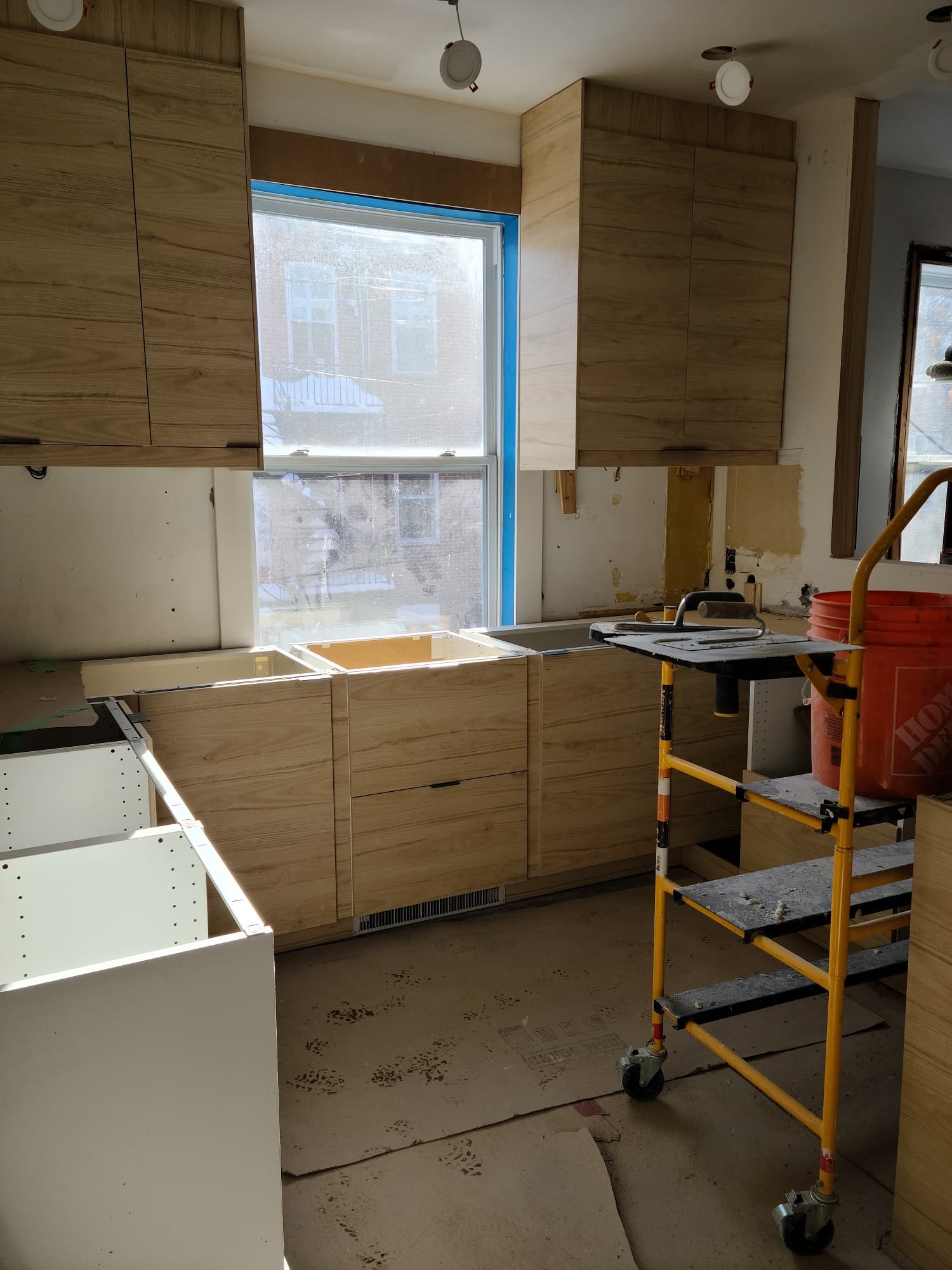
Source : Generational Homes Inc
Now, you’re coming into the final stretch of this renovation project. You can finish the job by gluing or bolting the mitre in place and following this, screwing down the tops. Make sure that you don’t use screws that are too long, meaning going any more than ½ an inch into the counter. Once the counter is properly in place, you can seal it further using a caulk that matches the colour of the countertop, filling in the space between the countertop and the walls.
If your countertop has a backsplash, the method for installation is the same. However, when it comes time for installation, you may need to do some fancy maneuvering to get the counter neatly into place. Further, you may be required to cut a hole in the drywall surrounding your counter to be able to fit it in place.
When the counter has been installed and secured, you can reinstall the sink in place. Reattach the pipes and turn your water supply back on.
Here are other interesting articles on the subject:
Looking for something else?
Related articles
The latest industry news, interviews, technologies, and resources.
Editorial Team
•17 Feb 2025
Kitchen cabinets can be the centrepiece of the space, and beautiful, well-designed ones will make a huge difference in both the layout and feel of the room. Custom kitchen cabinets are an excellent way to add a unique element to your home as well as increasing the resale value.

Editorial Team
•04 Feb 2025
Taking the leap and investing several thousand dollars in a renovation comes with its fair share of worries, especially with regard to the contractor hired to manage the project. If you hire the wrong person, you're likely to find yourself amid a serious mistake that will cost you both time and money to make go away.

Editorial Team
•03 Sep 2025
Between Bricks and Binders is the podcast that bridges the gap between construction entrepreneurs and the business world. In this introduction episode, Frédérique from RenoQuotes and Ronaldo share why this podcast was created and what you can expect from future episodes.

Editorial Team
•02 Aug 2024
Working on a construction site has its fair share of risks, regardless of the nature of the work involved. Since worker safety is an ever-present concern, it requires the cooperation of quite a few players. Therefore, last October, the CNESST initiated an awareness campaign, targeting construction industry workers, employers, general contractors, and affiliated individuals in the province of Quebec.

Editorial Team
•08 Nov 2023
Garbage disposals were invented in America in the late 1920s, but it was only during the postwar years that there was a growth in the installation of this device in the private homes of North Americans.