The CCQ: Role, Services, and Workforce Training
By Editorial Team
Updated on August 14, 2026
The Commission de la construction du Quebec (CCQ) plays a central role in Quebec's construction industry. It administers rules affecting workers and employers, applies collective agreements, manages workforce qualifications and benefits, supports training, and helps ensure compliance with Act R-20.
For homeowners, the CCQ is also relevant when determining whether workers need competency certificates and how those requirements differ from contractor licensing through the Régie du bâtiment du Quebec (RBQ). Here is what the CCQ does, how its workforce system works, and which recent initiatives are shaping the industry.
What is the CCQ and what does it do?

Source: Menuiserie CJV
Created in 1987, the Commission de la construction du Quebec administers the Act Respecting Labour Relations, Vocational Training and Workforce Management in the Construction Industry, commonly known as Act R-20, along with its regulations.
Its mandate covers four construction sectors:
Residential
Industrial
Institutional and commercial
Civil engineering and roads
The CCQ works with workers, employers, unions, employer associations, government bodies, and other industry stakeholders. Its responsibilities include labour relations, compliance, workforce qualification and mobility, training, benefits administration, and workforce planning.
Applying Collective Agreements and Enforcing Act R-20
One of the CCQ's core responsibilities is ensuring that the sector-based collective agreements covering workers subject to Act R-20 are applied properly. These agreements establish working conditions such as wages, certain allowances, vacations and holidays, and other employment conditions.
The CCQ also verifies compliance with rules governing hiring, pay, workforce mobility, competency certificates, employer reporting, and other obligations under Act R-20.
Its representatives may:
Enter a construction site or employer's office at a reasonable time
Require information or documents related to construction work
Investigate potential violations
Bring civil proceedings, including claims to recover unpaid wages for employees
Recommend penal proceedings when offences are identified
Order the suspension of work in certain circumstances, including when a person fails to demonstrate that the required licences or competency certificates are in place
Non-compliance can therefore include unpaid amounts, incorrectly applied working conditions, undeclared work, missing qualifications, or other breaches of Act R-20 and the applicable collective agreement.
The CCQ's broader compliance mandate also includes combating undeclared work and unfair competition and contributing to corruption-prevention and tax-law compliance efforts in the construction industry.
Managing Benefits, Vacation Pay, and Leave
The CCQ administers industry benefit programs negotiated through collective agreements, including pension and insurance plans. MÉDIC Construction is part of this social-benefit system.
Leave-related compensation is managed through a separate mechanism. Employers must credit an amount equal to 13% of each worker's weekly salary:
6% for obligatory annual vacations
5.5% for paid statutory holidays
1.5% for sick leave
These amounts are paid by the employer to the CCQ rather than deducted from the worker's pay. The CCQ places the money in a fund and remits it to workers before the summer and winter vacation periods.
Workers generally receive vacation allowances twice a year. The summer payment covers amounts accumulated from July to December of the previous year, while the winter payment covers amounts accumulated from January to June of the same year.
Workers can also use CCQ online services to review information such as reported hours and documents related to paid leave.
The Construction Holiday and Workforce Planning
The Quebec Construction Holiday is more than a seasonal tradition. The vacation period forms part of the industry's working conditions and affects staffing, project schedules, subcontractor availability, and leave planning.
For summer 2026, the Construction Holiday ran from July 19 at 12:01 a.m. to August 1 at midnight.
Because a large share of the construction workforce takes vacation during this period, employers need to plan staffing and project timelines accordingly. Homeowners may also find that contractor availability and scheduling are more limited.
However, not every type of construction activity must stop. Exceptions can apply depending on the sector and type of work, so homeowners should confirm scheduling directly with their contractor.
Managing Quebec's Construction Workforce
Construction activity varies by region, season, and trade. The CCQ therefore monitors labour availability and manages labour pools to help employers access qualified workers when shortages occur.
Its workforce-management responsibilities also include:
Hiring rules
Worker referrals
Labour mobility
Competency requirements
Measures aimed at addressing labour shortages
Certain interprovincial mobility arrangements
Quebec also maintains agreements with other provinces affecting the recognition and mobility of some construction workers.
CCQ Competency Certificates and Workforce Training

Source: Reno Quotes
A major part of the CCQ's role is ensuring that workers entering and progressing through Quebec's construction industry meet the required qualification standards while having access to training and skills development.
What is a CCQ competency certificate?
A CCQ competency certificate, often informally called a "CCQ card," confirms that a worker meets the applicable conditions for working in a trade or occupation covered by Quebec's construction-industry rules.
The main types are:
Apprentice competency certificate
Journeyperson competency certificate
Occupation competency certificate
Requirements vary depending on the certificate and the candidate's situation. They may involve recognized vocational training, documented work experience, required safety training, apprenticeship hours, an employment guarantee, upgrading activities, or a qualification examination.
Because the requirements differ significantly between pathways, candidates should verify the conditions for their specific trade or occupation directly with the CCQ.
Entering the Industry Through a Labour Pool
People without a diploma may have another route into the construction industry when a regional labour pool opens because of low worker availability.
For CCQ purposes, a labour shortage occurs when fewer than 5% of holders of the relevant apprentice or occupation competency certificate are available in a region.
When this happens, eligible non-graduate candidates may obtain access to the industry, provided they meet the other applicable requirements. Entry through a labour pool does not eliminate training obligations.
Broader access measures also exist for women, First Nations people, Inuit, and people representative of Quebec's diversity. Eligible candidates may have access when the applicable labour pool is at 30% or below, subject to the other conditions.
Training and Skills Development
The CCQ supports vocational training, apprenticeship, upgrading, and continuing skills development to help maintain a qualified construction workforce.
This role is particularly important in trades and regions where labour needs change quickly. Workers can access hundreds of upgrading and training activities aimed at maintaining or developing their qualifications.
Supporting Women and a More Diverse Workforce
The CCQ and its industry partners also maintain measures aimed at improving access, retention, and career development for women in construction.
These include:
Priority for qualified women in certain worker-referral situations
Reserved places in some upgrading activities
More flexible workforce-access measures
Specific mobility provisions
On-the-job training support for women and their work teams
Through the On-the-Job Training for Women Program, participating employers may receive financial assistance equal to approximately 30% of the participating woman's wages, up to $15,000 over 52 weeks.
The objective is not only to recruit more women into construction, but also to support long-term retention and career progression.
Workforce Referral and Online Services

Source: Reno Quotes
The CCQ also helps employers find qualified workers and provides digital tools for day-to-day workforce administration.
Finding Workers Through the CCQ
The Carnet référence construction is the industry's official workforce referral service.
Employers can request workers who meet their needs, while workers can make themselves available for referral. The service complements the CCQ's labour-pool, hiring, and workforce-mobility functions.
What can workers and employers do online?
CCQ online services allow employers to complete tasks such as:
Filing monthly reports
Submitting hiring and termination notices
Requesting worker referrals
Managing certain labour-shortage procedures
Accessing documents and account information
Workers can also access information related to their file, reported hours, benefits, and paid leave.
These online tools are especially important because monthly reporting ties directly into workforce management, employer obligations, and the administration of vacation and holiday amounts.
Recent CCQ Initiatives and Updates
Source: Soluo
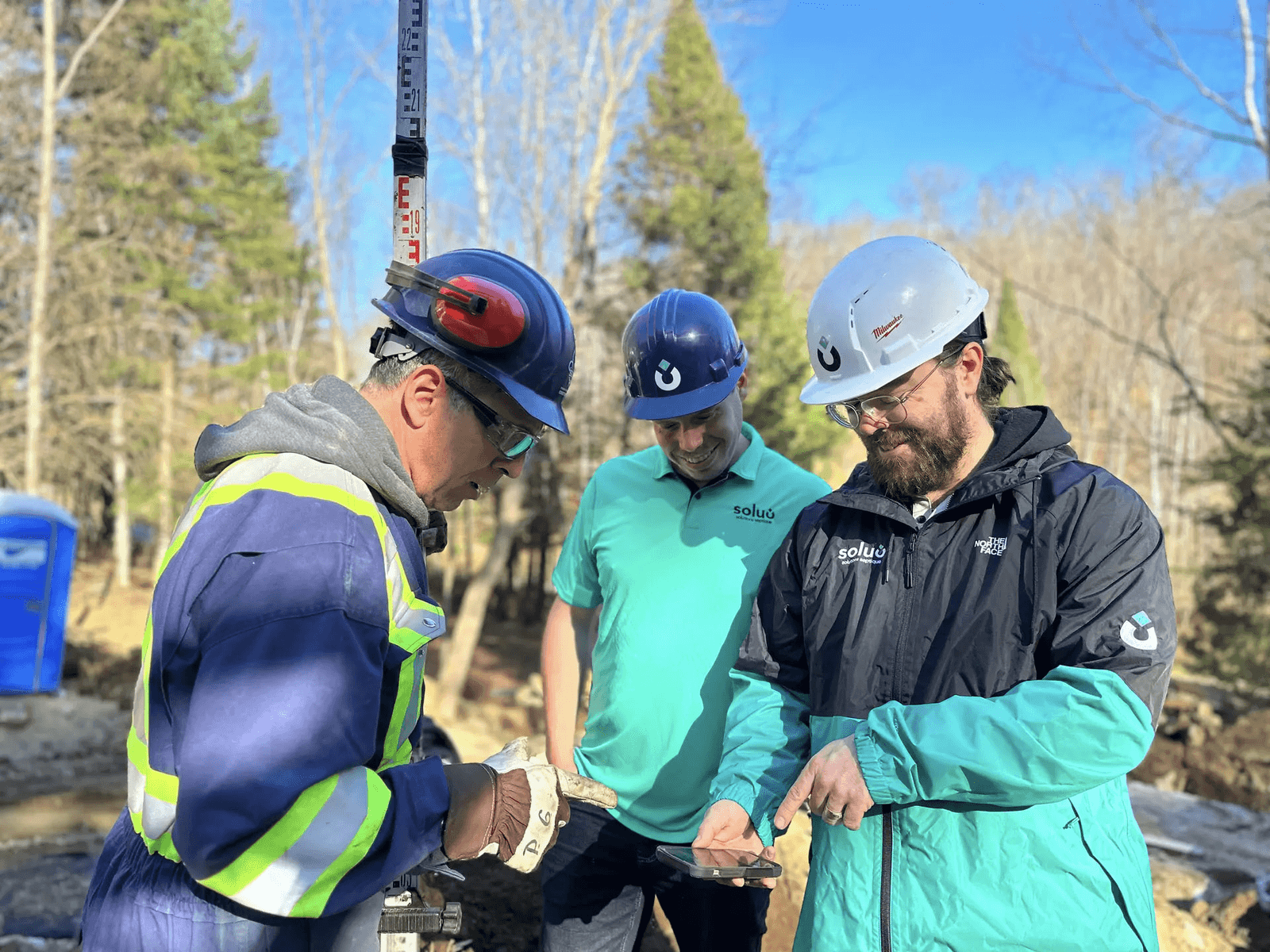
The CCQ's core responsibilities are long-standing, but several recent initiatives show how the organization is adapting its workforce-development, workplace-culture, and digital-service strategies.
Paid Work-Study Programs
The Paid Work-Study Program in Construction combines vocational studies with paid employment and construction-site internships.
As of 2026, the program targets training linked to several priority trades, including:
Bricklayer-mason
Carpenter-joiner
Electrician
Pipe fitter
Refrigeration mechanic
Eligible participants can work toward a Diploma of Vocational Studies while remaining connected to an employer. Participating employers may also qualify for financial support for eligible training periods.
The initiative is intended to create more flexible pathways into trades where workforce needs are significant.
ZONE RESPECT and Workplace Culture
The ZONE RESPECT initiative focuses on the right to a healthy construction-site environment free from discrimination, intimidation, and harassment.
It addresses behaviours that may be dismissed as jokes or workplace culture but that can contribute to exclusion, harassment, or an unhealthy work environment.
The initiative complements the CCQ's broader workforce efforts by focusing not only on attracting qualified workers, but also on creating conditions that support their retention.
Chantier numériCCQ
The Chantier numériCCQ project is a long-term modernization of the CCQ's online services. Its first major stage launched on January 12, 2026.
Improvements include:
A single user ID for different CCQ profiles
Mobile access to client files
Simplified access to account information
Modernized monthly reporting
Online request tracking
Enhanced digital security
The project is continuing in stages rather than being treated as a one-time system update.
What Homeowners Should Know About CCQ Requirements

Source: Reno Quotes
Although many CCQ services are aimed at workers and employers, homeowners can also encounter Act R-20 requirements when hiring people for renovation or construction work.
When does a worker need a CCQ competency certificate?
Act R-20 applies broadly to construction work in Quebec, including many forms of erection, renovation, repair, alteration, maintenance, demolition, and related work.
However, the law also contains exclusions. Whether a competency certificate is required depends on the nature of the work, who is performing it, who benefits from it, and whether the project falls within Act R-20.
For example, certain work performed by a natural person on a dwelling they occupy for their own personal and non-profit purposes may fall outside the application of Act R-20.
For situations that are not clear-cut, homeowners should confirm the requirements directly with the CCQ.
CCQ Competency Certificates vs. RBQ Licences
A CCQ competency certificate and an RBQ licence are not the same thing.
A CCQ competency certificate relates to the worker and their qualification or authorization to perform work governed by the construction-industry labour framework.
An RBQ licence relates to the contractor or owner-builder and their authorization to carry out or have certain construction work carried out.
The two systems can apply to the same project, but they address different legal obligations.
What about the $20,000 owner-builder exemption?
The $20,000 threshold is an RBQ licensing rule, not a general exemption from CCQ competency-certificate requirements.
Under current RBQ rules, certain owner-builders may be exempt from holding an owner-builder licence when repair, maintenance, or renovation work on their property is valued at less than $20,000.
Important limits apply. Electrical, gas, and petroleum-equipment installations are subject to separate licensing requirements, and the nature and total estimated value of the work determine whether the exemption applies.
Whenever a homeowner hires a contractor, the contractor should hold the licence subclasses required for the work being performed.
Where to Find Official CCQ Information
The CCQ website provides access to:
Competency-certificate requirements
Labour-pool information
Collective agreements
Construction vacation and statutory holiday dates
Training and upgrading programs
Workforce referral services
Online services
Act R-20 rules and exclusions
Options for reporting suspected non-compliance
For contractor licensing, homeowners should consult the RBQ. Municipalities should also be contacted to determine whether a renovation or construction permit is required.
Why the CCQ Matters to Quebec's Construction Industry
The CCQ combines labour regulation, qualification, training, benefits administration, compliance, and workforce planning within a single industry framework.
For workers, that can mean obtaining qualifications, accessing benefits, completing training, or finding employment. For employers, it includes reporting obligations, workforce management, referrals, and collective-agreement compliance. For homeowners, the key is understanding where CCQ workforce requirements end and RBQ contractor-licensing rules begin.
Looking for something else?
Related articles
The latest industry news, interviews, technologies, and resources.

Editorial Team
•11 Nov 2023
During the learning stages of your professional career, meant for you to acquire the necessary skills to carry out your chosen trade in the most competent of ways, you’ll work with a journeyperson.

Editorial Team
•08 Oct 2025
Are you particularly handy, meticulous, and love working with machinery? You’re not afraid of heights, consider yourself a problem solver, and can manage your stress levels…how about considering specializing in elevator installation, repair, and maintenance! This type of work, with diverse duties, has excellent employment prospects; just consider the number of apartment and condo towers that are being built every month in urban and suburban areas.

Editorial Team
•08 Nov 2023
With so many rooms in a home and plenty of decor choices to take care of, the entryway is one area that’s sure to be overlooked time and time again. It’s only natural to underestimate this space, but it’s important to remember that this is the first area of the home guests will encounter as well as the one which will greet you at the end of a long day.
Editorial Team
•27 Jan 2026
Curious about the cost of a new fence and what type would best suit your property line? Whether it's ornamental fences and gates or wooden designs, each option offers distinct benefits and pricing. What are the most durable materials and what about the low-maintenance fences? How much should you budget to install a PVC or aluminum fence?

Cynthia Pigeon
•19 Jun 2026
Faced with the housing crisis and the growing need for gentler density, many homeowners across Canada are looking at ways to make better use of their residential lots. Building an accessory dwelling unit (ADU), also known as a garden suite, laneway suite, backyard suite or secondary detached dwelling, can be an effective way to house an aging relative, give a young adult more independence or generate stable rental income.