Factors to Consider When Choosing a Sunroom
By Editorial Team
Updated on January 29, 2024
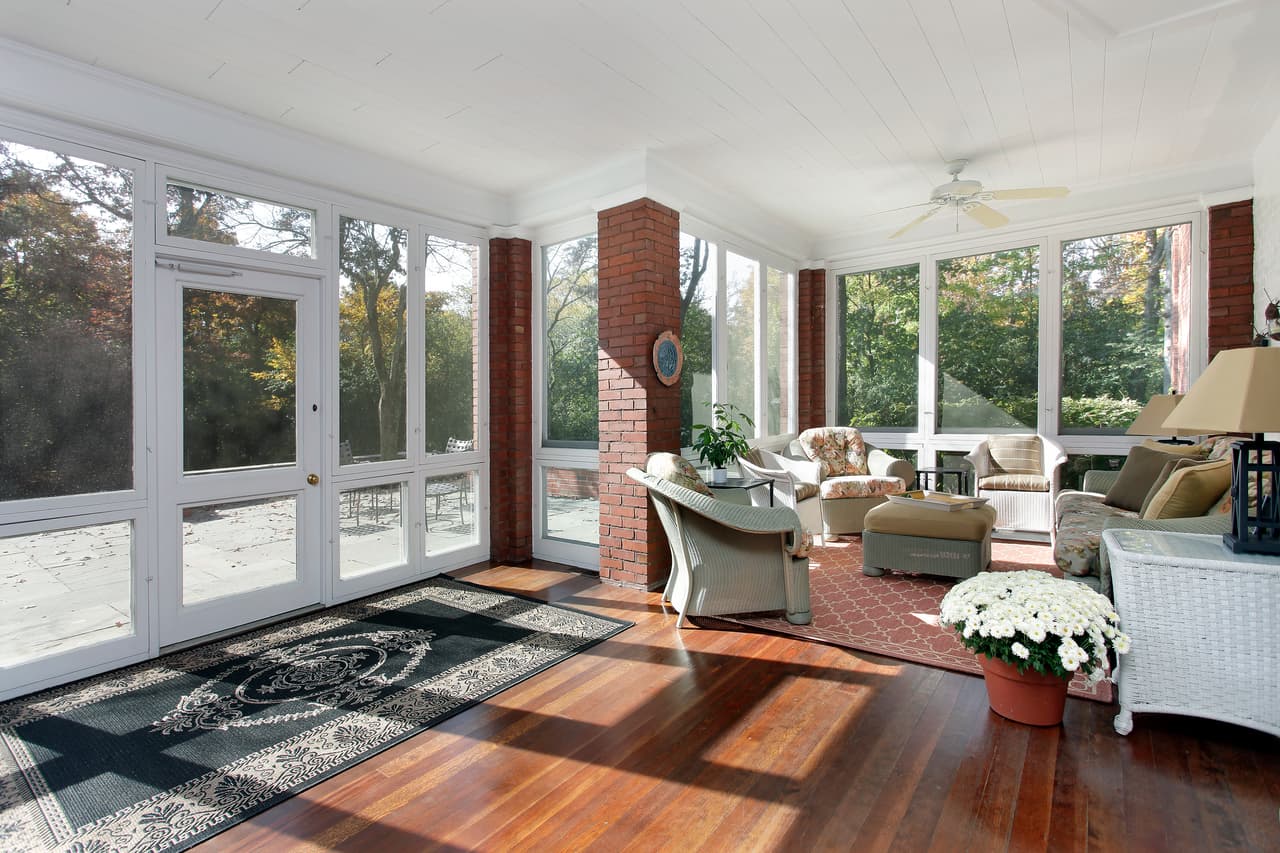
Are you looking for a beautiful sunroom to fully benefit, book in hand, from the summer? Given that it’s a significant investment, it’s definitely not a decision to be made lightly. So, without further ado, here are the different options available to you in the hopes you make the right decision.
Choosing Your Sunroom
The Difference Between Veranda and Sunroom
For those used to the term “veranda” or "screened-in porch," note that there isn’t a set-in-stone consensus on what differentiates a sunroom from a veranda. There are numerous distinct definitions of a veranda, but a 3-season sunroom very much resembles what people come to know as a modern veranda. Let it be known that the majority of sunrooms are aluminum-built.
Tempered Glass: A Must-Have

When purchasing a sunroom, make sure the company from which you’re buying truly retails tempered glass roofs and panels. Based on industry standards, this type of glass is mandatory to ensure a safe structure for its users. Why is that? Because if the glass breaks, it’ll shatter into tiny little pieces instead of flying everywhere.
Types of Sunrooms
Three-Season Sunroom
Both stylish and bright, 3-season sunrooms allow you to fully benefit from spring, summer, and fall without burning up or freezing—all that at an affordable price! The 3-season sunroom can be entirely glazed with fixed panels or screened-in. Unlike the other two types of sunrooms, a 3-season enclosure is the same colour, indoors and outdoors.
However, it’s not insulated; based on that factor alone, it can’t be enjoyed during wintertime. If you’re hoping to set up a hot tub in your 3-season sunroom, you won’t be able to use it during the winter. The lack of insulation in a 3-season sunroom makes it so that it wasn’t built to withstand harsh temperatures. Doing so would lead to a decent amount of condensation inside the enclosure.
Note that you may also be eligible for a tax credit ($4,000 by Écorénov) when installing a 3-season sunroom. Should you reassess your needs down the line and decide to transform your 3-season sunroom into a 3-season Plus sunroom, note that it can be done by adding insulation and replacing the single-glazing with thermal, double- or triple-glazing.
Thinking about building a sunroom? Our article How to Build a Solarium for Your House can help make it happen.
Three-Season Plus Solarium
The 3-season Plus sunroom is a worthwhile compromise between a 3-season and 4-season enclosure. Due to the sheer amount of insulation inside the walls and floors of the sunroom, you can comfortably sit in it during winter by adding a source of radiant heat. This allows you to feel warm and cozy, enjoy this well-lit installation that’s super conducive to unwinding and relaxing.
Four-Season Sunroom

A 4-season sunroom is the epitome of all sunrooms. Its structure is urethane-insulated and features energy-efficient glazing (R-2 to R-20), which can be doubled, tripled, quadrupled, or quintupled. In most cases, the structure is exclusively made using aluminum profiles fitted with a thermal barrier, paired with a built-in drainage system, and designed to offset sudden temperature changes.
As for a urethane-insulated, 4-season sunroom, there are some tax credits available through Écorénov, valued at $10,000. Lastly, you can also choose to install a polycarbonate roof to allow even more sunlight to filter through, while still managing the amount of heat seeping in.
Some companies set up their services in such a way that you can choose everything, down to the screws, to build a sunroom that's perfectly tailored to your needs, while others provide turnkey services. The latter includes a building permit request and installation. Once again, it all depends on your needs and budget.
Get 3 quotes for your renovation project
RenoQuotes.com can help you get quotes from a general contractor. By submitting your project, we’ll put you in contact with top-rated contractors. Fill in the form on the homepage (it only takes a few minutes) and get estimates from trusted professionals.
Dial 1-844 828-1588 to speak with one of our customer service representatives.
Looking for something else?
Related articles
The latest industry news, interviews, technologies, and resources.
Amanda Harvey
•08 Nov 2023
Rain gutters aren’t the most glamorous part of your home's exterior. They work hard to collect and carry rainwater away from the roof of your home but most homeowners pay little mind to these important structures. Gutters, also known as eavestroughs, work to keep basements or crawl spaces from collecting water. Therefore, they’re crucial in maintaining the structure and both the interior and exterior surfaces of your home.

Amanda Harvey
•08 Nov 2023
More and more homeowners are looking for alternative ways to heat and cool their homes, especially those which are environmentally friendly. Though it may not be a household name just yet, the heat pump is becoming commonly used in the Canadian household. This environmentally friendly system harnesses the earth's natural energies to keep us warm during winter months and cool during summer months.

Editorial Team
•10 Sep 2026
Most people know about acrylic paint and acrylic mediums or have heard of water-based paints. However, few actually know what acrylic pigments actually entail. As a matter of fact, when undertaking a renovation project, we often find ourselves faced with obscure terms that are hard to grasp at first.

Editorial Team
•08 Nov 2023
Regardless of the scale or size of a home renovation project, before getting started, it’s common to ask yourself how much you’re actually capable of doing. Of course, you’re going to come with your own set of skills and previous renovation experience and thus, you’ll know how much you can do. But have you ever thought about the legal repercussions of renovation projects?
Cynthia Pigeon
•12 May 2026
Replacing a bathtub with a shower in Canada is a strategic renovation that generally costs between $5,000 and $12,000, depending on the materials, the existing plumbing, and the complexity of the work. This upgrade can improve the functionality, comfort, and perceived value of a home, especially when it supports accessibility, aging in place, or a more modern bathroom layout. Given that this type of project may involve plumbing, drainage, waterproofing, ventilation, and sometimes floor preparation, it is important to plan carefully. Depending on the province or municipality, plumbing work may need to be completed by a licensed plumber or qualified contractor. In many bathtub-to-shower conversions, the existing drain may also need to be assessed or upgraded to meet the requirements of the new shower installation.