Water Softener Installation in Canada: Costs, Process and Hiring a Pro
By Editorial Team
Updated on September 22, 2026
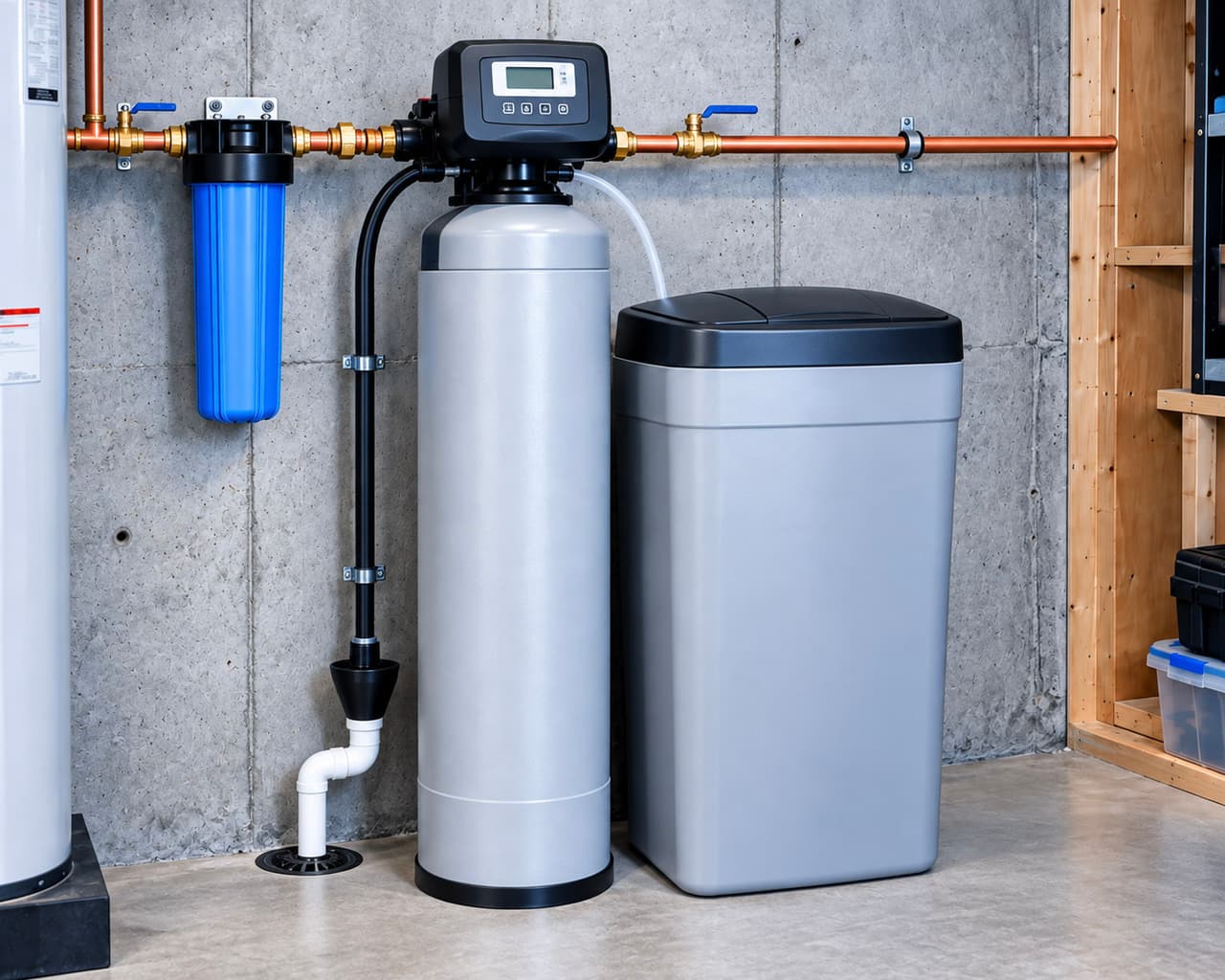
A water softener costs $1,500 to $4,500 installed in Canada, with most homeowners landing between $1,800 and $4,000. Labour alone runs $100 to $1,000 depending on how accessible your plumbing is, and the unit itself accounts for the rest.
Hard water is one of those problems that rarely gets attention until it starts causing damage: white scale on faucets, cloudy glassware, dry skin, and water heaters wearing out years early. This guide covers what installation costs, how to tell whether you need a softener at all, what the process involves, and how to choose an installer who won't leave you with an undersized system.
How much does installing a water softener cost?
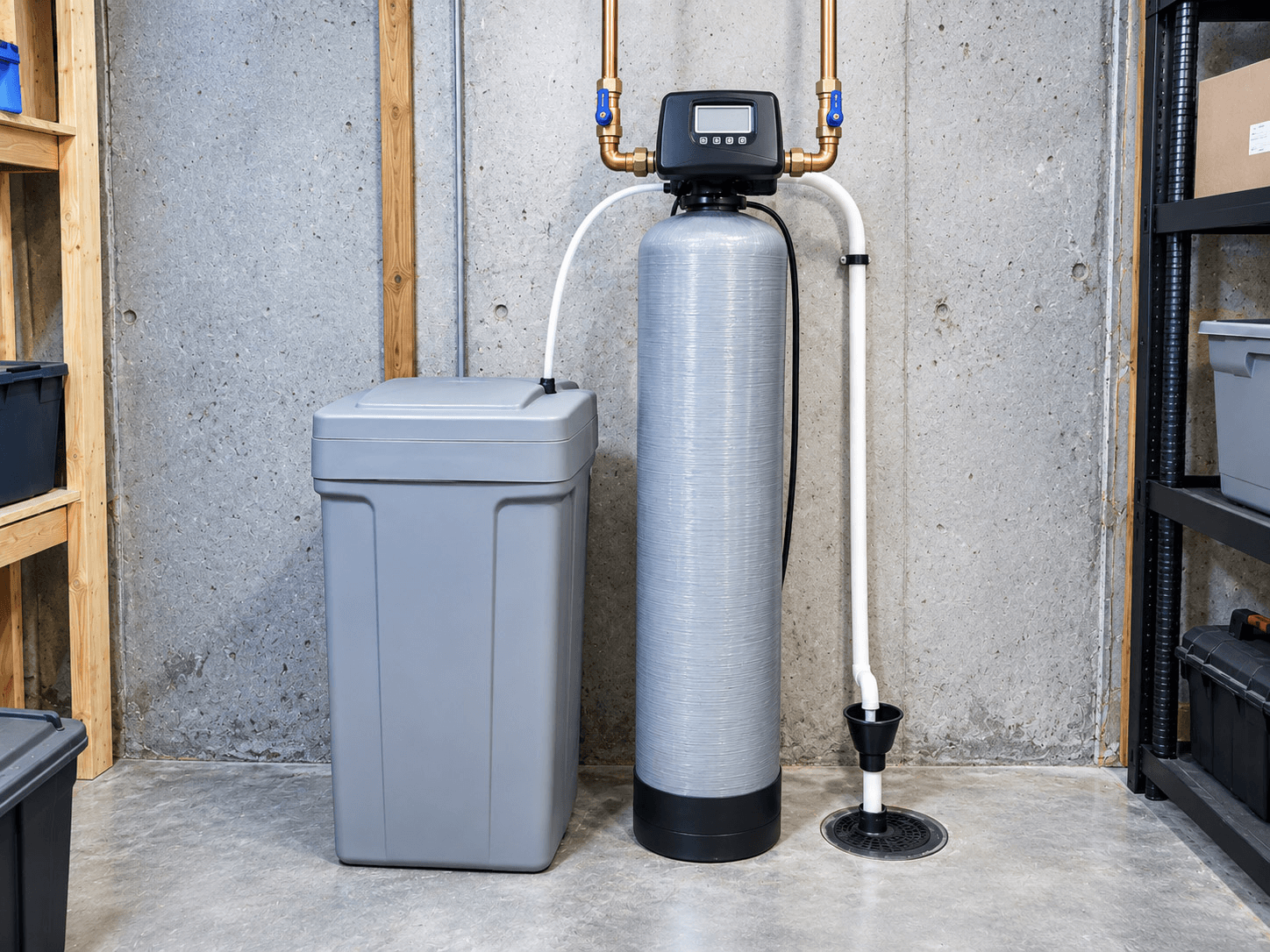
Source: Reno Quotes
Total Installed Cost
Scenario | Installed cost |
Budget unit, easy access, customer-supplied | $1,000 to $1,500 |
Standard salt-based system, good access | $1,800 to $3,000 |
Mid to high capacity, some complexity | $3,000 to $4,500 |
Premium twin-tank or difficult install | $4,500 to $6,000+ |
Labour typically accounts for 20% to 40% of the total. Licensed plumbers and water treatment specialists in Ontario charge $85 to $150 per hour, and a straightforward tie-in takes two to four hours.
Accessibility drives most of the variation. A missing floor drain or a finished basement adds $200 to $600 on top of a standard quote.
Real Installed Examples
Home | System | Installed cost |
Etobicoke, 2 people, customer-supplied unit | 30,400-grain budget unit | $1,150 labour only |
North York, 3 people, easy basement access | 32,000-grain metered single tank | $2,650 |
Vaughan, 5 people, 4,800 sq. ft. | 48,000-grain twin tank with WiFi monitoring | $5,890 including new drain run |
The Etobicoke job shows the floor: a retail unit the homeowner bought plus a plumber's time for the tie-in. The Vaughan job shows what a large home with a premium system and a new drain line costs.
Cost by System Type
System type | Installed cost | Best for |
Salt-based ion exchange | $1,500 to $4,000 | The default for genuinely hard water |
Salt-free conditioner | $1,500 to $4,500 | Below roughly 25 GPG, low-maintenance preference |
Dual-tank | $3,500 to $6,000 | Large households needing continuous soft water |
Softener plus iron filter | $3,500 to $7,000 | Well water with elevated iron |
Salt-based is the right starting point for most Canadian homes. It genuinely removes hardness minerals through ion exchange rather than altering their structure.
Salt-free conditioners eliminate the ongoing salt expense of $80 to $200 per year and need no drain connection, which appeals if you're worried about sodium or want low maintenance. They work best below about 25 grains per gallon, which covers most of southern Ontario but falls short in very hard water areas.
What Affects Your Price
Grain capacity: Sized to your household and water hardness. A 32,000-grain unit suits a typical three-person home in Toronto; hard-water areas need 45,000 or 60,000.
Accessibility: A finished basement, a tight mechanical room, or plumbing that runs through a wall all add hours.
Drain availability: A salt-based softener needs a drain for its regeneration cycle. No drain within reach means running new drainage piping, which is the single most common cost add.
Electrical access: The unit needs a nearby outlet. Running one adds electrical work to the job.
Existing plumbing condition: Old galvanized pipe often has to be replaced at the tie-in point. One Etobicoke job added 90 minutes for exactly this.
Iron content: Well water with high iron needs resin formulated for it, which costs 20% to 30% more, or a dedicated iron filter upstream.
Buy versus rent: Rental programs spread the cost but typically total more over ten years.
Do you need a water softener?
Understanding Water Hardness
Water hardness is measured in grains per gallon (GPG) or milligrams per litre. It reflects how much dissolved calcium and magnesium your water carries.
Hardness level | GPG | What it means |
Soft | 0 to 3 | No softener needed |
Moderately hard | 3 to 7 | Optional, mild scale |
Hard | 7 to 10 | Softener recommended |
Very hard | 10 to 20 | Softener strongly recommended |
Extremely hard | 20+ | Softener essential, higher capacity required |
Toronto's lake-source water arrives at about 7 to 7.5 GPG, which is moderately hard and handled well by a standard 30,000 to 45,000-grain system. Suburban GTA homes and private wells often test at 15 to 25 GPG or higher.
Parts of Ontario, Manitoba and Saskatchewan have some of the hardest municipal water in the country, with readings commonly between 20 and 40 GPG. That puts more strain on softener resin and shortens the life of an undersized unit considerably.
The Signs of Hard Water
Limescale and mineral deposits on faucets, showerheads and kettles
Soap scum that won't rinse away, and soap that won't lather
Spotted or cloudy glassware coming out of the dishwasher
Dry skin and hair after showering, and a film that won't rinse off
Stiff, scratchy laundry even with fabric softener
Reduced water flow over time as scale narrows pipe interiors
A water heater that's louder or less efficient than it used to be
What a Softener Actually Protects
Appliance lifespan is the clearest financial case. Scale accumulating inside a water heater, dishwasher or washing machine forces each to work harder and fail sooner. Hard water is what takes years off a tank.
Your plumbing system suffers the same way. Scale builds inside pipes over decades, narrowing them and reducing flow.
Skin and hair benefit noticeably, and it's what most homeowners report first after installation. Soap rinses cleanly instead of leaving a residue.
Get Your Water Tested First
Don't buy anything before you know your numbers. Most plumbers and water treatment contractors offer a free water test that gives you exact hardness in grains per gallon.
Catalogue numbers and municipal averages aren't a substitute for a measured reading at your own tap. Skipping this step is what produces undersized systems that regenerate too often and oversized units that waste salt.
Common Reasons for Installation
Hard Water Damage
The most common reason. Mineral buildup from calcium and magnesium accumulates on fixtures, inside appliances and throughout the plumbing. Once deposits on appliances are visible, the invisible damage inside the water heater and pipes is already underway.
A softener works by ion exchange: water passes through a resin bed that swaps calcium and magnesium for sodium ions, leaving genuinely soft water throughout the home.
Replacing an Aging Unit
Most water softeners last 10 to 15 years. Toward the end, they regenerate more often, use more salt and soften less effectively.
Common end-of-life failures include cracked tanks, damaged seals, and resin beads that no longer regenerate properly. Once a unit reaches that stage, replacement almost always costs less than repair.
Water Quality Changes
A municipal supply change, a new well, or a shift in water source can alter hardness significantly. Homeowners moving from city water to a well frequently discover the difference the hard way.
Plumbing Repairs and Renovations
Softener installation is often bundled with other work. If you're already replacing a water heater, doing plumbing repairs, or finishing a basement, the mechanical room is open and the plumber is on site. Call-out time is a significant share of any bill, so pricing both in the same visit almost always beats two separate appointments.
A Clogged Drain or Failing Fixtures
A clogged drain caused by scale accumulation, or fixtures that keep failing prematurely, often prompts a plumber to recommend addressing the water itself rather than the symptoms.
Diagnosing Water Softener Problems
If you already have a softener and something seems wrong, these symptoms tell you what's happening.
Symptoms and What They Mean
Symptom | Likely cause |
Hard water returning, scale buildup reappearing | Resin exhausted, salt bridge, or failed regeneration |
Salty-tasting water | Malfunctioning valve or stuck regeneration cycle |
Stiff clothing after washing | Unit not softening effectively |
Unusual noises during regeneration | Valve or motor failure |
Warning lights or error codes | Control head fault; check the manual |
Visible leaks at the tank or fittings | Damaged seals or a cracked tank |
Salt not being consumed | Salt bridge in the brine tank, or no regeneration occurring |
Very high salt consumption | Unit stuck in continuous regeneration |
What You Can Check Yourself
Break up any salt bridge, a hardened crust that forms above the water line in the brine tank and prevents salt from dissolving. Confirm the unit is plugged in and the bypass valve isn't left in bypass position, which is a surprisingly common cause of "sudden" hard water. Run a manual regeneration cycle if your unit allows it, and check that the drain line isn't kinked.
Repair or replace?
Repair makes sense on a unit under eight years old with a single failed component. A control valve, motor or seal replacement typically runs $200 to $600.
Replace when the unit is over ten years old, when the tank is cracked, when resin tank replacement is required — which often approaches the cost of a new unit — or when you've had multiple failures in a short period.
A water test and a technician's diagnostic will tell you which. If you're not sure, the age of the unit is usually the deciding factor.
The Water Softener Installation Process
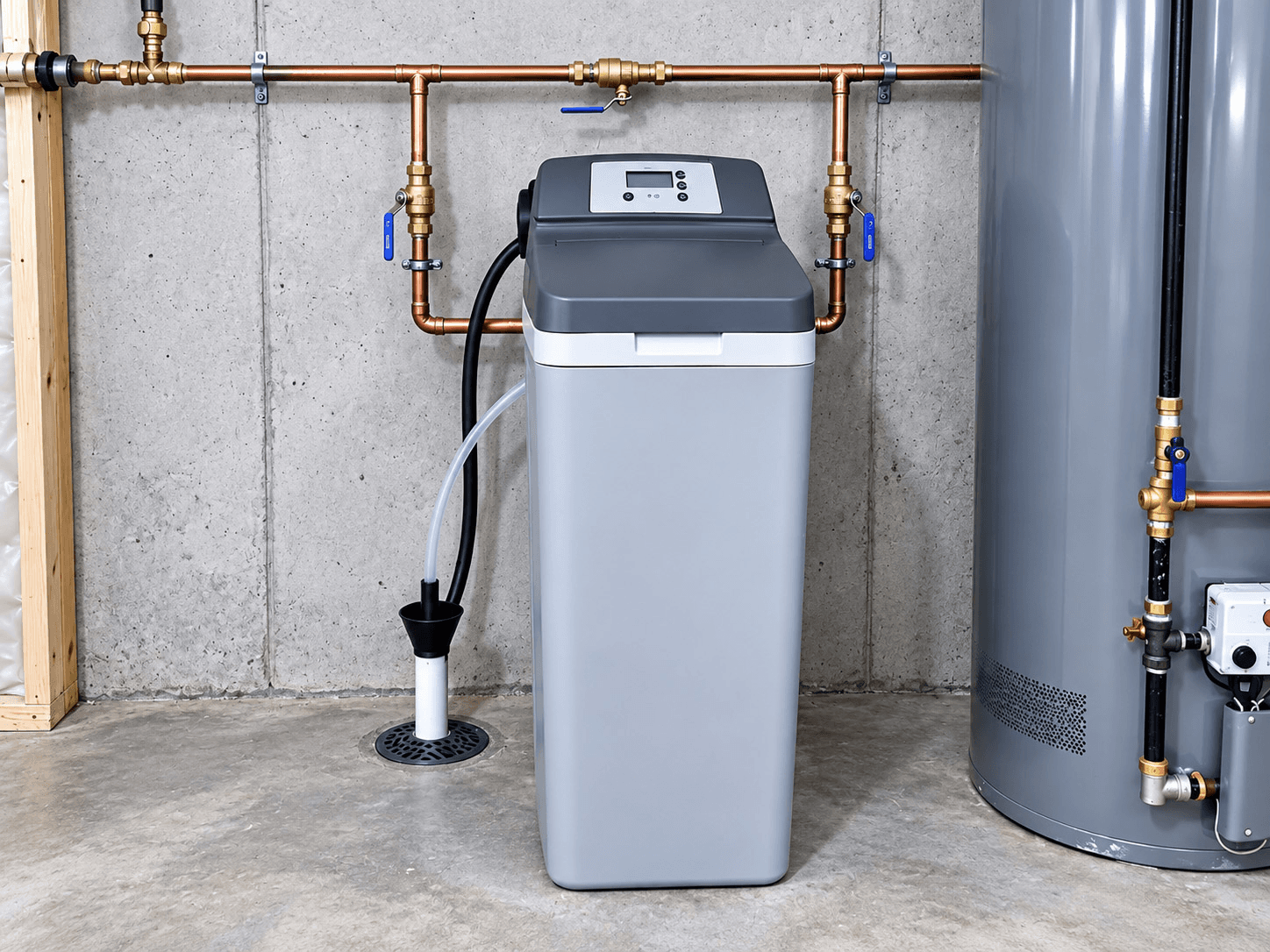
Source: Reno Quotes
A standard installation takes two to four hours. Complex jobs requiring new drainage or electrical work take most of a day.
Step by Step
Water test and sizing. The technician measures hardness in grains per gallon and calculates the grain capacity your household needs based on occupancy and water use.
Choosing the location. The unit goes near where the main water line enters the home, ideally close to both a drain and an electrical outlet.
Shutting off the water and draining the line at the tie-in point.
Installing the bypass valve. This lets you route water around the softener for maintenance or if the unit fails, and it's not optional.
Making the line connections. Either a hard connection in copper or PEX, or flexible pipes where movement and serviceability matter. Soft water is plumbed to the house while outdoor taps typically stay on hard water.
Running the drainage piping. The regeneration cycle discharges to a floor drain, standpipe or laundry tub, with an air gap to prevent backflow.
Connecting the brine tank with brine tubing between it and the resin tank.
Electrical work. The control head plugs into a standard outlet; if none is nearby, one gets installed.
Loading salt and programming the unit with your hardness reading and regeneration schedule.
Running a manual flush cycle to clear resin dust and verify every connection.
Checking for leaks and testing water pressure. A small pressure drop is normal; a significant one signals a problem.
What to Expect Afterward
Water may run slightly discoloured for the first few draws as the resin settles. Minor water pressure drops of a few PSI are normal and shouldn't be noticeable at the tap.
The unit regenerates automatically, usually overnight, on a schedule set by your hardness and usage. You'll top up salt every four to eight weeks depending on household size.
Salt Types and Ongoing Costs
Salt type | Cost per bag | Verdict |
Pellet salt | $12 to $14 | The default choice for most homeowners |
Solar salt | $10 to $12 | Works fine, slightly more dust |
Block salt | $14 to $18 | Only for units that specify it |
Potassium chloride | $30 to $40 | Low-sodium households, three times the cost |
Rock salt | $6 to $8 | Avoid — leaves residue in the brine tank |
Budget $80 to $200 per year on salt for a typical Canadian household. Mixing salt types is fine; loading rock salt is not.
Choosing a Water Softener Installer
Three things separate installers: credentials, reliability and what they guarantee. Price is a fourth, and it's the one most homeowners over-weight.
The Credentials That Matter
Companies often list certifications together to imply they're equivalent. They aren't.
Plumbing licence: The legal requirement. Whole-house equipment tying into your main water supply is licensed plumber territory, meaning a 306A licence in Ontario or the provincial equivalent elsewhere. Verify this first and eliminate anyone without it.
Red Seal certification: A national benchmark rather than a provincial minimum. A useful signal of depth, but not a substitute for the licence.
Water treatment certifications: Indicate experience with sizing, resin selection and iron pre-treatment. Valuable on a well or in very hard water, less critical on a straightforward municipal tie-in.
NATE certification: North American Technician Excellence certifies heating and cooling technicians. Combined HVAC-plumbing companies list it legitimately, but it says nothing about plumbing competence.
General claims: "Certified specialists" and "factory trained" are marketing until someone names the certifying body. Ask which one, then check the registry.
Provincial licences are searchable through the regulator, and liability insurance through a certificate the installer can produce on request. Hesitation at either question tells you what you need to know.
Judging Reliability
The quote is itemized. Someone who breaks out the unit, labour, drain work and commissioning has done this enough to know what each costs.
Pricing is confirmed before work begins, not an estimate that firms up on site.
They arrive with the parts. "We'll pick up what we need" is how a three-hour job becomes two visits.
They ask about your water before quoting. An installer who quotes a grain capacity without testing is guessing, and you'll live with that guess for a decade.
Reviews are independent. Check verified reviews on third-party platforms, and look for ones mentioning softener installations specifically rather than general plumbing.
Speed of Service
A failed softener isn't an emergency the way a burst pipe is. You'll have hard water until it's fixed, which is inconvenient rather than damaging.
Same-day service genuinely matters when a failing unit is leaking, when a stuck regeneration cycle is dumping brine, or when you're mid-renovation with the plumbing open.
For a planned installation, what matters is what "same-day" includes. Genuine fast service means the unit is in stock in your grain capacity, the technician arrives with drain and electrical materials, and the system is commissioned before they leave. Ask directly: "Will the system be programmed, flushed and running before you go?"
The warning sign is a quick turnaround promised before anyone has seen your mechanical room. An installer who commits to same-day without knowing whether you have a floor drain will discover you don't, and the second visit lands two weeks out.
What a Professional Quote Includes
The gaps between quotes almost always live in drain work, electrical and commissioning.
Line item | What to confirm |
The unit | Make, model, grain capacity, and how that capacity was determined |
Labour | Hourly rate or flat fee, and estimated hours |
Drain work | Whether an existing drain is usable, or what running new drainage costs |
Electrical work | Whether an outlet exists within reach, or what adding one costs |
Bypass valve and fittings | Included as standard, not an upgrade |
Old unit removal | Removal and disposal of the existing softener, if replacing |
Testing and commissioning | Programming, initial flush, leak check, pressure verification |
Salt for startup | Whether the first fill is included |
Warranty | Parts and labour, listed separately with durations |
A quote covering all nine comes from someone who installs these regularly. A quote covering four is going to grow.
Understanding the Guarantee
Three separate protections apply, and they're frequently conflated.
The manufacturer's warranty: This covers the equipment, typically 5 to 10 years on the tank and resin and 3 to 5 on the control valve. It's honoured by the manufacturer rather than the installer, and it usually requires professional installation to remain valid.
The workmanship warranty: This covers the installer's own work, meaning connections, drain line and programming. It varies most of the three, from three months to a full year. Three months is common and adequate, since installation faults surface almost immediately.
The service guarantee: This is the promise to return and correct problems at no charge. Company language varies; the substance to confirm doesn't.
The question that matters: "If this leaks in six weeks, who pays for the repair and who pays for the water damage?" Get the answer in writing, because a softener failure can release hundreds of gallons.
Also confirm the installer uses OEM replacement parts for future service, since generic components can void your equipment warranty.
How to Compare Three Installers
Rank them in this order, because the sequence reflects what actually costs you money.
Credentials: Anyone without the provincial plumbing licence is eliminated regardless of price. Many homeowner policies require licensed installation to honour water-damage claims.
The guarantee: A $200 price difference is irrelevant next to a $15,000 basement claim.
Quote completeness: The installer covering all nine line items has priced the real job.
Speed: Only decisive between two installers who are otherwise equal, or if you have genuine urgency.
Price comes last, and only between quotes covering identical scope. A bid substantially below the others usually reflects an undersized unit, excluded drain work, or a customer-supplied model priced as labour only.
Buy, Rent or Customer-Supplied
Buying outright costs the most upfront and the least over ten years.
Renting spreads the cost but typically totals more, though it usually bundles service and eventual replacement.
Customer-supplied means buying a retail unit and hiring a plumber for the tie-in only. It's the cheapest legitimate version of this job — a $750 retail unit plus a couple of hours of plumber time — but confirm the installer will warranty their labour on equipment they didn't supply, since many won't warranty the unit itself.
What should you budget?
For most Canadian homes, water softener installation costs $1,800 to $4,000 all in, with the unit accounting for roughly 60% to 80% and labour the rest. Budget another $80 to $200 annually for salt.
Two things determine where you land. Your water hardness dictates grain capacity, and an undersized unit costs more over its life than the right one did upfront. Drain access is the single most common cost add, at $200 to $600 if new drainage has to be run.
Get your water tested before requesting quotes, and compare three itemized estimates on what they include rather than what they total.
Water Softener Installation FAQs
How much does water softener installation cost in Canada?
$1,500 to $4,500 installed, with most homeowners paying $1,800 to $4,000. Labour accounts for 20% to 40% of the total, at $85 to $150 per hour in Ontario. A customer-supplied unit with a simple tie-in can come in around $1,000 to $1,500.
How long does installation take?
Two to four hours for a standard installation with good access and an existing floor drain. Add time if new drainage piping, electrical work or plumbing modifications are needed, which can extend it to most of a day.
Can a water softener be installed on short notice?
Often yes, if the unit is in stock and the job is straightforward. Most plumbers can schedule a standard installation within a week. A complex installation requiring new drainage or a special-order unit takes longer, and spring and fall are the busiest seasons.
Do I need a plumber, or can I install it myself?
Whole-house equipment tying into your main water supply requires a licensed plumber in most provinces, including Ontario. Beyond the legal question, many homeowner insurance policies require licensed installation to honour water-damage claims, which matters given how much water a failed softener can release.
What size water softener do I need?
Grain capacity depends on your household size and water hardness. A three-person home on Toronto water at 7 GPG is well served by a 30,000 to 32,000-grain unit. A five-person household in a 20+ GPG area needs 45,000 to 60,000. A water test is what determines this, not square footage.
Does a water softener need a drain?
Salt-based systems do, for the regeneration cycle. A floor drain, standpipe or laundry tub within reach keeps costs down. No drain nearby means running new drainage piping, which adds $200 to $600. Salt-free conditioners need no drain, which is part of their appeal.
How much does salt cost per year?
$80 to $200 for a typical Canadian household. Pellet salt at $12 to $14 per bag is the default recommendation. Potassium chloride costs three times as much and is only worth it for low-sodium households.
Does venting matter for a water softener?
The drain line needs an air gap to prevent backflow contamination, which is a code requirement rather than an optional detail. The softener itself doesn't require combustion venting the way a gas appliance does.
Will a water softener reduce my water pressure?
Slightly, by a few PSI, which most homeowners never notice. A significant pressure drop after installation signals a problem — usually an undersized unit, a partially closed bypass valve, or a restriction at the connection point.
What are my model options?
Single-tank metered units are the most common and suit most households. Twin-tank systems provide continuous soft water without interruption during regeneration, which matters for large families. Salt-free conditioners are an alternative below roughly 25 GPG.
Does a water softener remove iron?
A salt-based softener reduces dissolved iron at moderately elevated levels. Well water with high iron concentrations needs a dedicated iron filter upstream, and softeners built for iron-laden water use specific resin formulations costing 20% to 30% more. On a well, price the pre-treatment and the softener as one project — discovering an iron problem after installation means opening the same plumbing twice.
How long does a water softener last?
10 to 15 years with regular maintenance. Resin degrades over time, and very hard water shortens that lifespan. Annual maintenance and correct sizing are what get a unit to the upper end of the range.
Looking for something else?
Related articles
The latest industry news, interviews, technologies, and resources.
Cynthia Pigeon
•23 Jul 2026
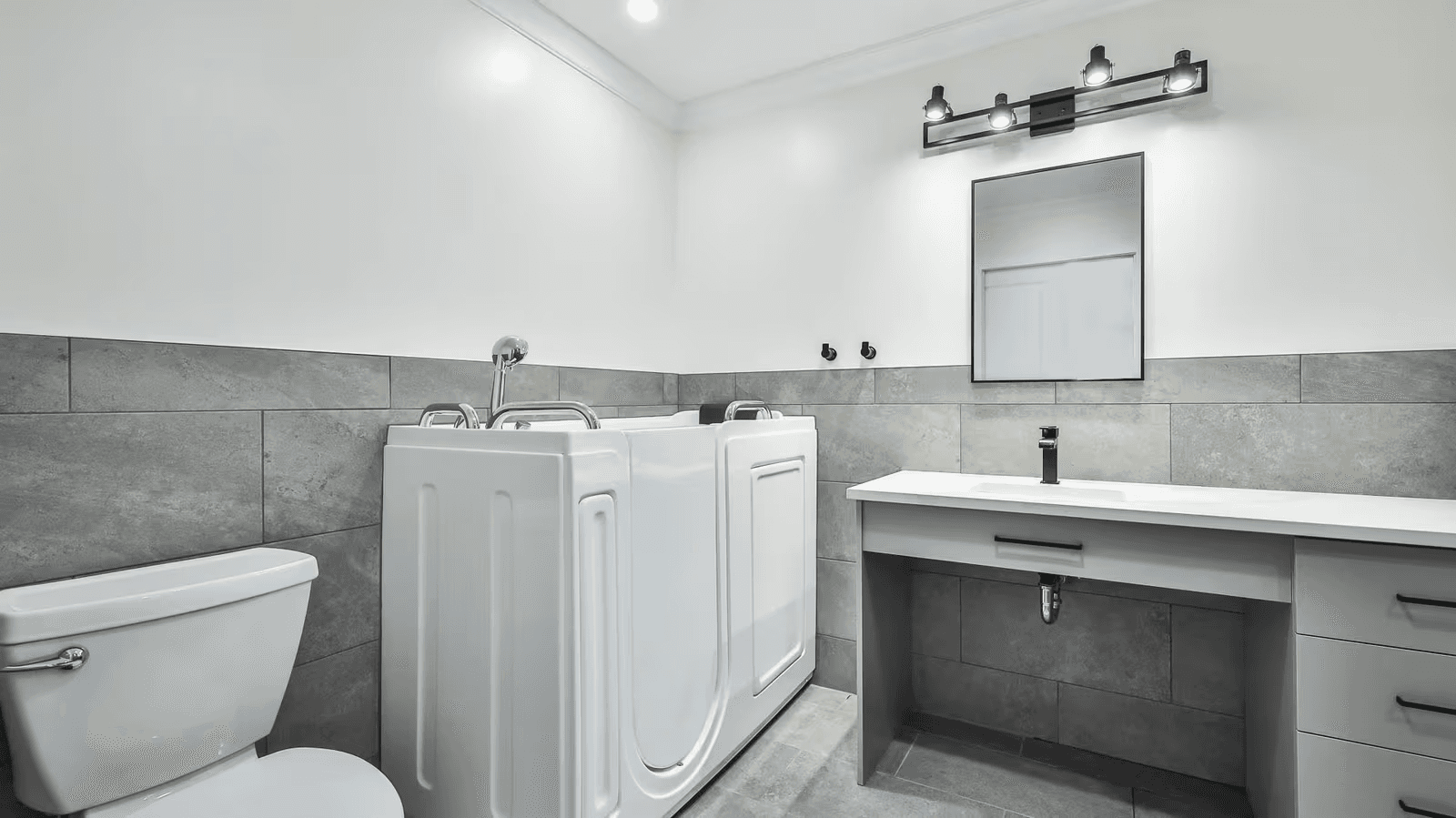
Installing a walk-in bathtub in Canada is a key solution for improving bathroom safety and supporting aging in place. This specialized renovation requires advanced plumbing expertise for fast drainage and strict electrical compliance with provincial building codes. In addition to increasing independence, these upgrades may qualify for significant financial assistance, such as the Home Accessibility Tax Credit (HATC) and various provincial home adaptation programs.
Cynthia Pigeon
•28 Apr 2026
In Canada, moving the plumbing for a bathroom vanity typically costs anywhere from a few hundred to several thousand dollars, depending on accessibility, relocation distance, and finishing work required. Costs increase significantly if drains, vents, or flooring systems must be modified—especially when transitioning from a concrete slab to a wood-framed floor. Plumbing work must be carried out by a licensed professional in accordance with provincial regulations.

Editorial Team
•28 Apr 2026
Planning a home painting project in 2026 and eager to discover the latest trends? This article highlights the top shades forecasted by leading paint distributors in Canada.
Léa Plourde-Archer
•16 Jun 2025
Thinking about laying tiles as a wall covering? Learn more about the different characteristics of this material that’s both durable and customizable, as well as maintenance tips, and the average cost of tiles.

Cynthia Pigeon
•08 Nov 2023
Since summer is a short-lived experience every year in Quebec, most of us try to squeeze the most out of the season by designing outdoor spaces to fully enjoy sunny days. Building a patio is a good idea should you want to have an outdoor seating area, paired with a table, barbecue, and sunshade.