Access Ramps in Quebec: RBQ Standards, Municipal Requirements and Best Practices
By Cynthia Pigeon
Updated on June 26, 2026
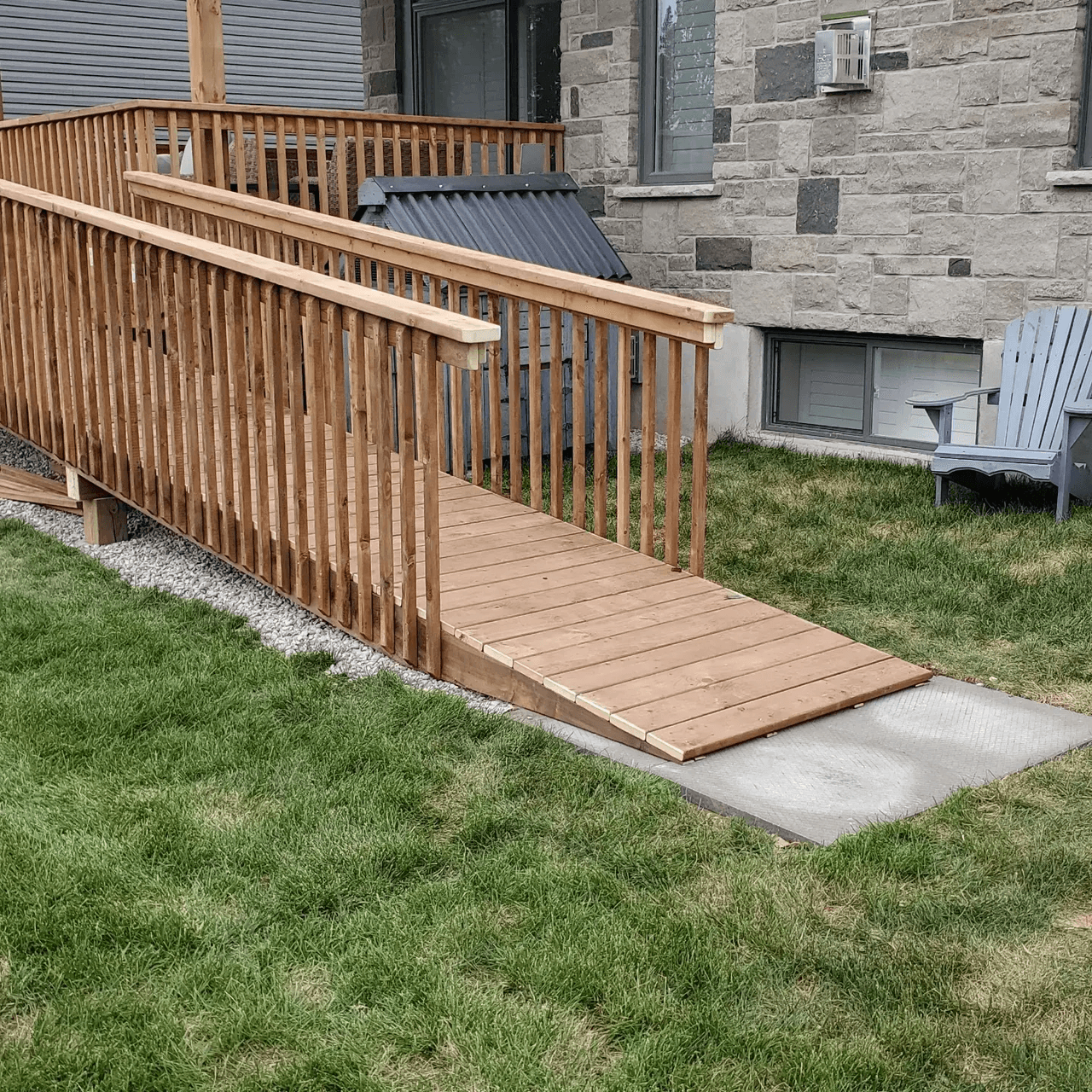
Universal accessibility is a major issue for residential property owners, commercial building managers, municipalities and building professionals. In Quebec, building an access structure requires careful planning to ensure the safety of people with reduced mobility. Depending on the type of building, its use and the municipality, the project may have to comply with the Quebec Construction Code, municipal requirements and best practices adapted to Quebec’s climate.
Whether you are planning this type of work to adapt your home or bring a business into compliance with legal requirements, this technical guide explains the main best practices to follow.
Slope and Dimension Requirements Under the Construction Code
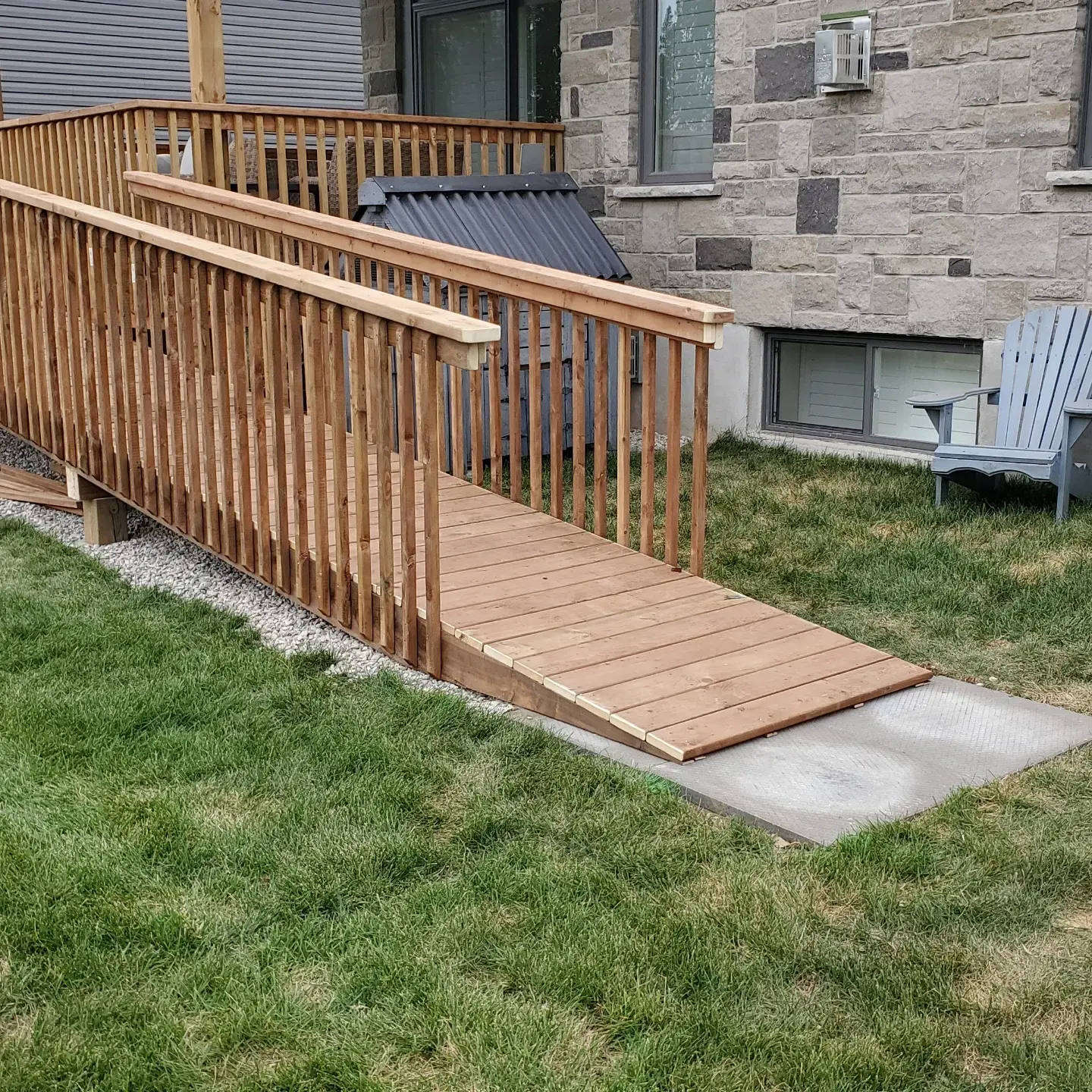
Source: Rideout North Construction Ltd
The architectural design of an access ramp is based on two regulatory pillars: the slope and the available clearance width. Respecting these criteria determines whether a wheelchair user can overcome the obstacle independently and safely.
Maximum Regulatory Slope (1:12)
According to the standards issued by the Régie du bâtiment du Québec, the maximum permitted slope ratio for an access ramp is 1:12. This means that for every centimetre of vertical rise, the ramp must extend 12 centimetres horizontally, which is equivalent to a slope of approximately 8.33%.
Although this is the maximum legal limit for barrier-free paths of travel, this configuration requires significant physical effort from the user or their caregiver. For this reason, when the available space on the property allows it, experts strongly recommend choosing a gentler configuration:
1:16 slope (6.25%): Offers an excellent compromise between the total length of the structure and ease of use.
1:20 slope (5.00%): Represents a gentler slope that is generally more comfortable for manual wheelchair users.
Mandatory Regulatory Widths
A wheelchair requires enough space to avoid friction against guards, handrails or edge protection. The Quebec Construction Code states that a ramp that forms part of a barrier-free path of travel must have a minimum clear width of 1,000 mm, measured between the handrails.
This measurement must be taken at the narrowest point, meaning between the inside faces of the handrails, not from the exterior supporting structure. For high-traffic commercial or institutional buildings, it may be advisable to provide a ramp or landings that are more spacious than the regulatory minimum. However, the minimum width of an accessible ramp is 1,000 mm, and intermediate landings may be enlarged, for example, up to 2,100 mm × 2,100 mm, where circulation is heavier.
Calculating the Slope: From Theory to Quebec Practice
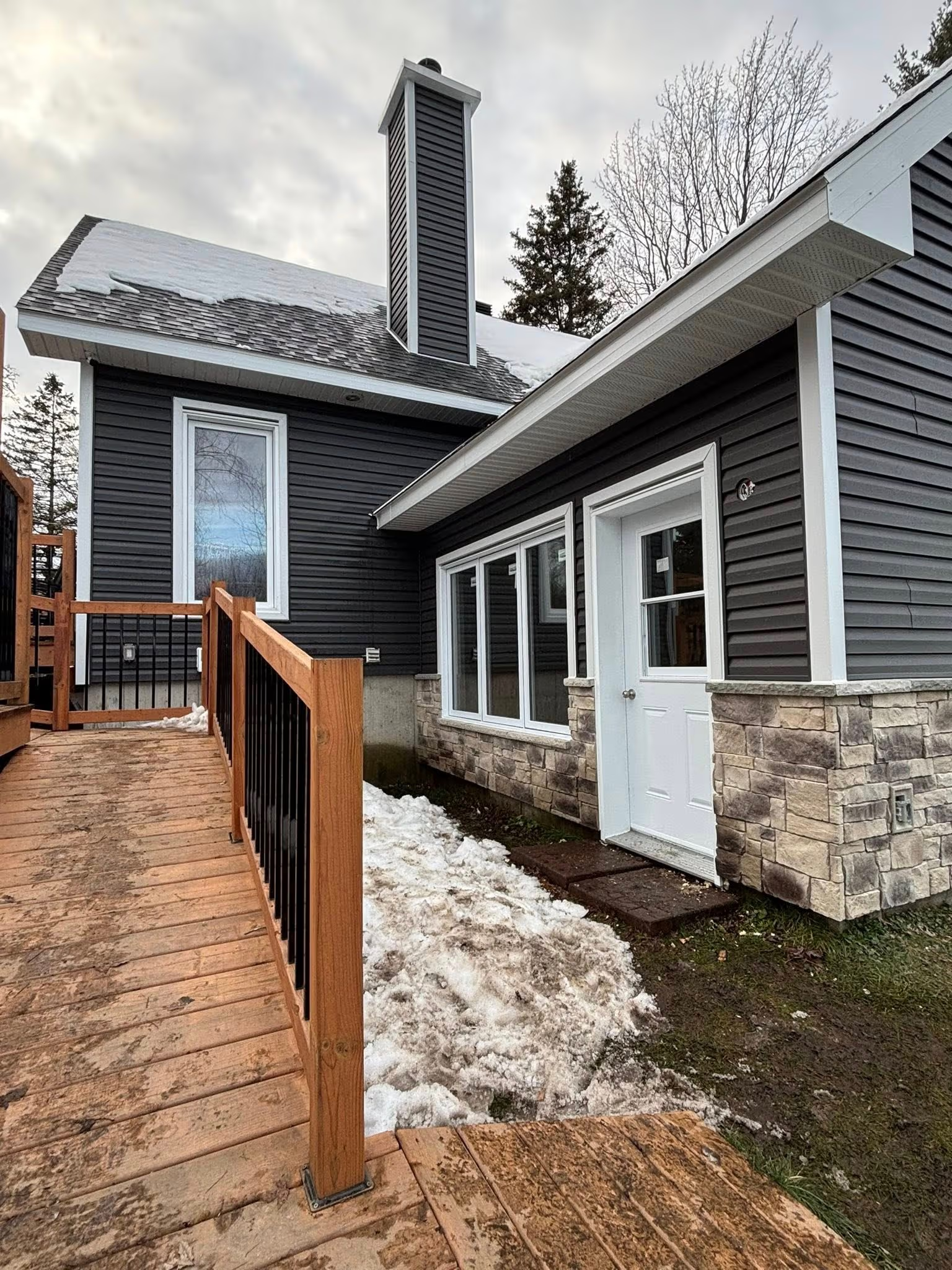
Source: Portes et Fenêtres Joncas
To move from plans to on-site construction, designers and carpenters must understand the linear mathematical formula that determines the length of the structure. A calculation error of just a few centimetres can be enough to make an installation non-compliant in the eyes of municipal inspectors or the RBQ.
Exact Formula
To determine the minimum horizontal length of a ramp, apply the following formula:
Ramp length = total height of the rise × slope factor
For the maximum 1:12 standard, the multiplication factor is 12.
Concrete example: If the threshold of your front door or business entrance is 24 inches (61 cm) above the exterior ground level, the calculation is as follows:
24 inches (height) × 12 = 288 inches in length
Converting this result gives a total linear ramp length of 24 feet, or approximately 7.3 metres.
Length Reference Table (1:12 Slope)
The table below shows the required ramp length based on the height of the step or porch to be overcome:
Height of rise (inches / cm) | Minimum required length (feet / metres) |
6 in / 15 cm | 6 ft / 1.83 m |
12 in / 30.5 cm | 12 ft / 3.66 m |
18 in / 45.7 cm | 18 ft / 5.49 m |
24 in / 61 cm | 24 ft / 7.32 m |
36 in / 91.4 cm | 36 ft / 10.97 m |
These figures make it clear that ground space can quickly become a major constraint. If your residential lot or commercial façade does not have the depth required for a straight run of 24 or 36 feet, you will need to design a switchback structure, such as an L-shaped or U-shaped ramp, with intermediate landings. To validate the technical feasibility of your layout, it is recommended to work with a general contractor in Quebec who can design a realistic site plan.
Rest Landings and Intermediate Landings
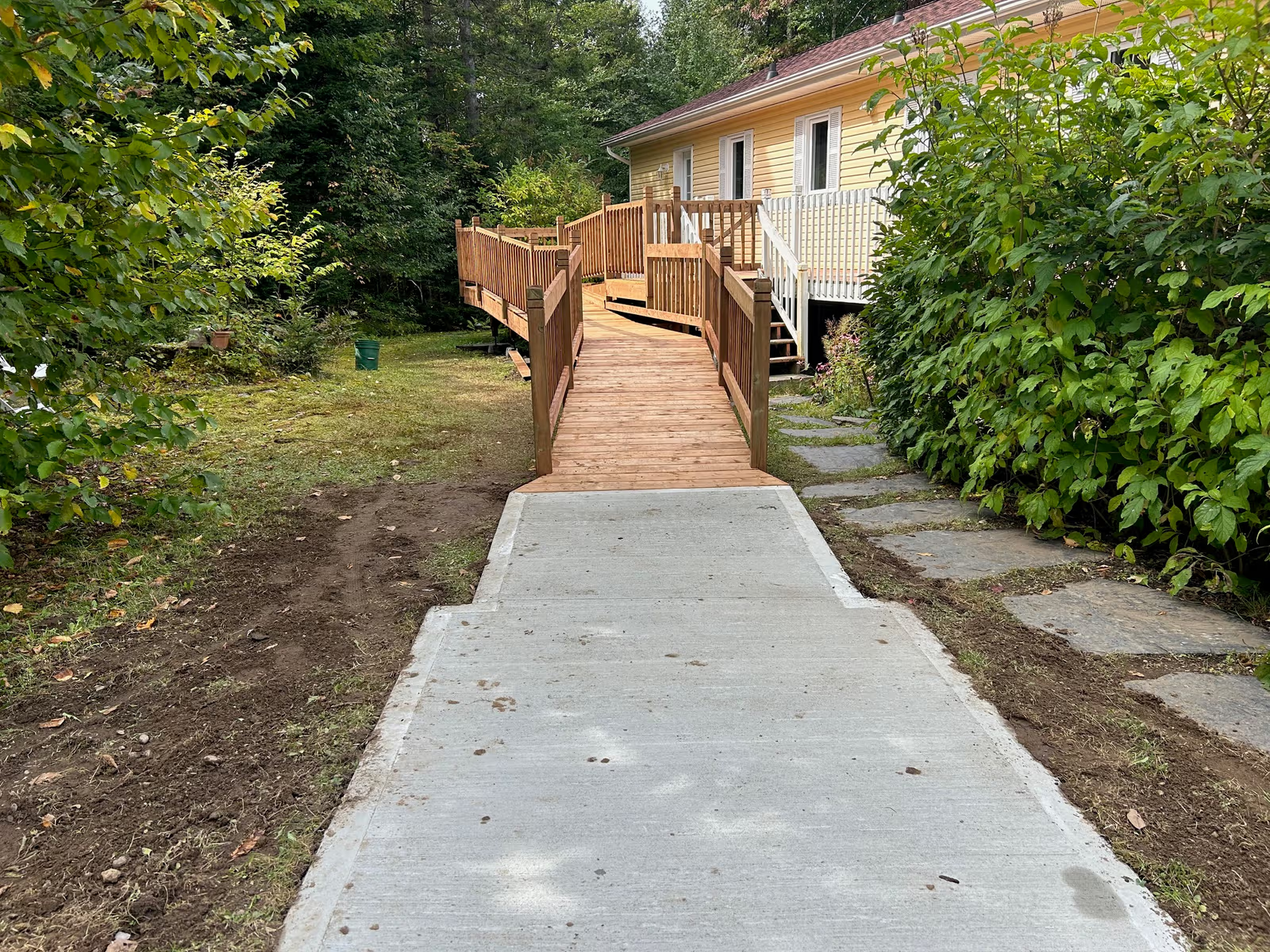
Source: Finitions 'country' finishings
Landings are not aesthetic options: they are mandatory safety components integrated into the Construction Code. They allow a person with a disability to stop and rest, stabilize their wheelchair or make a turn without the risk of tipping.
Required Landing Locations
A horizontal rest landing must be installed in the following locations:
At the top of the ramp, in front of the entry point.
At the bottom of the ramp, where it meets the sidewalk or asphalt surface.
A landing must be provided at each abrupt change in direction of the ramp. This landing must have a minimum length of 1,350 mm and a width at least equal to the width of the ramp, unless it is a landing associated with a door, in which case it must comply with the applicable door landing dimensions.
At regular intervals on long straight runs, the RBQ requires a rest landing for every 9 metres (30 feet) of linear ramp length.
Minimum Regulatory Dimensions
The size of a landing must allow the user to stop, stabilize themselves, and, where required, manoeuvre in front of a door or during a change in direction. Dimensions vary depending on the location of the landing and the ramp configuration. Landings located at the top and bottom of a ramp leading to a door, as well as intermediate landings for this type of ramp, must measure at least 1,700 mm × 1,700 mm. Intermediate landings required at intervals of no more than 9 m or at each abrupt change in direction must have a minimum length of 1,350 mm and a width at least equal to that of the ramp.
If the landing is in front of a door that opens outward, toward the user, the size of the landing must be increased to prevent the space needed to open the door from forcing the wheelchair backward toward the edge or onto the slope. When the landing serves a door, it must provide clearance on the strike side of at least 600 mm if the door opens toward the ramp, or at least 300 mm if it opens in the opposite direction.
Guards, Handrails and Winter Safety in Quebec
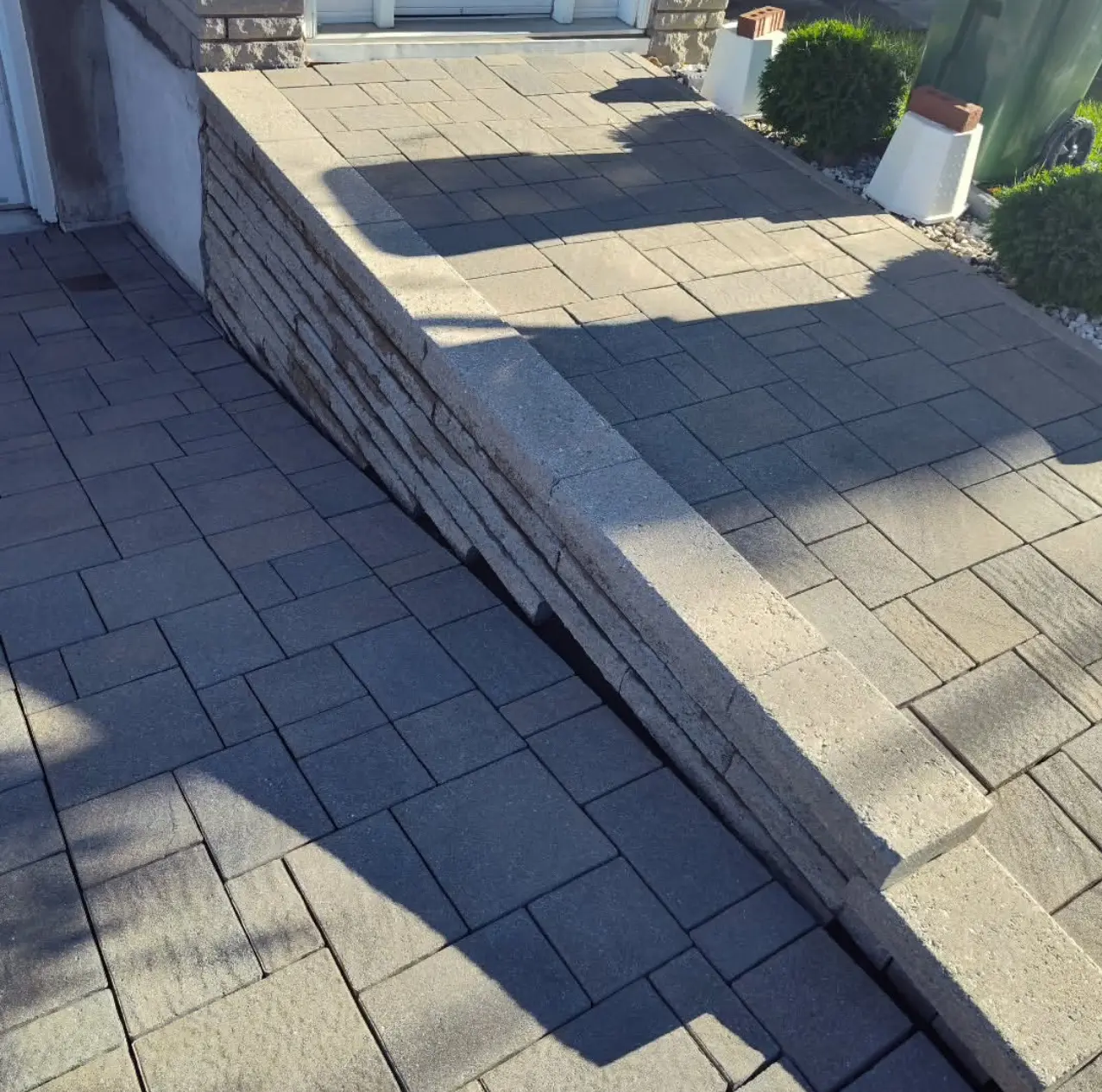
Source: Pavemulti
Building a ramp with the right dimensions is not enough if it becomes an unusable ice surface as early as November. Quebec’s climate requires impeccable material choices and safety features.
Standards for Guards and Handrails
As soon as the height of the access ramp exceeds 24 inches (60 cm) above the adjacent ground, guards become mandatory to prevent falls.
Guard height: Guardrails must be designed according to the type of building, the use of the ramp and the difference in height with the adjacent ground. For exit ramps and their landings, the Code provides for a minimum height of 1,070 mm. For residential projects, applicable requirements must also be verified with the municipality.
Handrails: Handrails must be installed on both sides of the ramp at a uniform height between 34 and 38 inches (865 mm to 965 mm), measured vertically from the walking surface.
Ergonomics: The handrail diameter must allow for a firm grip, generally between 30 mm and 50 mm. It must be continuous, including at intermediate landings, and extend at least 300 mm (12 inches) beyond the top and bottom of the ramp to provide a stable point of support before the transition.
Edge protection: To prevent a wheelchair wheel or the tip of a cane from slipping off the ramp, lateral protection must be provided. This may take the form of a curb at least 75 mm high, or a raised rail or curb located no more than 100 mm above the surface of the ramp or landing.
Adapting the Structure to Quebec’s Harsh Climate
Snow accumulation, spring thaw and freezing rain can quickly turn poorly designed ramps into dangerous areas. When choosing materials, three fundamental criteria should guide your decisions:
Permanent slip-resistant surface: Smooth pressure-treated wood should be avoided, as it becomes extremely slippery when exposed to moisture and frost. Choose a stable, firm, slip-resistant and well-drained surface. Openwork materials must be selected carefully to ensure that openings do not create risks for wheels, canes or mobility aids. For exterior surfaces, the design must also provide proper drainage, with a maximum cross slope of 1:50, or 2%. If you use wood, apply a textured slip-resistant coating containing silica aggregates.
Foundation management in freeze conditions: The ramp’s support posts must be anchored below the frost line in your region, generally at a minimum depth of 4.5 feet or 1.4 m in Quebec, using concrete sonotubes or screw piles. A ramp simply placed on surface concrete blocks will shift with freeze-thaw cycles, dangerously altering the slope over the years.
Meltwater drainage: The walking surface must include a very slight cross slope, with a maximum of 1:50 or 2%, to allow rainwater or meltwater to drain quickly before freezing and forming black ice.
To ensure that the selected structure meets these northern durability criteria, you can request quotes for your home renovation project and compare the solutions proposed by exterior-structure specialists.
Grants and Financial Assistance for Residential Accessibility

Source: RenoQuotes
Adapting a building for universal accessibility represents a significant financial investment. Fortunately, several government programs can help reduce the financial burden for homeowners.
The Home Adaptation Program (HAP)
Administered by the Société d’habitation du Québec (SHQ), the Home Adaptation Program (Programme d’adaptation de domicile, or HAP) is intended for people with disabilities whose physical limitations restrict their ability to perform daily activities at home.
Type of assistance: This program provides direct financial assistance in the form of a grant that can cover all or part of the eligible costs for carrying out compliant work, up to predetermined amounts that may reach several thousand dollars.
Eligibility: The application must be supported by a report prepared by an occupational therapist showing that installing an access ramp that complies with RBQ standards is essential to allow the person to enter and leave their home safely.
Execution: The work must be carried out by a contractor holding the appropriate licence from the Régie du bâtiment du Québec.
Other Tax Incentives
Tax credits may also apply depending on the situation of the owner or occupant. Federally, the Home Accessibility Tax Credit may apply to certain eligible renovations. In Québec, certain tax measures may also apply, particularly for seniors aged 70 or older, depending on the expenses incurred and the conditions set out by Revenu Québec.
Before buying materials over the weekend, take the time to prepare your financial file and accurately estimate the cost of the renovation work. It is important to wait for official approval from the SHQ before starting the work, as this is mandatory to qualify for grants under the HAP program.
Administrative Steps and Municipal Permits
Before launching the project, you must check with your municipality’s urban planning department. Even if your project fully complies with the Québec Construction Code, local municipal regulations often impose their own conditions:
Encroachment on setbacks: Because of their length, access ramps often encroach on the front or side setback of a property. Many municipalities provide special exemptions or relaxed rules for universal accessibility infrastructure, but obtaining a building permit remains mandatory.
Architectural heritage: If your building is located in a historic or heritage area, such as Old Québec or Old Montréal, the choice of materials, such as aluminum versus wood or wrought iron, as well as the colour of the structure, may be subject to approval by an urban planning advisory committee.
To complete your project without administrative headaches or structural surprises, the best approach is to entrust the work to construction professionals who are used to dealing with municipal authorities and RBQ standards.
Looking for something else?
Related articles
The latest industry news, interviews, technologies, and resources.
Amanda Harvey
•08 Nov 2023
A fence protects the exterior of your home, and when well maintained, can add some serious curb appeal to any property. Since this structure is left outside day and night, it comes up against some severe conditions: snow, rain, sleet, heat, both freezing and melting water. Therefore, it's only natural that the paint on an outdoor fence should easily wear and fade.

Editorial Team
•20 Oct 2026
In 2026, the cost of building a deck in Canada generally ranges from $35 to $130 per square foot, including installation, depending on the materials, dimensions and complexity of the project. For a standard 12 × 12-foot deck (144 sq. ft.), expect to pay approximately $5,500 for a simple pressure-treated wood structure, while a high-end composite deck with railings and helical piles can exceed $18,000.
Editorial Team
•21 Dec 2023
When the months start to feel warmer, there’s nothing we crave more than some time outside. There are plenty of ways to make the most of your front or backyard, and this includes building a beautiful deck. If you’ve been considering this project but are having a hard time making a concrete choice between the different materials on the market, then look no further!

Christine Simard
•08 Nov 2023
You might have noticed a steady stream in paint colour trends in 2020 and 2021. Like we talked about in our article Design trend 2021: curves, shapes and squiggles, the past 2 years had their fair share of ups and downs, with a lot of us stuck at home, probably stuck staring at the same home decor.

Editorial Team
•08 Nov 2023
As the cold weather arrives, the lucky few who can afford it may look forward to a vacation home getaway, a place dedicated to comfort and relaxation. On a winter evening, what could be better than a cozy fireplace, surrounded by good company, as well as an all-white landscape visible through the windows?