Expanding an Interlocking Paver Driveway in Quebec: Permits and Costs
By Cynthia Pigeon
Updated on September 10, 2026
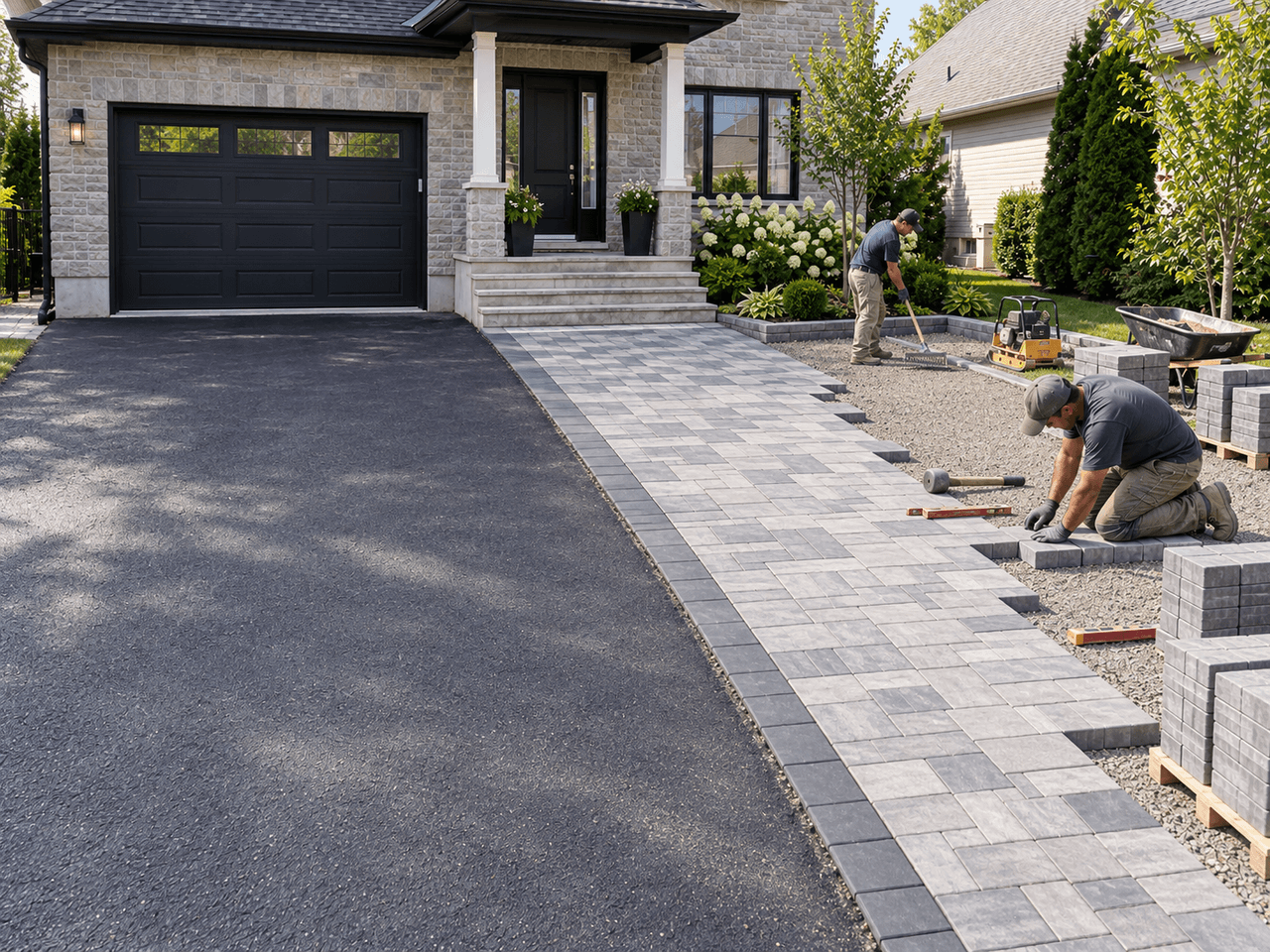
Buying a second vehicle, adding an electric car that needs a dedicated parking space, creating room for a recreational vehicle, or simply updating the look of a home leads many Quebec homeowners to consider widening their driveway.
Among the various exterior surfacing options available, interlocking pavers remain a popular choice in Quebec. Known for their appearance, durability, and ability to withstand freeze-thaw cycles when installed over a proper base, interlocking pavers are well suited to residential driveways. A well-designed outdoor space can also enhance a property’s curb appeal and perceived value, although the return on investment varies depending on the project, the real estate market, and the quality of the work.
However, widening a driveway involves more than simply installing concrete pavers over an existing lawn. The project is subject to municipal regulations and requires proper base preparation to withstand Quebec winters.
Municipal Permits for Expanding an Interlocking Paver Driveway
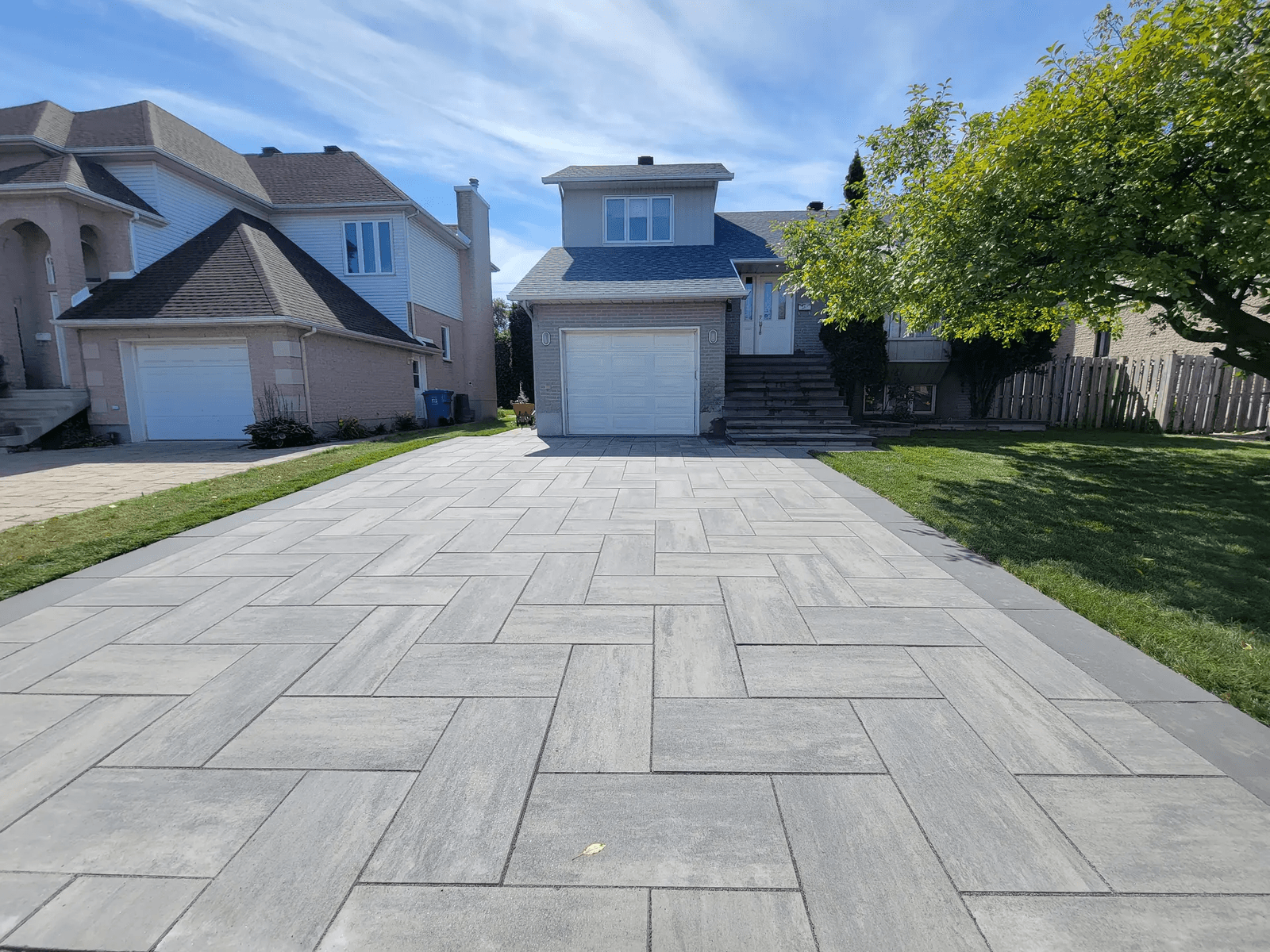
Source: 9400-1849 Québec inc.
In Quebec, municipalities regulate stormwater runoff, neighbourhood appearance, and street parking availability. Many municipalities require a permit or authorization certificate to modify or expand a driveway. Requirements vary depending on the municipality and applicable zoning bylaws.
Permits are generally obtained through the local planning department. Fees vary depending on the municipality, the value of the work, and the type of intervention. Additional fees may apply when work is required within the public right-of-way.
When applying, you may be required to provide a site plan or scaled sketch showing:
Current dimensions of the property and existing driveway.
Dimensions of the proposed expansion.
Distances between the widened driveway, side property lines, and the public right-of-way.
Materials to be used, such as interlocking pavers, natural stone, or slabs.
Possible consequences of completing work without the required municipal permit include:
Receiving a notice of violation or stop-work order.
Fines imposed under applicable municipal bylaws.
Being required to correct non-compliant work or, in some cases, restore the site to its previous condition at the owner’s expense.
To avoid legal complications or disputes with neighbours, it is advisable to have your proposed layout reviewed before signing a construction contract.
Zoning Rules: Maximum Driveway Width and Minimum Green Space
Municipal zoning bylaws often aim to limit excessive soil impermeability and reduce pressure on storm sewer systems during heavy rainfall.
Typical considerations may include:
Maximum Driveway Width
The maximum width of a driveway or access lane is established by municipal bylaws and may vary depending on the type of property, lot width, and number of parking spaces.
Some municipalities also limit how much of the front façade or front yard can be occupied by parking.
Front Yard Minimum Green-Space Requirements
Some municipalities require a minimum percentage of the front yard to remain landscaped or permeable.
The applicable percentage must be confirmed with the municipality.
Side Setback
A setback or landscaped strip may be required between the paved area and the property line, depending on the applicable municipal bylaw.
Some municipalities allow the use of permeable pavers, designed with wider joints filled with fine aggregate that allow water to infiltrate directly into the ground, to help meet stormwater management or green-space requirements. Check with your municipality for the rules that apply in your area.
Street Curbs and Municipal Sidewalk Modifications
If your driveway expansion extends vehicle access toward the street, the project may affect the public right-of-way, meaning the municipal land bordering your property.
Depending on the site configuration, cutting or lowering a street curb or modifying a municipal sidewalk may be required to create or widen the driveway access.
Typical process for modifying a municipal curb:
Authorization for work within the public right-of-way
Submit a request to the municipal department responsible for public works.
Payment of curb-cutting or modification fees
Fees vary significantly depending on the municipality, the width of the access, and the type of municipal infrastructure involved.
They may be charged as a flat fee, per linear metre, per square metre, or based on the actual cost of the work.
Curb cutting
The work may be completed by a municipal crew or by a specialized contractor authorized by the municipality.
No work should be done on a curb, sidewalk, or other infrastructure within the public right-of-way without prior municipal authorization. Depending on the municipality, the work may be carried out by municipal crews or by an authorized contractor.
How Much Does It Cost Per Square Foot to Expand an Interlocking Paver Driveway?
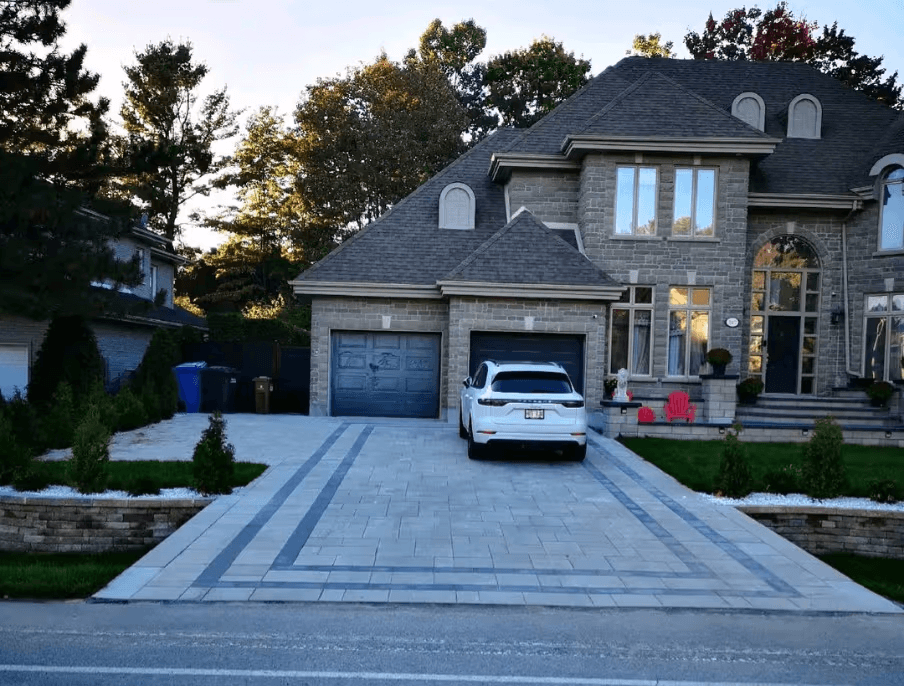
Source: Aepavages 9474-3564 qc inc
In Quebec, the average turnkey cost of expanding an interlocking paver driveway ranges from approximately $20 to $45 per square foot (about $215 to $485 per square metre).
This price may include:
Excavation of the existing soil.
Supply and compaction of granular base material.
Geotextile installation.
Interlocking pavers.
Bedding material.
Edge cutting.
Polymeric sand.
To plan your outdoor renovation budget, you can request landscaping quotes to compare rates from professionals serving your municipality.
Expansion Area | Type of Driveway Expansion | Estimated Budget – Low End | Estimated Budget – High End |
50 sq. ft. | Narrow side strip to improve parking space | $1,000 | $2,250 |
100 sq. ft. | Small expansion for motorcycle parking or easier door clearance | $2,000 | $4,500 |
200 sq. ft. | Addition of a full parking lane for a second vehicle | $4,000 | $9,000 |
350 sq. ft. | Major expansion with a turning area or space for an ATV/RV | $7,000 | $15,750 |
Material Costs: Interlocking Pavers, Gravel, and Geotextile
The paver model selected has a major impact on the final cost per square foot. Quebec manufacturers such as Techo-Bloc, Permacon, and Bolduc offer a wide range of products designed for residential vehicle loads.
Estimated material costs per square foot:
Residential interlocking pavers, 60 to 80 mm thick: $5 to $18/sq. ft.
Separation geotextile: $0.40 to $0.80/sq. ft.
MG-20 / 0–3/4 in. crushed stone base: $2 to $4/sq. ft.
Bedding material: $0.50 to $1.00/sq. ft.
High-performance polymeric joint sand: $0.60 to $1.20/sq. ft.
For residential driveways, many paver lines designed for vehicle traffic are available in 60 mm or 80 mm thicknesses. The selected product should meet the manufacturer’s specifications for the expected loads, and thicker pavers may be recommended for heavier vehicles.
To determine the exact cost based on your preferred style and materials, it is advisable to estimate the cost of expanding your driveway with paving professionals.
Labour and Excavation Costs with an RBQ-Licensed Contractor
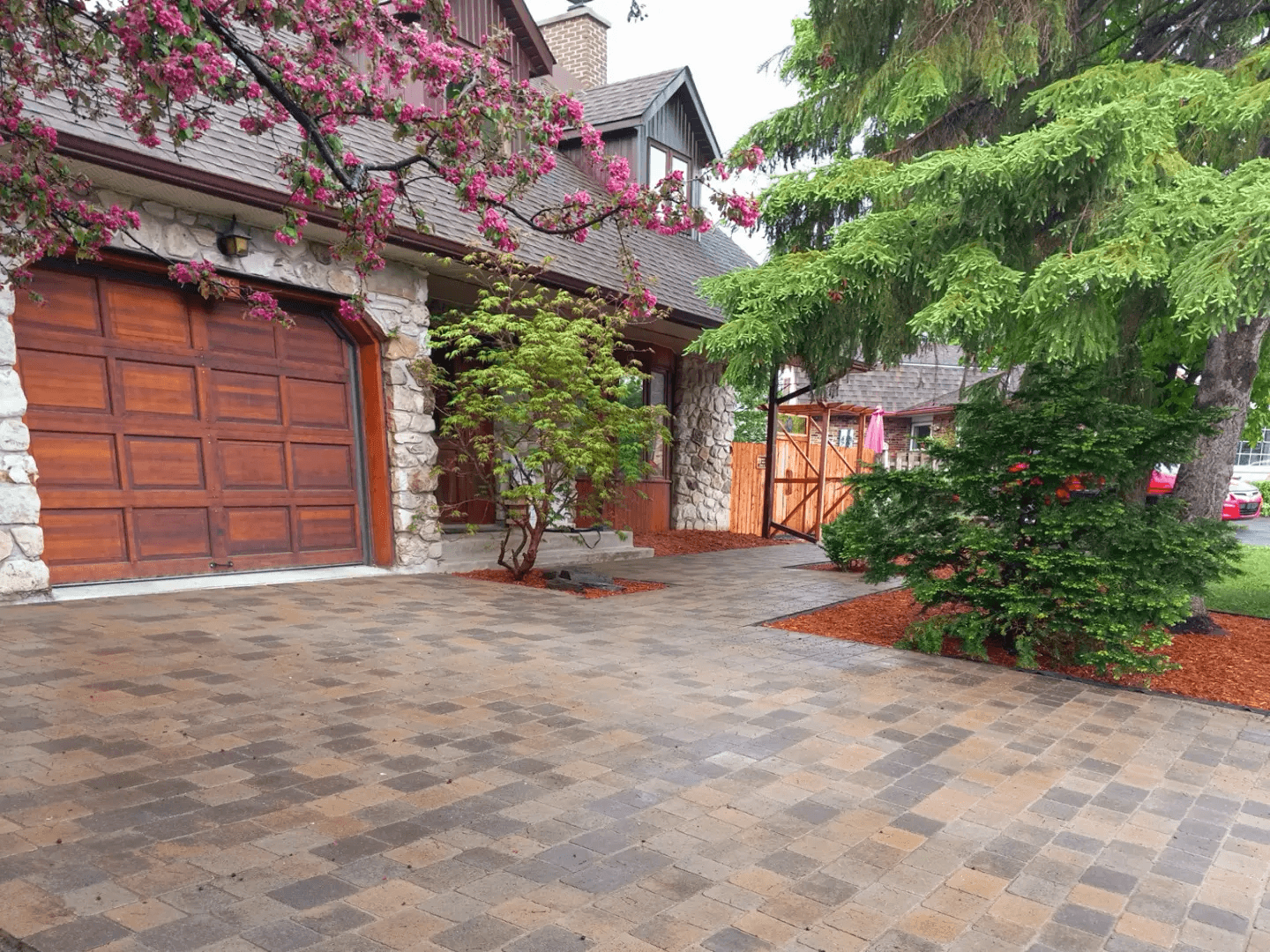
Source: maconnerie meritage inc
Labour and equipment may account for approximately 50% to 65% of the total project cost. A driveway expansion generally requires specialized equipment such as a compact excavator, skid-steer loader, and heavy-duty plate compactor, as well as a trained crew.
Indicative labour costs in Quebec:
Average Hourly Rate
$65 to $110/hour per skilled worker.
Excavation and Disposal
$350 to $900 per container for disposing of sod, clay soil, or old asphalt.
Custom Cutting and Polymeric Sand
$3 to $6 per linear foot for diamond-blade cutting and polymeric-sand compaction using protective equipment.
Installation Steps for Quebec Freeze-Thaw Conditions
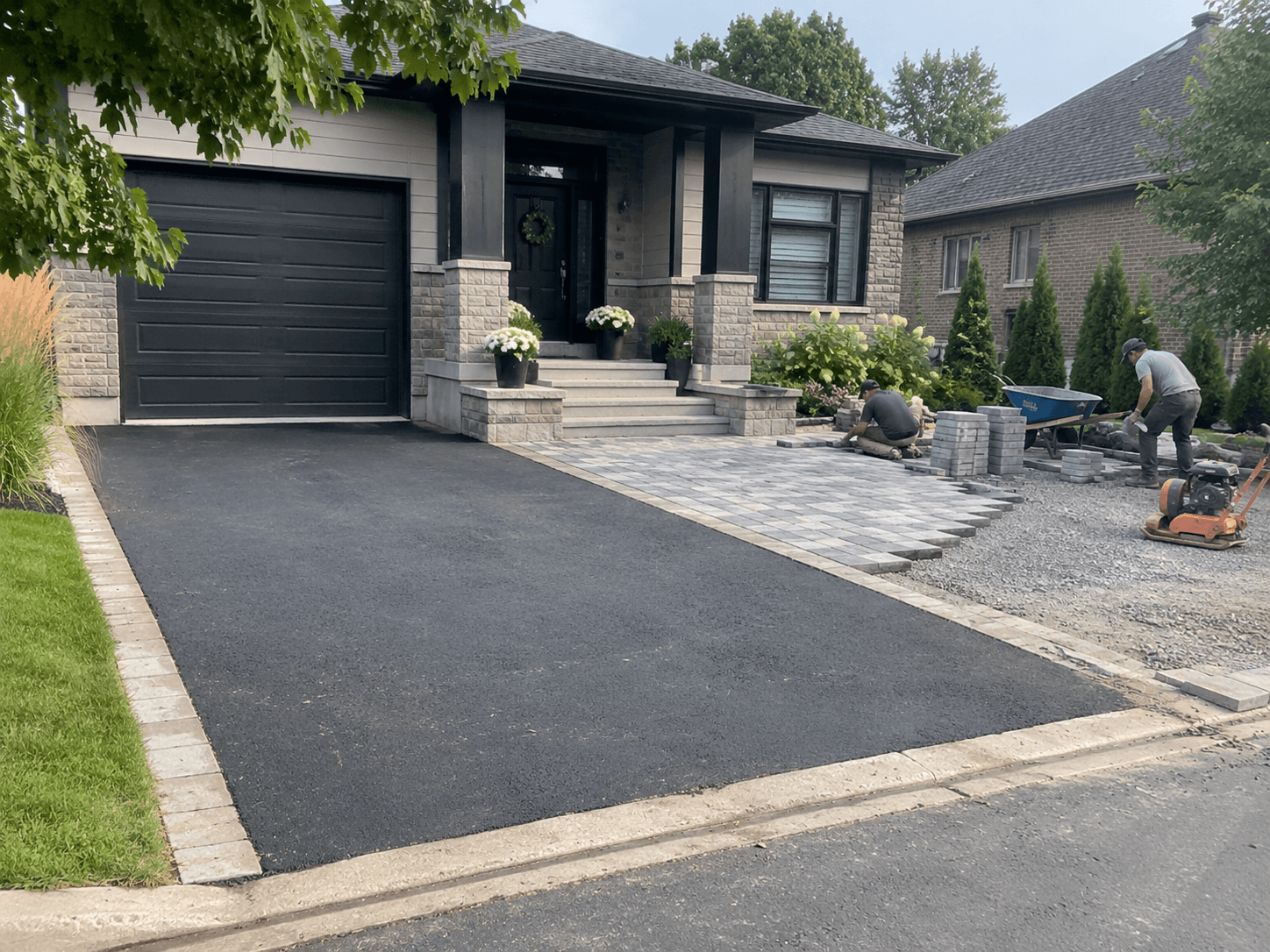
Source: RenoQuotes
In Quebec, soil can experience significant frost heave during winter. As the ground freezes, water in the soil can form ice lenses that push the soil upward. During spring thaw, saturated soil may temporarily lose bearing capacity.
To reduce the risk of rutting, settling, and deformation, the base must be prepared according to the manufacturer’s technical recommendations and adapted to soil conditions, drainage, and expected loads.
Typical interlocking paver driveway assembly:
80 mm interlocking pavers
Bedding layer: Manufacturer-recommended aggregate, generally 15 to 25 mm (5/8 to 1 in.) before final compaction
Granular base: Compacted MG-20 crushed stone (0–20 mm / 0–3/4 in.)
Non-woven separation geotextile
Excavated natural subgrade
The installation process generally includes the following steps.
1. Excavation
Excavation depth must be adapted to soil conditions. As a general reference, some manufacturer guides recommend approximately 12 in. in sandy soil and 16 in. in clay soil for a residential driveway, with additional depth where the soil has low bearing capacity.
In clay, wet, or weak soils, deeper excavation and a thicker granular base may be necessary to improve stability and drainage.
2. Geotextile Installation
A high-strength non-woven geotextile membrane is installed over the excavated subgrade. It helps keep fine natural soil from mixing with the granular base while still allowing water to drain through.
Geotextile is particularly useful over fine, clayey, or weak soils.
3. MG-20 Base Installation and Compaction
The base is built using MG-20 crushed stone (0–3/4 in.). The aggregate should be laid and compacted in successive lifts according to the manufacturer’s recommendations and project requirements to create a dense, stable base.
4. Bedding Layer and Paver Installation
A bedding layer made from the aggregate recommended by the manufacturer is screeded to a thickness generally between 15 and 25 mm before final compaction.
The pavers are then installed in the selected pattern, such as herringbone, modular layouts, or Roman-style patterns. Herringbone patterns are particularly well suited to driveways because they provide strong mechanical interlock against the turning forces created by vehicle tires.
5. Edge Restraints and Polymeric Sand
Rigid plastic or concrete edge restraints are securely anchored along the perimeter to prevent lateral movement of the pavers. Polymeric sand is then swept into the joints, compacted using a plate compactor equipped with a protective mat, and lightly wetted to activate the binding agents.
Long-term resistance to freeze-thaw cycles depends on several factors, including subgrade quality, drainage, base thickness and compaction, and compliance with the paver manufacturer’s installation recommendations.
Choosing a Qualified Contractor for Interlocking Paver Work
Source: Groupe TT
Expanding a driveway is a demanding landscaping project that requires proper preparation of the subgrade and granular base. Hiring an unqualified contractor working without the appropriate licence can increase the risk of premature settlement, deformation, and legal complications if problems arise.
Before hiring a paving contractor, verify the following:
Valid RBQ Licence
Confirm that the contractor holds the RBQ licence subclasses required for the work being performed.
According to the RBQ index, paving work is notably associated with Subclass 2.7 – Site Work Contractor. Other subclasses may be required depending on the scope of the project.
Liability Insurance
Confirm that the contractor carries adequate liability insurance for potential damage to public or private infrastructure.
Written Warranty Covering Settlement
Ask for a written warranty that clearly states what is covered, including paver settlement and ground movement where applicable.
Professional Associations
Check whether the contractor belongs to a recognized professional association, such as the APPQ, or holds relevant training or certification in interlocking paver installation.
The Civil Code of Québec provides various warranties and legal responsibilities that may apply to construction work, including poor workmanship and other defects. Their scope depends on the nature of the problem and the circumstances of the contract. To choose an experienced professional, take the time to find a qualified contractor in your area.
Requesting at least three written quotes will help you compare the proposed excavation depth, amount of MG-20 base material, and payment terms. You can then compare multiple quotes from RBQ-licensed contractors to find the best overall value for your project.
Looking for something else?
Related articles
The latest industry news, interviews, technologies, and resources.
Editorial Team
•06 Sep 2024
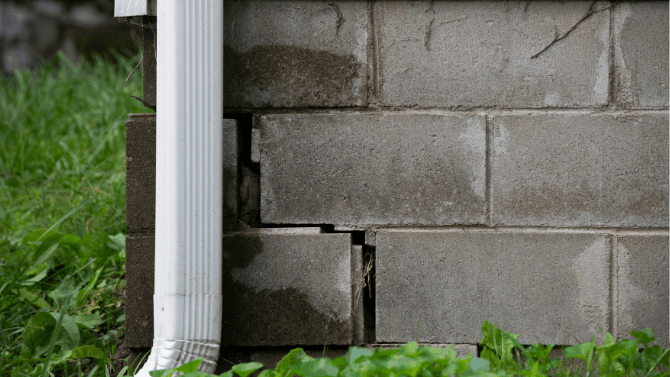
The foundation of your home may not be visible, but it is one of the most important aspects of a house, as it supports the weight of everything, including family, friends and furniture. Although newer homes may have a solid foundation, older ones may require some extra tender love and care. Unfortunately, older foundations can suffer from a lack of drainage as well as adequate support from their materials.

Editorial Team
•08 Nov 2023
As the weather gets warmer, many of us jump at the chance to spend our days outdoors taking in the sights and sounds while occasionally working to spruce everything up. As much as we love our outdoor space, the fact of the matter is that it’s not always easy to arrange our land in a beautiful as well as functional way.
Cynthia Pigeon
•02 Jul 2026
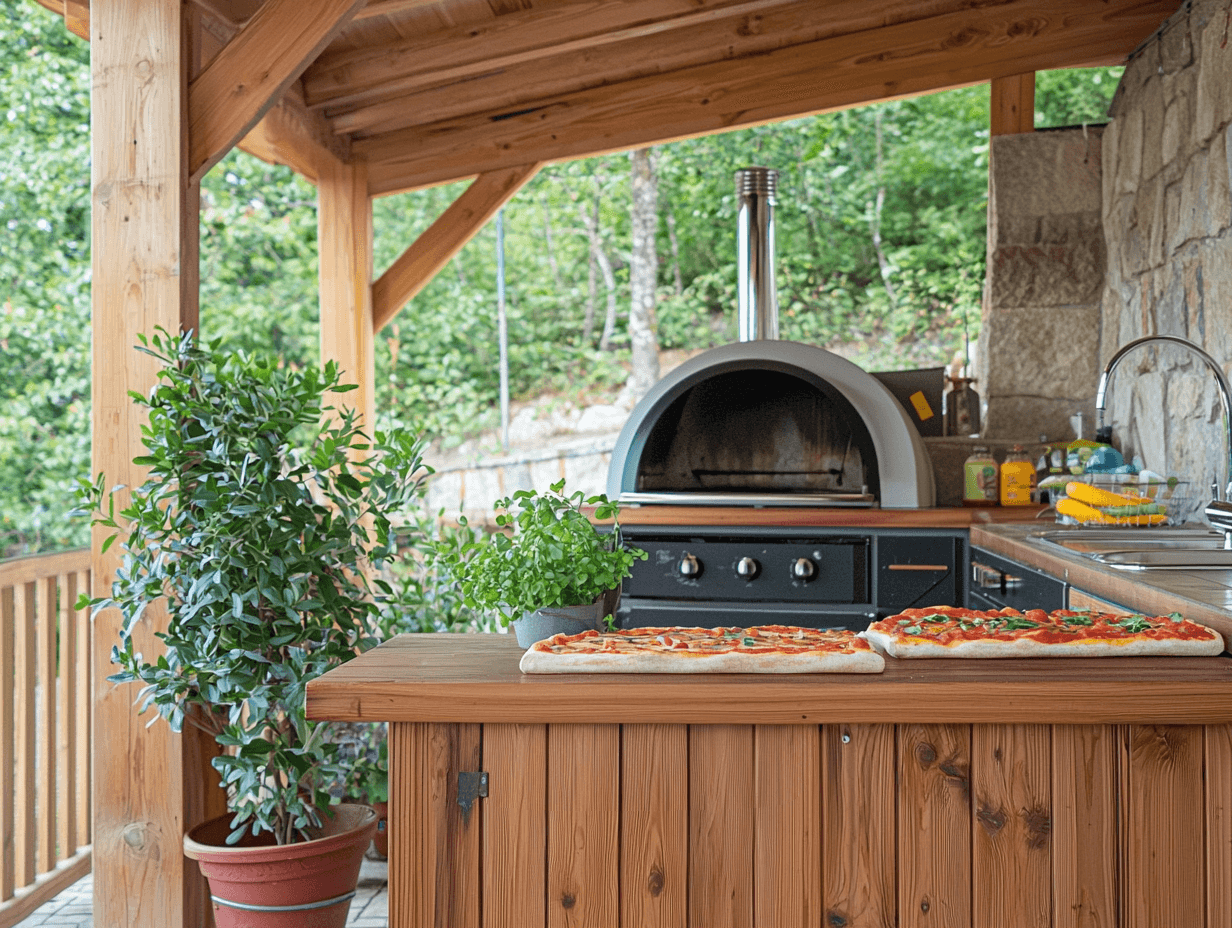
Outdoor living has undergone a spectacular transformation in Quebec. Simple auxiliary grills have given way to true high-end outdoor kitchens, designed as seamless extensions of exceptional properties in Montréal, Westmount, or the natural landscapes of the Laurentians. These outdoor entertaining spaces, which include professional-grade grills, artisanal pizza ovens, and ambient fire features, require an energy infrastructure worthy of their refinement.

Editorial Team
•25 Jul 2025
Between Bricks and Binders is the podcast that bridges the gap between construction entrepreneurs and the business world. In this introduction episode, Frédérique from RenoQuotes and Ronaldo share why this podcast was created and what you can expect from future episodes.
Editorial Team
•26 Feb 2024
The exterior elements of your home have a huge impact on curb appeal and overall attraction. When it comes to your house’s siding, has it been the same colour since you moved in? Over time, many hope to update these exterior surfaces to offer new life to tired, drab or worn-out siding materials.