Sheet Metal Worker: An Important Yet Little-Known Trade
By Cynthia Pigeon
Updated on November 8, 2023
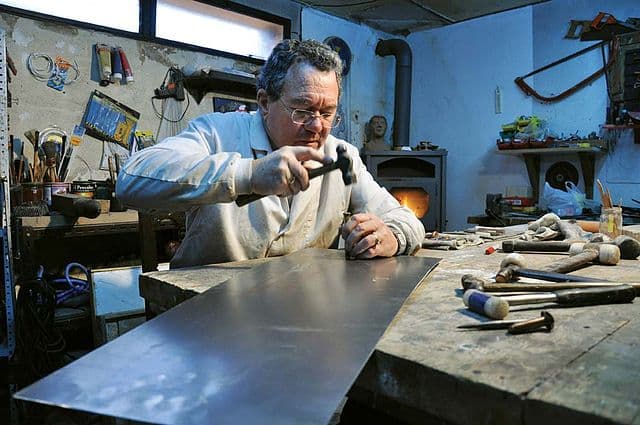
Although the sheet metal trade is largely unknown, it plays an important role in the construction industry and is currently facing a major labour shortage. But what exactly does this little-known trade entail?
Sheet Metal Working in a Nutshell
Generally speaking, a sheet metal worker is someone who cuts and assembles sheet metal (stainless steel, copper, or steel) to create various devices or materials, including exterior siding, metal roofing, ventilation units, heating systems, or gutters. They also ensure that said elements are properly installed.
Once the parts are assembled, they can be welded, folded, or stapled together, as appropriate. Although traditional roof repairs on heritage homes are part of the skill set of a sheet metal worker, few actually practice this type of work.
As stated by the Commission de la construction du Québec (CCQ), "(...) sheet metal workers are actively involved in all four construction trades," i.e. industrial, institutional/commercial, residential, and civil engineering, although 80% of the jobs fall in the institutional/commercial sector.
It's interesting to think of ways to exploit the more artistic dimension of the trade by creating artwork or replicas of such buildings. Whether it be to create a church steeple or a figurative ornament on a building, the possibilities are endless. However, since very few sheet metal workers have the necessary skill set to do so, and those who are interested in this avenue oftentimes opt to travel to Europe to further develop their craft.
Sheet Metal Working: A Fast-Changing Trade
Originally, a sheet metal worker was a tradesperson who made and sold items made of tinplate (steel coated with a type of tin), which could include anything from pots to utensils, or any everyday object.
Although metalwork continues to dominate the trade, the skillset has expanded to include fibreglass manufacturing and slate roofing. Over time, on-site production of items has become less common, as the majority of the work is being performed offsite, in factories. The work done directly on construction sites consists mainly of putting in place previously manufactured metal objects or devices.
Furthermore, products with harmful volatile compounds (VOCs) aren't tolerated quite as much, and neither are oil leaks from the lifting equipment. Moreover, greater care is being taken to insulate and seal walls and ducts. And, over the years, among the changes experienced within the profession, the emergence of new ecological awareness has been a distinctive feature.
Being a Sheet Metal Worker in Quebec
To work as a sheet metal worker in Quebec, you need to obtain a valid license from the RBQ. For work related to the trade, you have to obtain a 7.0 license (for insulation, waterproofing, roofing, and siding contractors).
In France, here’s a website for self-employed craftsmen.
For consumers seeking the services of a sheet metal worker, note that by working with a specialized sheet metal contractor, you can obtain a $20,000 compensation warranty in the event of damage, including incomplete or poorly carried out work.
To know more about the procedure to follow to obtain an RBQ license, check out our article on the matter (French only).

Photo: cersa
Becoming a Sheet Metal Worker
The sheet metal trade is offered through a 1,800-hour apprenticeship in sheet metal work. After successfully completing the course, a minimum of 150 hours of guaranteed employment on a job site for a maximum period of three consecutive months must be submitted to the CCQ to then obtain an apprentice competency certificate.
To obtain the coveted journeyman competency certificate, one must complete three periods of 2,000 hours each (representing an apprenticeship period of approximately three years).
What Does it Take to Be a Good Sheet Metal Worker?
The skills required to perform the numerous duties of a sheet metal worker are as diverse as they are extensive. As with most construction trades, being physically fit is a must. Especially given the fact that carrying heavy objects (such as materials and tools) is a requirement. Also, being comfortable working at great heights is also a prerequisite, with scaffolding and lifting equipment being an integral part of the trade.
Next, it's hard not to mention the importance of having good math skills — knowledge of trigonometry to accurately translate the technical drawings that serve as the theoretical basis for the projects being built. In addition, one must be meticulous and methodical to accurately measure and cut metal sheets. Also, attention to detail is significant in terms of producing an aesthetically pleasing finish.
The ability to understand the precise steps needed to correctly assemble materials and to anticipate what's expected as a final product when reading the specifications is just as necessary.
Obviously, good dexterity is a must when it comes to assembling sheet metal devices, cutting sheet metal, and handling the many tools involved in the day-to-day duties of a sheet metal worker.
For those interested, given that this trade involves considerable turnover, the employment rate for graduates is very high and the cost of training is quite modest at $450 for tuition, materials, and uniforms (if required).
Cover photo: Wikimedia Commons
French by Karine Dutemple
Get 3 quotes for your home renovation project
RenoQuotes.com can help you get quotes for your home renovation project. By submitting your project, we’ll put you in contact with top-rated contractors. Fill in the form on the homepage (it only takes a few minutes), and you will get estimates from trusted professionals.
Dial 1-844 828-1588 to speak with one of our customer service representatives.
Looking for something else?
Related articles
The latest industry news, interviews, technologies, and resources.
Editorial Team
•20 Jun 2024
Carpenter-joiners are as important as ever on construction sites, given that building and erecting wood-made structures are, to this day, an integral part of all new construction projects, whether for commercial or residential projects. If this trade has piqued your interest, you no doubt want to know more about it! Keep reading to learn everything that could be of interest about becoming a carpenter-joiner in Canada.

Editorial Team
•03 Jul 2026
The HVAC (Heating, Ventilation, and Air Conditioning) industry is a vital sector in Ontario, catering to residential, commercial, and industrial needs. HVAC technicians play a crucial role in ensuring comfort and safety by maintaining, installing, and repairing heating and cooling systems. This article serves as a comprehensive guide to becoming an HVAC technician in Ontario, outlining the educational pathways, certification requirements, and career opportunities.

Editorial Team
•08 Nov 2023
Quartz countertops are popular for kitchen remodelling projects, valued as much for their durability as they are for the pattern and colour variations in which they’re available.

Editorial Team
•16 Oct 2026
For many homeowners, finding a reliable contractor is one of the most important steps in a renovation project. It can be tempting to choose the first contractor available, but taking the time to compare several options can lessen the risk of unpleasant surprises.

Amanda Harvey
•03 Nov 2025
It has become common to preserve and experiment with concrete surfaces both inside and outside of the home. Modern homeowners are exploring the possibilities of painting concrete, offering an alternative to its more commonly known drab shades of grey.