Tankless Water Heater Cost in Canada: What to Budget in 2026
By Editorial Team
Updated on September 29, 2026
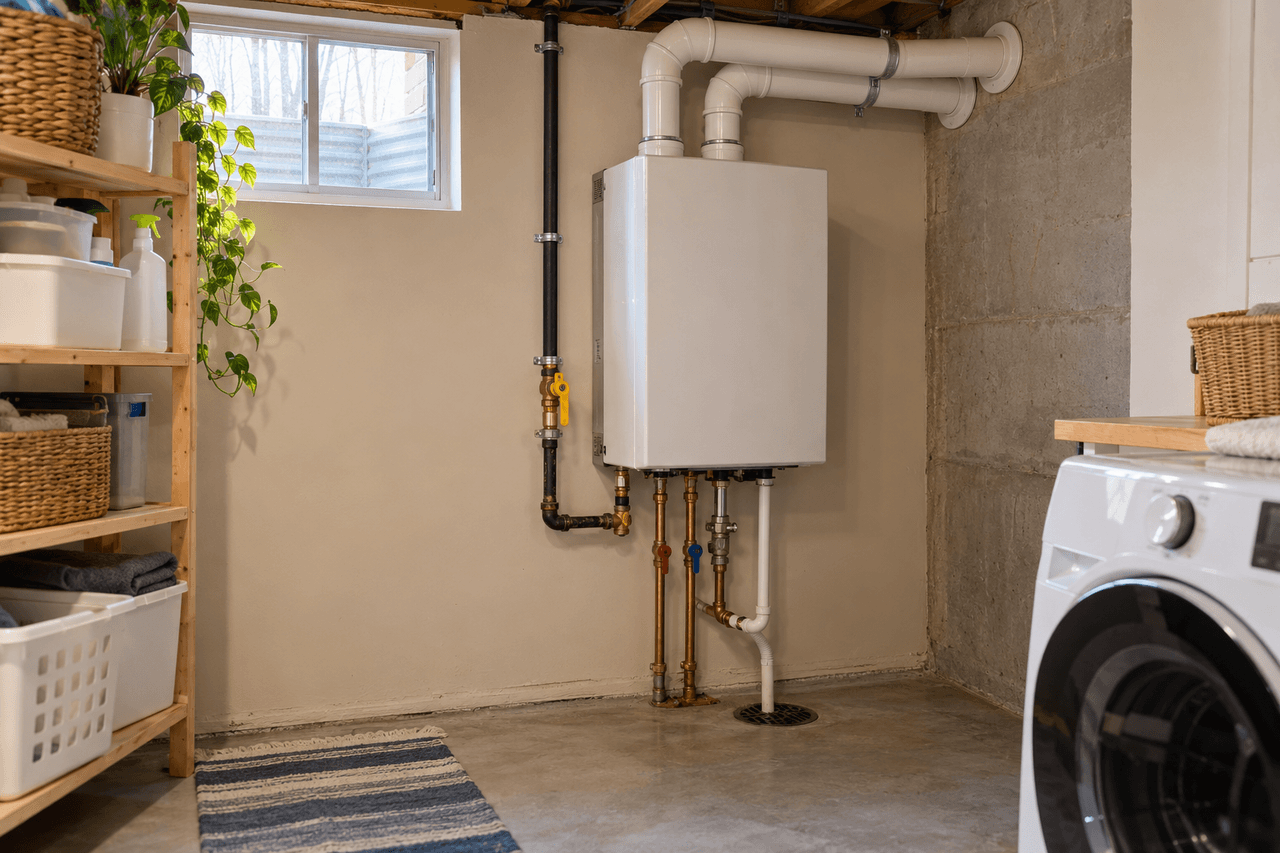
A tankless water heater heats water only when you turn on a tap, which means no storage tank sitting in the basement losing heat around the clock. The appeal is obvious. The price is where most homeowners get surprised, because the unit itself is often the smaller half of the bill.
Installed, a tankless water heater costs $1,800 to $5,900 in Canada. Electric models sit at the bottom of that range and condensing gas units at the top, with the average Canadian installation landing near $3,000. This guide breaks down where that money goes, what pushes a quote higher, and how the numbers compare against a conventional tank over the fifteen to twenty years you'll own it.
What a Tankless Water Heater Costs in Canada

Source: Reno Quotes
Installed Price by Fuel Type
System type | Unit only | Installed total |
Electric tankless | $600 to $2,000 | $1,800 to $3,000 |
Gas tankless, non-condensing | $1,200 to $2,500 | $2,500 to $4,000 |
Gas tankless, condensing | $1,800 to $3,500 | $3,000 to $5,000 |
Premium condensing with recirculation | $3,500 to $5,000 | $4,500 to $6,000 |
The Canadian average across all types comes in around $2,980 installed. In Ontario, quotes typically run $2,800 to $5,500 fully installed, and British Columbia sits slightly higher for comparable condensing units.
For a concrete example: a three-bathroom home replacing a gas storage tank with a condensing Navien or Rinnai unit, where the existing gas line and venting both need work, lands around $4,200 to $5,500 all in.
Where the Money Actually Goes
Labour is the line item people underestimate. Professional installation runs $1,000 to $3,000 depending on complexity, which on a mid-range job is roughly 40% of the total.
Cost component | Typical range |
The unit | $600 to $5,000 |
Installation labour | $1,000 to $3,000 |
Venting materials and routing | $300 to $1,200 |
Gas line upgrade | $500 to $1,500 |
Electrical panel upgrade | $1,500 to $4,000 |
Permits and inspection | $100 to $500 |
Isolation valve kit | $150 to $300 |
Inline scale filter | $200 to $700 |
Permit fees average about $180 across most GTA municipalities. Gas and electrical work trigger permit requirements in nearly every Canadian city, so treat this as a cost you will have rather than one you might.
Factors That Affect the Price
Fuel source is the single largest variable: An electric unit avoids venting and gas line work entirely, which is why it can come in $1,500 lower installed even though the appliance itself performs a similar job.
Household demand and capacity: A unit sized for one bathroom costs far less than one feeding three bathrooms and a laundry room simultaneously. Higher flow rates require larger burners, which in turn require more gas supply and bigger venting.
Venting type and configuration: Condensing units vent through 2-inch ULC S636 certified plastic piping, such as System 636 PVC or CPVC, which is relatively inexpensive and flexible to route. Non-condensing units need stainless steel category III venting, which costs considerably more per foot. Older homes with metal flue pipes usually cannot reuse them for a modern condensing unit.
Existing gas line capacity: Supply lines sized for a storage tank are frequently too small for the higher BTU demand of a tankless heater. This is the most common source of surprise charges on gas installations.
Electrical panel capacity: A whole-home electric tankless unit draws a substantial dedicated high-amperage circuit. If your panel cannot support it, an upgrade adds $1,500 to $4,000 and turns a simple swap into a much larger project.
Home age and accessibility: Finished basement walls, limited ceiling clearance, and complex vent routing all add labour hours regardless of which system you choose.
Water hardness: Hard water causes mineral buildup inside the heat exchanger. In hard water regions, budget for a scale filter at installation rather than discovering the problem through reduced flow three years later.
Brand, features, and efficiency rating: Digital temperature control, built-in recirculation, and higher UEF ratings each add to the unit price.
Gas vs. Electric Tankless Water Heaters
Source: Reno Quotes
Gas Tankless
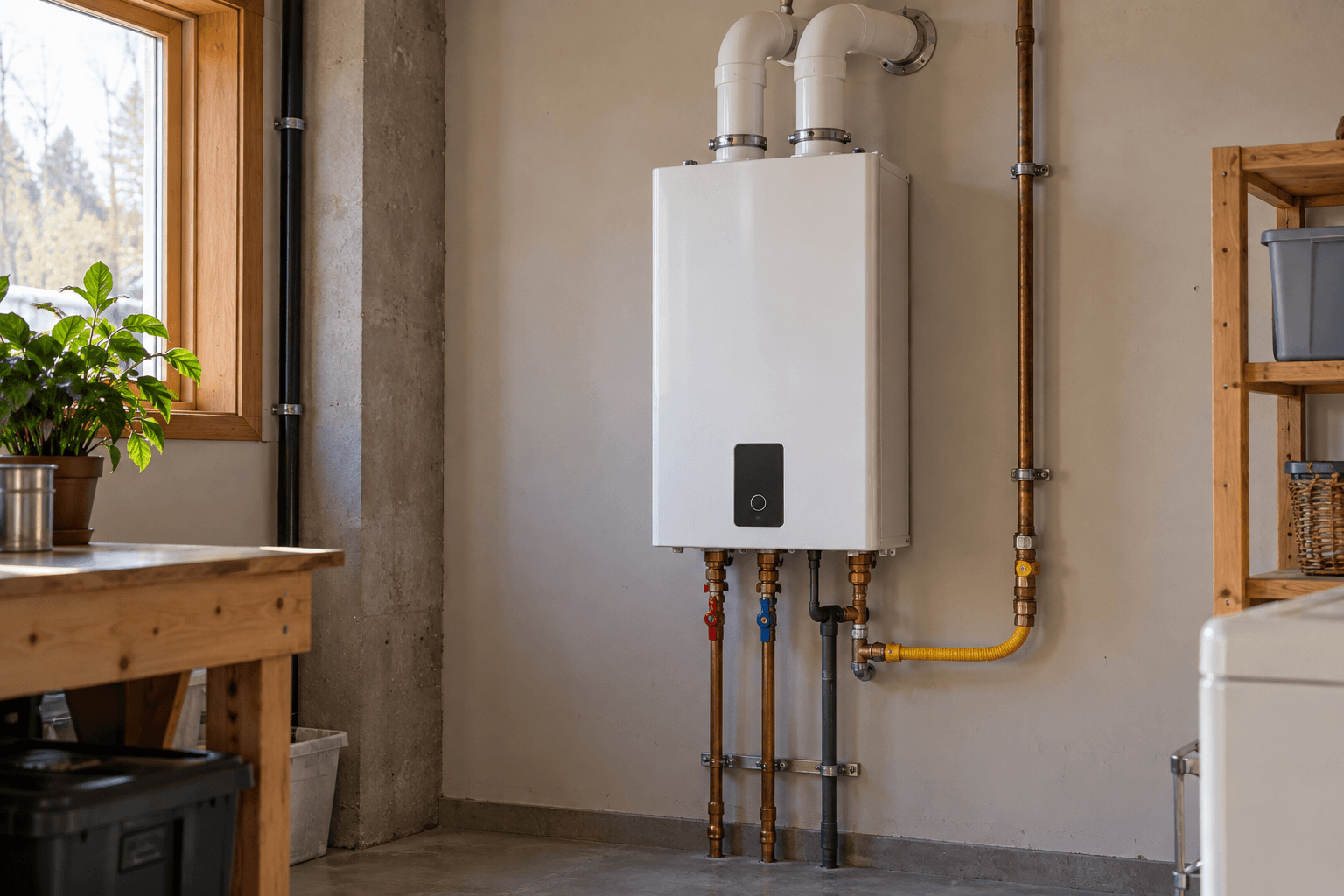
A gas burner heats water as it passes through the exchanger, and gas models handle whole-home hot water demand comfortably even in Canadian winters where incoming groundwater sits near freezing.
The trade-off is installation complexity. Gas units need venting, adequate gas supply, and in Ontario a TSSA-licensed technician to perform the gas work. Expect $2,500 to $5,000 installed.
Gas makes sense when you already have a gas line, when your household is three or more people, and when running out of hot water genuinely bothers you.
Electric Tankless
An electric element does the heating, which eliminates venting entirely and simplifies installation considerably. Electric tankless water heaters reach efficiency levels up to 98%, higher than any gas model.
The constraint is electrical capacity, and Canadian winters make it severe. Heating incoming 4°C groundwater to 49°C for a standard 3 GPM shower requires roughly 27 kW to 36 kW, which draws 120A to 150A on its own. That typically means a 200A or 300A main panel upgrade at $1,500 to $4,000 or more, and many older Canadian homes cannot accommodate it at all.
For that reason, whole-home electric tankless units are rarely practical in cold Canadian climates. They remain an excellent choice for single-point applications such as a garage sink, a basement bathroom addition, or a condo where gas isn't an option. Some homes install several small electric units near the fixtures that need them rather than one central heater.
Comparing the Two
Gas tankless | Electric tankless | |
Installed cost | $2,500 to $5,000 | $1,800 to $3,000 |
Efficiency | Up to 0.96 UEF | Up to 98% |
Venting required | Yes | No |
Whole-home capable | Yes | Rarely, in cold climates |
Operating cost | Depends on gas rates | Depends on electricity rates |
Cold climate performance | Strong | Weak at very low inlet temperatures |
Which costs less to run depends entirely on your provincial energy rates. Quebec's low electricity prices change the calculation substantially compared to Ontario or Alberta, though the amperage constraint applies everywhere in Canada.
Condensing vs. Non-Condensing Models
This distinction affects both price and long-term operating cost, and it's worth understanding before comparing quotes.
Non-condensing models vent hot exhaust gases outside through stainless steel venting. They carry a lower upfront cost but waste the heat leaving through the flue, and the venting material itself is expensive.
Condensing tankless water heaters capture that escaping heat using dual stainless steel heat exchangers, extracting energy from the exhaust before it exits. The result is 96% or better efficiency and compatibility with ULC S636 certified venting rather than costly stainless steel.
The higher upfront cost of a condensing unit typically pays back through lower gas bills within a few years, particularly in households with high daily hot water use. For most Canadian homes on gas, condensing is the better purchase.
The Cold Water Sandwich
Both types share a quirk worth knowing about. When you turn off a tap briefly and turn it back on, you get a short burst of cold water before the burner catches up. This is the cold water sandwich effect, and it's most noticeable when showering in a home where someone just used another fixture.
A recirculation setup eliminates it by keeping hot water moving through the lines, though it adds to both the unit price and the installation.
Sizing and Flow Rate
Source: Reno Quotes
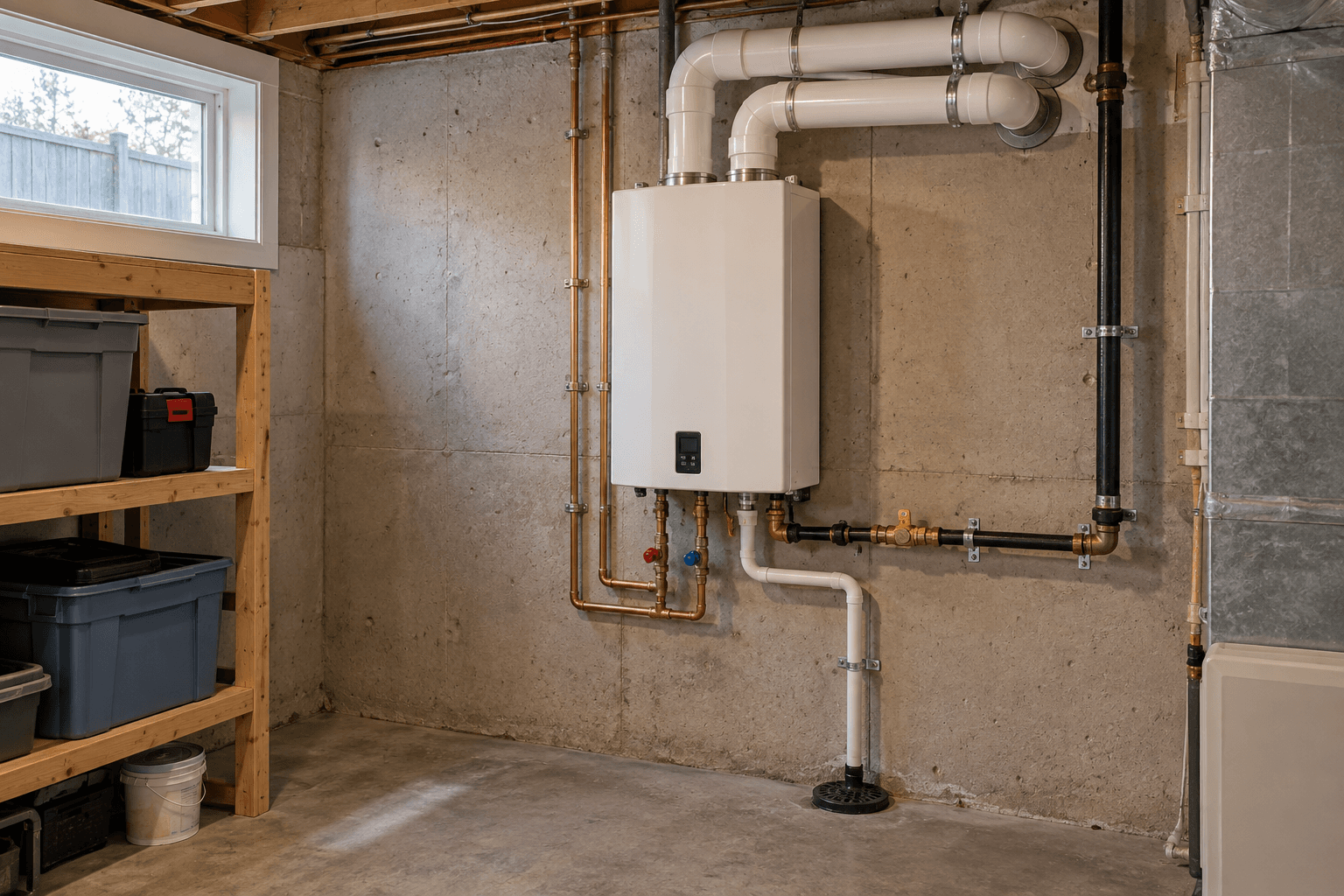
Getting the size right determines whether the system satisfies your household or frustrates it daily.
Tankless units are rated in gallons per minute (GPM), which measures how much hot water they can deliver continuously. The right rating depends on two things: how many fixtures might run at once, and how cold your incoming water is.
Temperature rise is what makes Canadian sizing different. Groundwater entering a home in January sits around 4°C in much of the country, and getting that to a usable 49°C means a 45-degree rise. A unit rated at 7 GPM in a mild climate might deliver only 4 GPM here.
Household size | Typical simultaneous use | Recommended GPM |
1 to 2 people, one bathroom | Shower and sink | 4 to 6 |
3 to 4 people, two bathrooms | Shower, sink, dishwasher | 6 to 8 |
5+ people, three bathrooms | Two showers plus laundry | 8 to 11 |
Manufacturer sizing calculators give a reasonable starting point, but they typically assume warmer inlet temperatures than Canadian reality. A professional plumber sizing the unit against your actual peak water usage demand and local groundwater temperature is what prevents an undersized purchase.
Undersizing is the more common mistake, and it produces exactly the complaint tankless heaters are known for: inconsistent temperatures when two fixtures run together.
Pros and Cons of Going Tankless
The advantages:
Continuous hot water supply. On-demand heating means you don't run out mid-shower, which is the single most cited reason homeowners switch.
No standby energy loss. A storage tank reheats water all day whether you use it or not. Eliminating that saves 20% to 30% on water heating for a gas condensing unit.
Space savings. A wall-mounted unit frees the floor space a 40 or 60-gallon tank occupied.
Longer lifespan. 15 to 20 years against 8 to 12 for a storage tank.
No tank to fail. A water heater leak from a ruptured tank can flood a finished basement. Tankless units have no reservoir to rupture.
The drawbacks:
Higher installation cost, often double a like-for-like tank replacement.
Delay in hot water at the tap, since the unit has to fire before delivering.
The cold water sandwich effect during intermittent use.
No hot water during a power outage, even on gas models, because the ignition and controls need electricity.
Maintenance is not optional. Annual descaling is required in most Canadian water conditions.
The honest arithmetic on savings: a gas tankless unit cuts water heating gas use by roughly 27% to 35%, which for an Ontario household of four works out to about $59 to $76 per year. That's real, but paid annual descaling can cost more than the saving. The stronger case for tankless is endless hot water and a longer service life, not the utility bill.
Lifespan, Maintenance, and Operating Costs
A tankless water heater lasts 15 to 20 years with proper maintenance, roughly double a storage tank heater. Many manufacturers back the heat exchanger with a 12 to 15-year warranty, and replacement parts remain available far longer than for tank models.
That lifespan is conditional. The main threat is mineral buildup inside the heat exchanger, which restricts flow, reduces efficiency, and eventually causes error codes and shutdowns.
System flushing, also called descaling, is the maintenance that matters. Plan on annual service in hard water areas and every two years in softer water, at $150 to $300 professionally. An isolation valve kit installed with the unit makes this straightforward; without one, the plumber has to cut into the lines.
In hard water regions, an inline scale filter costs $200 to $700 to add at installation and meaningfully reduces how often descaling is needed. If your area has hard water, this is money well spent at install time rather than a retrofit later.
Top Brands and Models
Four manufacturers cover roughly 85% of Canadian tankless installations. Pricing is similar within each performance tier, so the decision usually comes down to local parts availability, warranty terms, and whether technicians in your area know the brand.
Rinnai
The proven default across most of Canada, with the widest service network and the best parts availability of any brand. If something fails on a Sunday, a Rinnai is the unit most likely to have a technician and a part nearby.
The V series covers straightforward residential needs and sits at the value end of the gas tankless water heaters category. The RU series moves into condensing gas tankless water heaters with higher efficiency and ULC S636 certified venting.
Navien
The efficiency leader. The NPE series reaches a 0.96 UEF efficiency rating using dual stainless steel heat exchangers, and offers ULC S636 certified venting compatibility that keeps installation material costs down.
Navien is the choice when lowering gas bills is the priority, and several models include built-in recirculation, which addresses the delay at the tap without a separate pump.
Noritz
Strong on flow rate, which makes Noritz the pick for larger families and homes where two showers plus laundry might run simultaneously. Their higher-capacity models handle the peak demand that causes undersized units to falter.
Rheem and Bosch
The value tier. Both offer reliable whole-home hot water heaters at lower price points, with Rheem more common in gas and Bosch particularly suited to small homes, condos, and single-point use applications.
Bosch's compact electric units work well for a garage sink or a basement bathroom where running gas isn't practical.
John Wood
A familiar Canadian name in water heating, better known for higher capacity tanks than for tankless. John Wood tankless water heaters exist and are serviced across Canada, though the lineup is narrower than the specialists above.
Worth considering if your existing equipment is John Wood and your technician already knows the brand.
Comparing the Field
Brand | Unit price | Strongest at | Best suited to |
Bosch | $600 to $1,800 | Compact sizing | Condos, single-point use |
Rheem | $900 to $2,200 | Value | Budget-conscious replacements |
Rinnai | $1,200 to $2,800 | Service network, parts availability | Most Canadian homes |
John Wood | $1,200 to $2,500 | Canadian service presence | Existing John Wood households |
Noritz | $1,500 to $3,200 | High flow rate | Large families |
Navien | $1,800 to $3,500 | Efficiency, 0.96 UEF | Lowering gas bills |
Premium technology such as built-in recirculation and Wi-Fi monitoring pushes the top of each range higher.
What Actually Matters When Choosing
Spec sheets tend to dominate this decision, but three practical considerations matter more.
Local service availability: A unit that nobody within an hour can service is a problem waiting to happen. Ask two or three local licensed water heater technicians which brands they stock parts for.
Cold-climate freeze protection: Canadian winters push standard models past their design limits. Confirm the unit has freeze protection rated for your region, particularly if it mounts on an exterior wall or in an unheated space.
Common parts and warranty terms: Heat exchanger warranties typically run 12 to 15 years and parts warranties one to five. Longer isn't automatically better if replacement water heaters from that brand are hard to source locally.
Upgraded venting is worth pricing during the comparison rather than after. A non-condensing unit that looks $400 cheaper on the shelf can cost more installed once stainless steel category III venting is factored in.
Renting vs. Buying a Tankless Water Heater
Source: Reno Quotes
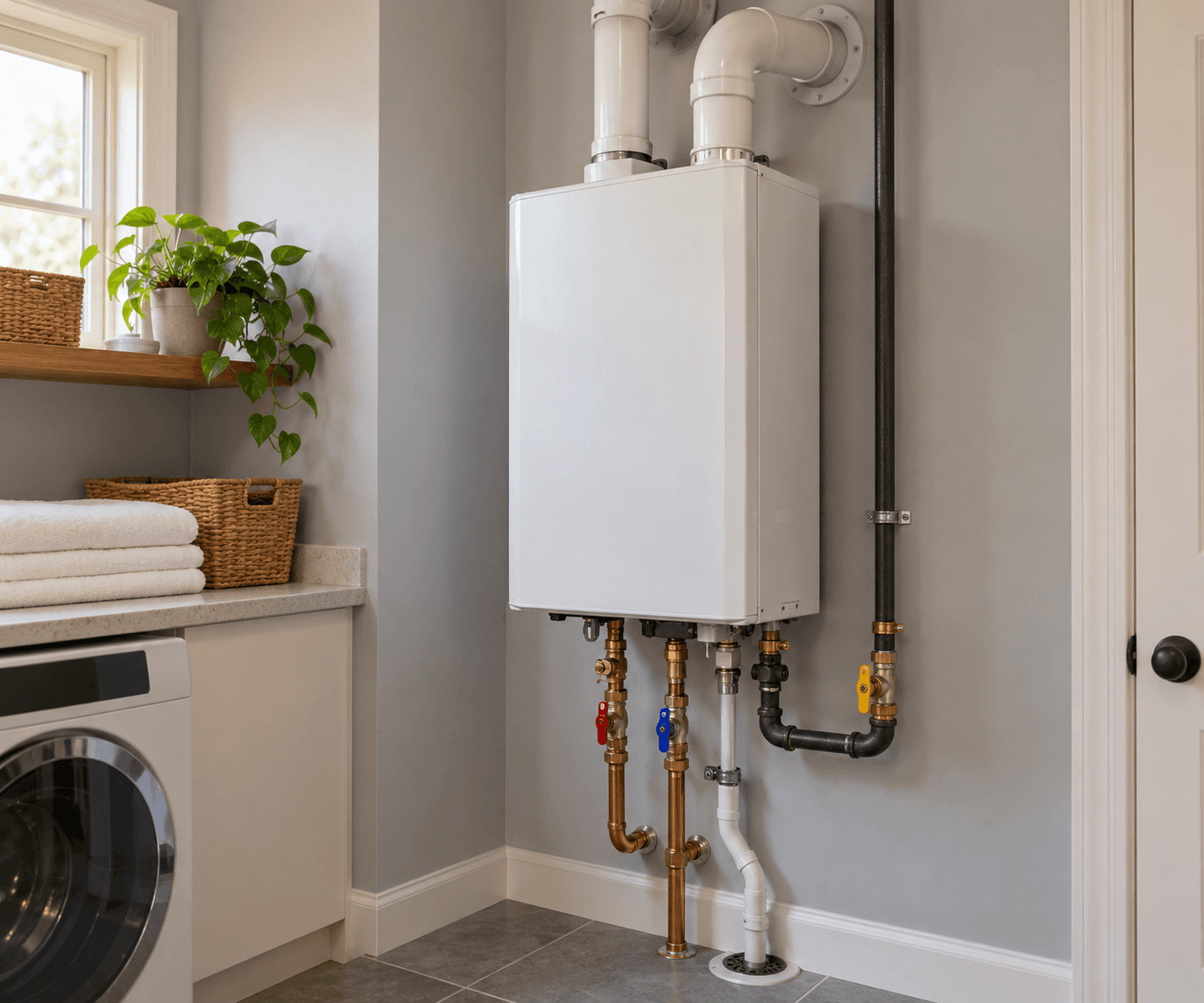
Rental programs are common in Ontario and parts of Atlantic Canada, and the choice affects both your upfront cost and what you pay over the next fifteen years.
What Renting Involves
Renting eliminates the purchase price entirely. You pay monthly payments of roughly $30 to $60 depending on the model and features you select, and the rental company retains ownership of the equipment.
Maintenance coverage is the genuine advantage. Annual descaling, parts, and service calls are included, which means zero repair cost to you for the life of the agreement. On a unit that needs yearly flushing at $150 to $300, that coverage carries real value.
The constraints are worth understanding before signing. Model and features selection is limited to what the rental company stocks, which usually means mid-tier units rather than the premium condensing models described above. You cannot sell the equipment, and you don't build equity in it.
What Buying Involves
Buying means paying the full purchase price, then owning the appliance outright.
You choose freely among gas versus electric options and high efficiency units, including models a rental company wouldn't stock. You control the maintenance schedule and can shop service competitively rather than being tied to one provider. Once the unit is paid for, your only ongoing cost is descaling.
The downside is the upfront cost and full responsibility for repairs once the warranty expires.
The Fifteen-Year Arithmetic
Renting | Buying | |
Upfront cost | $0 | $1,800 to $5,900 |
Monthly payments | $30 to $60 | $0 |
Annual maintenance | Included | $150 to $300 |
15-year total | $5,400 to $10,800 | $4,050 to $10,400 |
Ownership at end | None | Full |
Removal fees on exit | $200 to $500 typical | None |
At $45 per month, a rental costs $8,100 over fifteen years against roughly $4,000 to buy and $3,000 in maintenance for the same unit. The gap narrows on premium equipment, but ownership wins the long-term comparison in nearly every scenario.
Watch the Contract Terms
Removal fees are the clause that catches people out. Ending a rental agreement early frequently triggers a buyout charge calculated on the remaining term, and many contracts bill separately for equipment removal.
This matters most when selling a home. A rental water heater becomes a negotiating point during a sale, since buyers often want the contract terminated rather than assumed, and that termination cost falls to the seller.
Ask three questions before signing: what the buyout schedule looks like year by year, whether removal is billed separately, and whether the agreement transfers to a new owner.
Which Makes Sense for You
Renting suits you when a $4,000 outlay isn't feasible right now, when you expect to move within five years, or when you'd rather not manage maintenance at all.
Buying suits you when you're staying put long term, when you want a specific model the rental company doesn't carry, or when you've run the arithmetic and the monthly payments bother you more than the upfront cost does.
Rebates and Incentives
This is where a lot of outdated information circulates, so the current situation is worth stating plainly.
Most Canadian rebate programs now target heat pump water heaters specifically, not conventional tankless units. A heat pump water heater is a tank-style electric appliance, not a tankless one, and it qualifies for funding that tankless models do not.
In Ontario, the Enbridge HER+ rebate of up to $1,000, which many articles still cite for condensing tankless units, closed to new applicants on February 5, 2024, alongside the federal Canada Greener Homes Grant. Homeowners already enrolled had until the end of 2025 to submit claims, but no new applications have been accepted for more than two years.
The active 2026 water heating rebate in Ontario is $500 through the Home Renovation Savings Program, and it applies to heat pump water heaters only.
Other provinces run their own programs through provincial utilities, and municipal incentives occasionally appear. Check your provincial energy utility's current offerings directly rather than relying on a contractor's claim, since these programs change frequently and eligibility requirements are specific.
If rebate eligibility is a priority for you, price a heat pump water heater alongside your tankless quotes. They cost $3,000 to $7,000 installed depending on province, qualify for $500 to $2,000 in rebates in several markets, and run two to three times more efficiently than gas tankless. They do need a warm ambient space above roughly 10°C, 240V service, and a condensate drain, so they don't suit every home.
Is a tankless water heater worth it?
For most Canadian households, a tankless water heater costs $1,800 to $5,900 installed, with condensing gas units at $3,000 to $5,000 covering the majority of whole-home installations. The unit is rarely the expensive part; venting, gas line capacity, and electrical work decide where in that range you land.
The financial case rests on lifespan rather than utility savings. Fifteen to twenty years against eight to twelve for a tank means you skip a replacement cycle, and that matters more than the $60 to $76 a year the efficiency gain actually returns. If your household runs out of hot water regularly, if you're staying put for more than five or six years, and if you'll commit to annual descaling, the numbers work. If you rarely exhaust a tank and you heat water with electricity, a heat pump water heater deserves a look first.
Frequently Asked Questions
How much does a tankless water heater cost installed in Canada?
$1,800 to $5,900 depending on fuel type and site conditions, with the Canadian average around $2,980. Electric units run $1,800 to $3,000 installed and condensing gas units $3,000 to $5,000.
How long does a tankless water heater last?
15 to 20 years with annual descaling, compared to 8 to 12 years for a storage tank. Skipping maintenance in hard water areas can cut that significantly.
Do tankless water heaters really save money?
On gas, roughly 27% to 35% of water heating gas use, or about $59 to $76 annually for an Ontario household of four. Annual descaling can offset much of that, so the stronger argument is the longer lifespan and endless hot water rather than the utility bill.
Is there a rebate for tankless water heaters in 2026?
Not for conventional tankless units in most of Canada. The Enbridge HER+ rebate closed to new applicants in February 2024, and Ontario's current $500 water heating rebate applies to heat pump water heaters only. Check your provincial utility for local programs.
Can an electric tankless water heater heat a whole house in Canada?
Rarely. Heating 4°C winter groundwater to a usable temperature at 3 GPM requires 27 kW to 36 kW, drawing 120A to 150A on a dedicated circuit. Most Canadian homes would need a 200A or 300A panel upgrade to support it. Electric tankless works well for single fixtures, not whole homes.
What size tankless water heater do I need?
4 to 6 GPM for one or two people with a single bathroom, 6 to 8 GPM for a family of three or four with two bathrooms, and 8 to 11 GPM for larger households. Canadian groundwater temperatures require a larger unit than US sizing charts suggest.
Is it better to rent or buy a tankless water heater?
Buying costs less over a fifteen-year lifespan, roughly $7,000 against $8,100 for a typical rental at $45 monthly. Renting makes sense when the upfront cost isn't feasible, when you may move within five years, or when you'd rather not manage maintenance.
Which tankless water heater brand is best in Canada?
Rinnai has the widest service network, Navien the best efficiency at 0.96 UEF, and Noritz the strongest flow rates for large households. Local parts availability matters more than the spec sheet, so ask which brands your area's technicians actually service.
Can I install a tankless water heater myself?
No. Gas work requires a licensed technician in every province, and in Ontario specifically a TSSA licence. Electric units need a licensed electrician for the dedicated circuit. Both trigger permit and inspection requirements.
What is the cold water sandwich effect?
A brief burst of cold water when you turn a tap off and back on shortly after, caused by the unit needing a moment to fire. A recirculation setup eliminates it at additional cost.
Do tankless water heaters work during a power outage?
No, including gas models. The ignition system, controls, and fan all require electricity, so hot water stops when the power does.
Looking for something else?
Related articles
The latest industry news, interviews, technologies, and resources.
Cynthia Pigeon
•08 May 2026
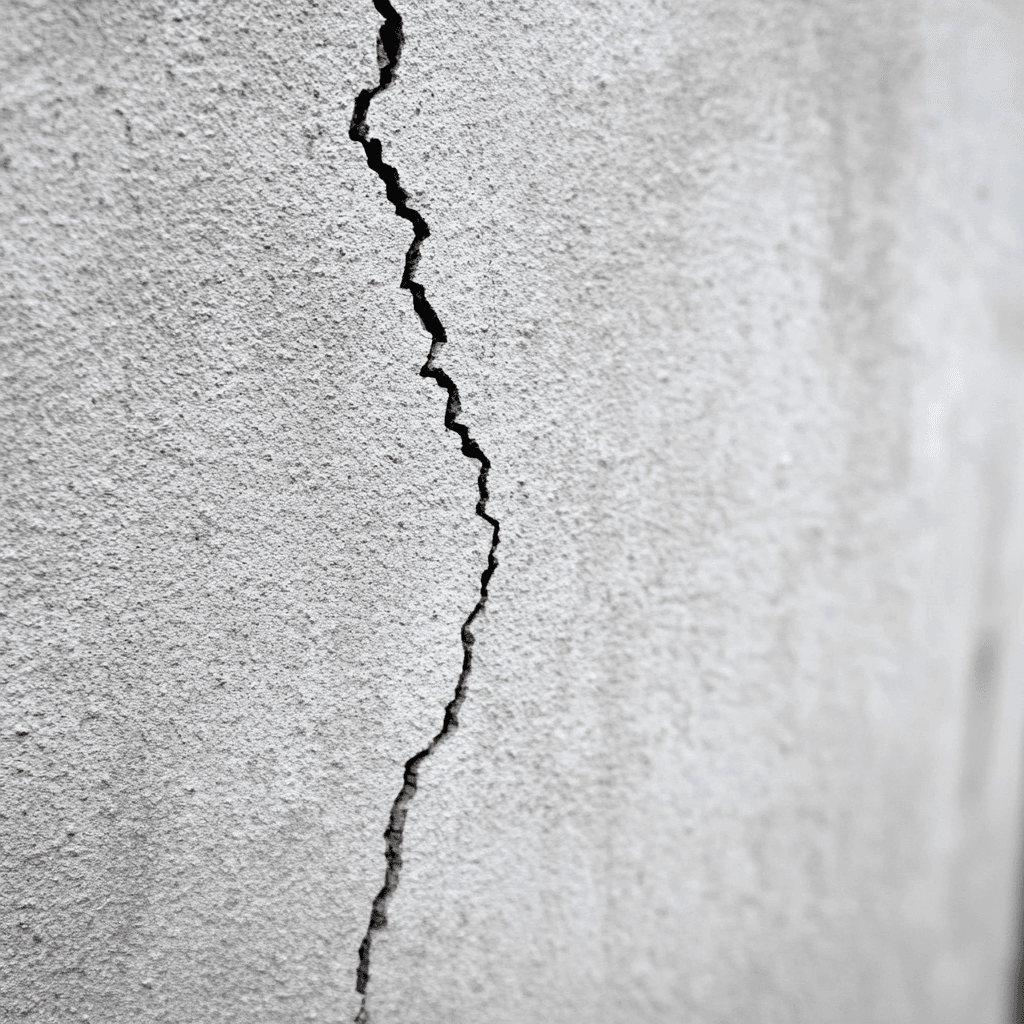
In Canada, the cost to repair a foundation crack generally ranges from $500 to $1,500 for an interior polyurethane or epoxy injection. If the situation requires exterior work, including excavation and waterproofing membrane installation, the cost is usually closer to $3,000 to $5,500 per crack. Prices vary depending on the depth and severity of the crack, site accessibility, soil conditions, and how urgent the repair is before freeze-thaw cycles worsen the damage.
Cynthia Pigeon
•11 Jun 2026
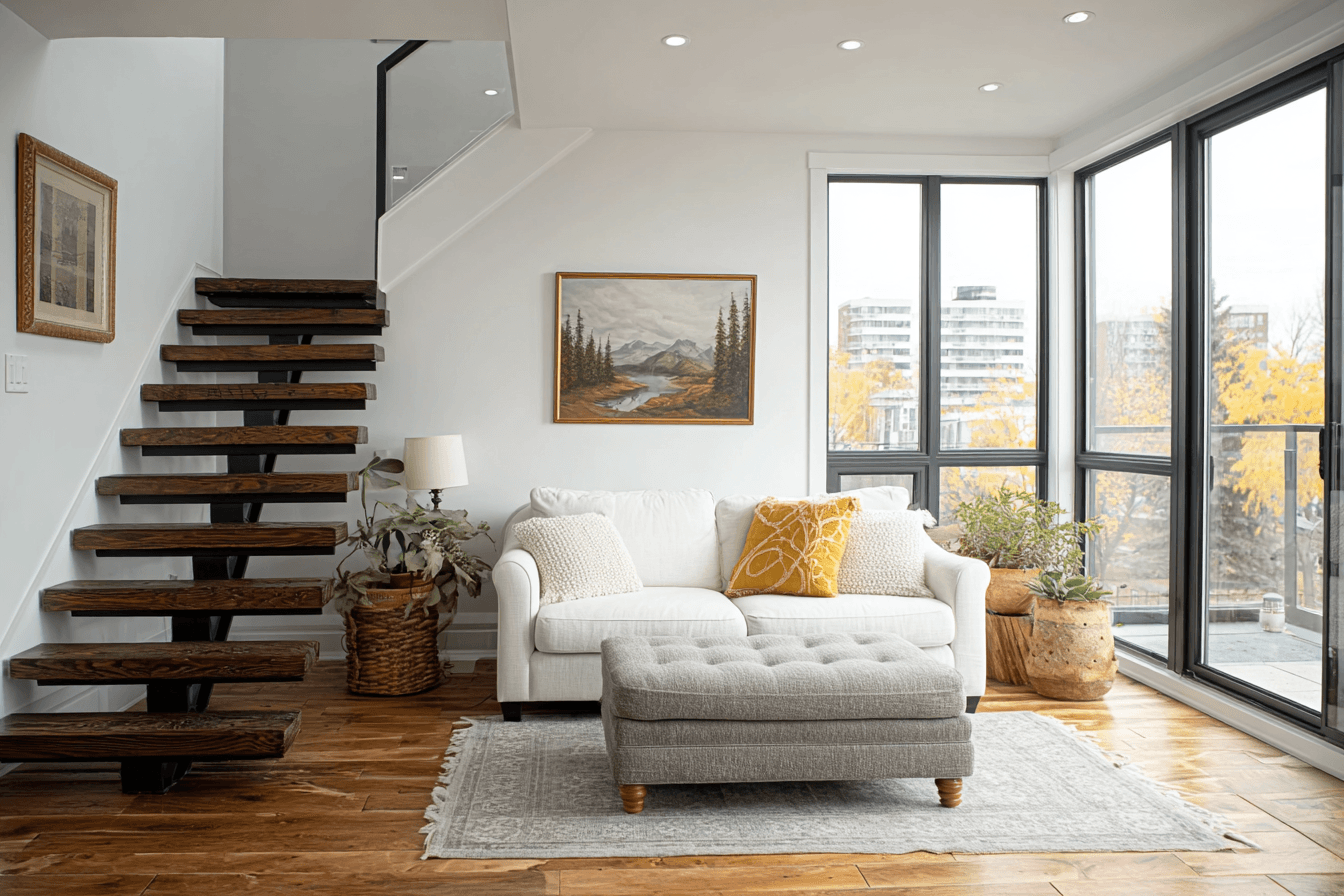
A central element of a home’s architecture, the staircase is more than just a functional link between two floors. It is a key feature of your interior design and can add considerable value to your property. When it comes to choosing a durable, warm, and timeless material, hardwood remains a top choice for Quebec homeowners.

Editorial Team
•25 Jun 2025
Tearing down walls in your home can seem like an exciting project, especially with the current trend in interior design favouring open-concept spaces. However, don’t grab your hammer and saw just yet! Removing or creating openings in an interior wall is a delicate process that must be handled with care. If done incorrectly, it can lead to ceiling collapse or damage to plumbing, electrical, HVAC systems, and more.

Editorial Team
•14 May 2026
While artesian wells are often the preferred choice for a cottage’s water supply, they have a slew of noteworthy yet overlooked features.

Editorial Team
•08 Nov 2023
Buying a house is probably the single most important financial investment of a lifetime. Therefore, a future homeowner should be assured of paying a fair price for their new property and avoid being confronted with unforeseen work and the costs that come with it.