Heat Pump Installation Cost in Canada: A 2026 Price Guide
By Editorial Team
Updated on August 25, 2026

Most Canadian homeowners pay between $2,000 and $15,000 to have a heat pump supplied and installed in 2026, depending on the type of system their home can accept. Investing in purchasing and installing a heat pump is a wise decision. Given Canada's ever-changing temperatures, consolidating both heating and air conditioning systems into one unit is not a bad idea, resulting in savings of nearly 20% off your usual utility bill.
If used and maintained properly, a heat pump should be an energy-efficient choice with an average durability of 10 to 20 years. However, the question remains: How much should you invest in such a project, and what does the installation process entail?
What is the typical cost of a heat pump system in Canada?
System | Cost including installation |
Console heat pump | Around $2,000 |
Wall-mounted heat pump | $2,000 to $9,000 |
Multi-zone heat pump | $4,500 to $15,000 |
Central heat pump | $8,000 to $15,000 |
Installation labour portion | $1,000 to $2,000 |
Affordable Option: How much does a wall-mounted heat pump cost?
In terms of the cheapest options, monobloc, mini-split, or bi-bloc wall units consume little energy and are convenient in homes, condos, or apartments devoid of ventilation ducts. Its central system can be split between several separate wall-mounted units for better temperature control depending on the lived-in areas. Due to the small amount of installation work in regards to this type of unit, as it doesn't require ventilation ducts, its price point is much more affordable compared to the following option.
Including installation, prices range from $2,000 to $9,000. For many homeowners comparing the average heat pump cost in Canada, wall-mounted systems are often a practical starting point because the heat pump install cost is usually lower than for ducted systems.
Affordable Option: How much does a console heat pump cost?
This model is floor-level and is a viable alternative to radiators and fireplaces. However, there must be sufficient space surrounding the unit and clear of any furniture within its vicinity to avoid hindering the air exchanger.
Such a unit costs roughly $2,000, making it one of the lower-priced options for homeowners asking how much a heat pump costs for a smaller space or trying to estimate the price for a heat pump before requesting quotes.
Standard-Priced Residential Product: How much does a multi-zone heat pump cost?
This is the best solution if your home doesn't have any ventilation ducts and the overall square footage is too much for a wall-mounted system, as four units can be installed.
Its cost, including installation, ranges from $4,500 to $15,000. The final residential heat pump cost will depend on the number of indoor units, installation complexity, and overall home heat pump cost.
High-End Option: How much does a central heat pump cost?
This is probably the most expensive and discreet option in terms of noise and aesthetics. The carrier or central heat pump diffuses both cool and warm air by way of centralized ventilation ducts toward all areas of a home. Therefore, as long as the ventilation ducts allow for it, a single unit is required to sustain an entire house. This efficient and high-performing system can provide three times as much energy as it requires.
However, in case of a leak or air duct damage, the repairs will be costly, and so will spending money on wasted energy should the repairs not be done in time. A well-maintained unit will perform more efficiently; it's better to hire skilled HVAC contractors.
Including installation, prices range from $8,000 to $15,000, which explains why the central heat pump cost is usually higher than the cost of wall-mounted or console models. In homes with existing ductwork, however, the cost of installing a heat pump may be easier to justify if the system can heat and cool the entire house.
Factors Affecting the Cost
Source: Canva
Installation
Heat pump installation is a key factor to consider when gauging overall costs. On top of the unit's cost in and of itself, installation fees can vary based on the complexity of the job, the unit's size, and home-specific needs. Also, it's important to hire a qualified HVAC contractor to ensure the unit is compliant and effective, which can increase overall costs, yet guarantee optimal yield and the device's longevity.
For this reason, the heat pump installation cost can vary widely from one home to another. The cost to install a heat pump in a small condo will not be the same as the cost to install a heat pump system in a larger detached house.
Type of Heat Pump
The heat pump type will affect costs significantly. For example, wall-mounted units are typically less expensive than central models, with prices ranging from $2,000 to $9,000, whereas central systems can cost up to $15,000. The price differences depend on the units' heating and cooling capacities, tech features, brand, and model. It's essential to choose a model suited to your energy needs to optimize performance and long-term savings.
This is why homeowners comparing the cost of heat pumps in Canada should look beyond the purchase price and consider how each system type fits the home's layout, insulation, and heating needs.
Size and Efficiency
The size of the heat pump is another cost-determining factor to consider. Household units are typically measured in tons, from 2 to 5 tons. To maximize the system's efficiency, it's essential to choose a unit that's suited to your home, size-wise. A too-small unit might not meet your heating or cooling needs, whereas a too-big device will unnecessarily increase costs. Your home's square footage, ceiling heights, window count, and insulation type are all factors that will affect the required heat pump capacity and the overall house heat pump cost.
The average cost of a heat pump can also change depending on efficiency ratings, cold-climate performance, and whether the system is being used as a primary or supplemental heating source.
What are the additional costs and considerations?
Source: Canva
Brand
There's a wide array of brands with a range of products suited to different budgets. Before selecting a brand, it's important to read customer reviews and compare what's available. Doing some research about unit prices, installation fees, and the price of a heat pump can lead to significant savings.
Brand choice can also influence the heat pump average cost, especially when comparing entry-level models with higher-efficiency or cold-climate units.
Supply and Demand
Supply and demand play a significant part in heat pump pricing. Given their increasing popularity and the ongoing supply chain-related challenges, prices fluctuate. Regional differences, specific suppliers, and the period of year can also affect the overall cost.
For example, the heat pump cost in Ontario, heat pump cost in BC, and heat pump cost in Alberta may differ because of local labour rates, available rebates, climate needs, and supplier availability.
Potential Electrical Upgrades
Some homes may need electrical panel upgrades or additional wiring to support the increased power demands of a new heat pump system. This can add to the overall project cost and should be considered when calculating the cost of heat pump installation.
These upgrades are one reason why homeowners asking how much it costs to install a heat pump should request detailed quotes rather than relying only on average price ranges.
Permits and Inspection Fees
Depending on local regulations, you might need to obtain building permits or pay for inspections before and after installation. These administrative costs can vary by region and are often overlooked during initial budgeting.
Permit requirements can affect the final heat pump installation cost in Canada, especially in municipalities where inspections or licensed trade work are required.
How much does it cost to install a heat pump?
Source: Canva
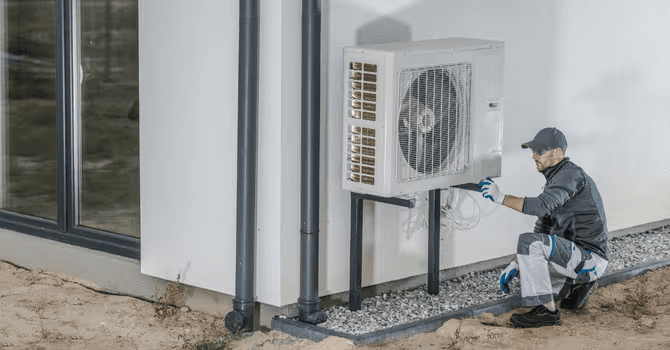
It's about $1,000 to $2,000 to install a heat pump. Without a doubt, there are some cost-determining factors, such as the model, the amount of work needed, and labour costs. Luckily, financial assistance is available, working as an incentive for homeowners to purchase an eco-friendly system that will benefit them and help pay for their new purchase.
In other words, when homeowners ask how much to install a heat pump, the answer depends on the system type, home layout, electrical requirements, and local labour rates. The install heat pump cost can also be higher if ductwork, wiring, or other upgrades are needed.
All heat pumps have model-specific characteristics. Some brands even provide hot water and basic heating and air conditioning features. Before proceeding with your purchase, make sure that the chosen model fits your needs and wants in terms of space, maintenance, noise level, power (BTU), energy efficiency, and coefficient of performance (high HSPF).
Moreover, before undertaking any work, reach out to municipal authorities since there are applicable standards and you may be required to obtain a building permit to install a heating or air conditioning system. Also, the RBQ often requires homeowners to hire certified contractors with valid refrigeration or electrical licences.
Once you know which type of system your home can accept, the remaining question is what it costs on your particular house, and that depends on your ductwork, your electrical capacity, and how much heating load the system actually has to carry. Those are things a contractor determines on site, which is why quotes for the same project routinely differ by thousands of dollars.
Heat Pump Grants and Rebates in 2026
The rebate landscape changed considerably over the past two years, and a great deal of published advice is now out of date.
The Canada Greener Homes Grant is closed to new applications, and the Canada Greener Homes Loan stopped accepting new applicants on October 1, 2025. Homeowners already approved keep their funding, but neither program is available to someone starting a project today. The Oil to Heat Pump Affordability program, which offered oil-heated households an upfront payment of up to $10,000, closed to new applications on July 31, 2026, though some provinces continue equivalent support through provincial co-delivery. In practical terms, the meaningful money in 2026 comes from your province and your utility rather than from Ottawa.
Province | Main 2026 program | Typical heat pump amount |
Quebec | LogisVert, Hydro-Québec | $50 per 1,000 BTU/h at -8°C for ENERGY STAR models, $120 per 1,000 BTU/h for cold-climate models, to roughly $6,700 |
Ontario | Home Renovation Savings Program | $500 per ton for Enbridge gas homes, to $2,000; $1,250 per ton for electric, oil, propane, or wood, to $7,500 |
British Columbia | CleanBC Better Homes and Energy Savings Program | Up to $6,000 standard stream, up to $13,000 income-qualified, plus a BC Hydro top-up to $4,000 |
Alberta | No province-wide program | Municipal rebates of roughly $500 to $1,500 in some cities, plus Clean Energy Improvement Program financing |
Some municipalities add their own support. The Better Homes Ottawa Loan Program, for example, finances heat pumps at a fixed rate of roughly 4.33% over terms up to 20 years, repaid through your property tax bill, with 0% interest for income-qualified households and a heat pump incentive of $700 per ton for cold-climate systems.
For homeowners comparing heat pump Quebec cost or looking up heat pump Montreal price, provincial and utility rebates can make a major difference in the final amount paid out of pocket. Bear in mind that most programs require the equipment to appear on an approved model list and the installer to be registered before you sign the quote. If you'd like to learn more, check out our article "Affordable Heat Pump Financial Aid Programs".
What should you budget for a heat pump?
For most Canadian homes the realistic planning range is $2,000 to $15,000 installed, with a console or single wall-mounted unit at the bottom, a multi-zone system in the middle, and a central ducted system at the top. Which of those your home can accept depends mostly on whether you already have ventilation ducts, and where you land within the range depends on sizing, electrical capacity, and the complexity of the installation itself.
Federal grants are no longer an option for new projects, so the assistance that remains comes from provincial and utility programs, and occasionally from your municipality. Those programs set conditions on equipment and installers, so confirm what you qualify for before you sign anything rather than after.
FAQ
What is the downside to a heat pump?
For most homeowners, the biggest drawback is the high upfront cost. Next in line is installation complexity, followed by increased electricity usage and environmental concerns.
What do SEER2 and HSPF2 ratings mean?
SEER2 measures cooling efficiency and HSPF2 measures heating efficiency, both under the updated testing standards that replaced the older SEER and HSPF ratings. Higher is better in both cases, and most rebate programs set a minimum on one or both.
Do heat pumps really work in Canadian winters?
Yes, modern heat pumps are designed to operate efficiently even in cold Canadian winters. Many models are built specifically for colder climates, ensuring your home stays warm all season.
How long does it take for a heat pump to pay for itself?
Most homeowners find that a heat pump pays for itself in 5 to 10 years, thanks to energy savings and lower monthly utility bills.
Are there rebates or financial assistance for heat pump installation in Canada?
Yes, though the programs have changed. Federal grants have closed to new applicants, so the main sources in 2026 are provincial and utility programs such as Hydro-Québec's LogisVert, Ontario's Home Renovation Savings Program, and CleanBC.
Will a heat pump increase my electricity bill?
While a heat pump may use more electricity, it is much more efficient than traditional heating systems. Most homeowners still see an overall reduction in their energy bills.
Is a heat pump noisy?
Heat pumps are generally quiet, especially newer models. Central systems are known for being particularly discreet, while wall-mounted units may produce a gentle hum. Proper installation also helps minimize noise.
Looking for something else?
Related articles
The latest industry news, interviews, technologies, and resources.
Editorial Team
•22 Apr 2026
Installing a septic system for a chalet in Quebec is rarely a “catalog purchase.” Two homeowners may choose a similar system and pay very different amounts simply because their land, site access, and municipal requirements don’t tell the same story. Before even talking about concrete, polyethylene, or capacity, one thing must be understood: the price depends primarily on the treatment solution your land allows, and what will be required to install it properly.
Editorial Team
•23 Sep 2025
Are you an HVAC contractor in Montreal looking for new contracts? The heating, ventilation, and air conditioning market continues to evolve rapidly in 2025, driven by building modernization, energy efficiency demands, and residential renovations. To stand out, you not only need to provide high-quality services but also know where and how to find the right projects.

Léa Plourde-Archer
•25 Jul 2024
Applying drywall joint compound is an art that requires patience and meticulousness. Contrary to other types of renovation projects, this task is accessible to anyone. However, in order to ensure good results, it is important to follow certain guidelines.
Editorial Team
•01 Dec 2025
It's important to know if your home's electrical installations meet current safety standards, especially if your house is older. Electrical codes are updated regularly to protect homeowners, contractors, and insurers.
Cynthia Pigeon
•09 Jun 2026
In Quebec, maintaining a single-family home, semi-detached house, or condo requires special attention to the building envelope. Given the harshness of our climate, marked by particularly cold winters, humid summers, and constant freeze-thaw cycles, exterior sealing is your first line of defence against the elements. With economic changes and the rising cost of materials observed in 2026, planning renovation work requires clear and transparent pricing data.