Everything You Need to Know About Roof Flashing
By Cynthia Pigeon
Updated on April 21, 2026
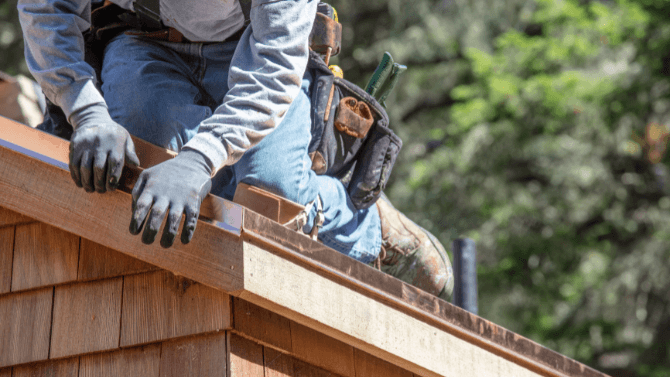
It is no secret that a leaky roof can have severe budgetary repercussions: moisture problems, heat loss, and property damage.
Get Your Project Started Today
Submit your details and receive three free quotes from trusted contractors.
To avoid such problems, avoid neglecting the installation of flashing on your roof.
Roof Flashing: Definition & Purpose

Source: Canva
Roof flashing—whether plastic, aluminum or steel—is a form of moulding that can be found in many different roof areas: in valleys, around plumbing vents, at the base of chimneys or roof vents.
Its purpose is to ensure that the roof is watertight in regard to the above-mentioned sections. Specifically, it allows the water to drain to the gutters and not stagnate on the surface of the roof, thus avoiding any water infiltration.
Furthermore, the seal provided by the flashing also prevents heat loss and therefore, any further expenses added to your heating bill.
While mortar flashings can be made by a seasoned professional, the materials above-mentioned are more durable and the fact that they are premade significantly speeds up their installation.
Installing Roof Flashing
Looking to install your own roof flashings? While it is possible to do so, note that it is a task that presents its share of challenges, including working at heights and having good manual skills in order to adequately perform the installation. So, feel free to call in a professional contractor!
Roof flashing costs vary depending on the material. Lead is the most expensive, ranging from $15 to $35 per square foot. Aluminum is more affordable, typically between $5 and $15 per square foot. Copper is a high-end option, costing between $25 and $55 per square foot. PVC/plastic is the least expensive, ranging from $2 to $10 per square foot.
Maintenance Needed

Source: Canva
Surely you want your flashings to last through the years while still looking good? Make minor repairs as soon as they are needed.
Have you noticed any small holes in your flashing? Do not wait to seal it with a gutter putty, do it right away! Make sure to clean the surface beforehand with a small wire brush.
Need more information regarding new roofing materials? Check out our article Which Roofing Material Will Best Suit Your Needs?
Counter-Flashing
To ensure roof flashing has maximum adhesion to the roofing material, it is equipped with a counter-flashing. There are two types of flashing: external and internal flashing.
External flashing: External flashing or exposed flashing is used to prevent moisture from seeping into the existing structural walls where the roof intersects the wall.
Internal flashing: Internal flashing or concealed flashing collects water that has penetrated any given wall of the building and then drains it out of the wall through drain holes.
Looking for something else?
Related articles
The latest industry news, interviews, technologies, and resources.

Amanda Harvey
•08 Nov 2023
If you’re walking from one room to another and notice a slant in your floor that falls to the left or right, don’t panic. Although feeling a dip or a sag in your floor might initially bring anxiety, don’t get too bent out of shape about it. Chances are an uneven floor is pointing to a deeper problem, yet although there might not be a quick fix or solution, there are still some methods you can take to deal with the issue.

Editorial Team
•16 May 2024
Formerly restricted to commercial, agricultural, and industrial buildings, sheet metal or corrugated metal has, as of late, made its way to the residential sector. On top of having great durability, such roofing material offers a wide range of possibilities in terms of innovative architectural designs. Are you looking to have sheet metal or corrugated metal roofing installed and want more information on the matter? Read on to learn what there’s to know.

Editorial Team
•12 Aug 2025
Whether for the kitchen, the bathroom, or other rooms in the house, ceramic is a material known for its various colours, shapes, and patterns. Typical properties of ceramic material include wear resistance, heat resistance, high hardness, good electrical insulation, and a certain lightness.

Editorial Team
•21 Jun 2024
In general, the living room is a space associated with relaxation, entertainment, and gatherings with friends or family. It's a room that often serves as the central point of the home, so architects will strategically place it.

Editorial Team
•24 Feb 2026
Is bundling up before heading out to work already making you dream of warmer days? Don’t worry—sunny weather is just around the corner.