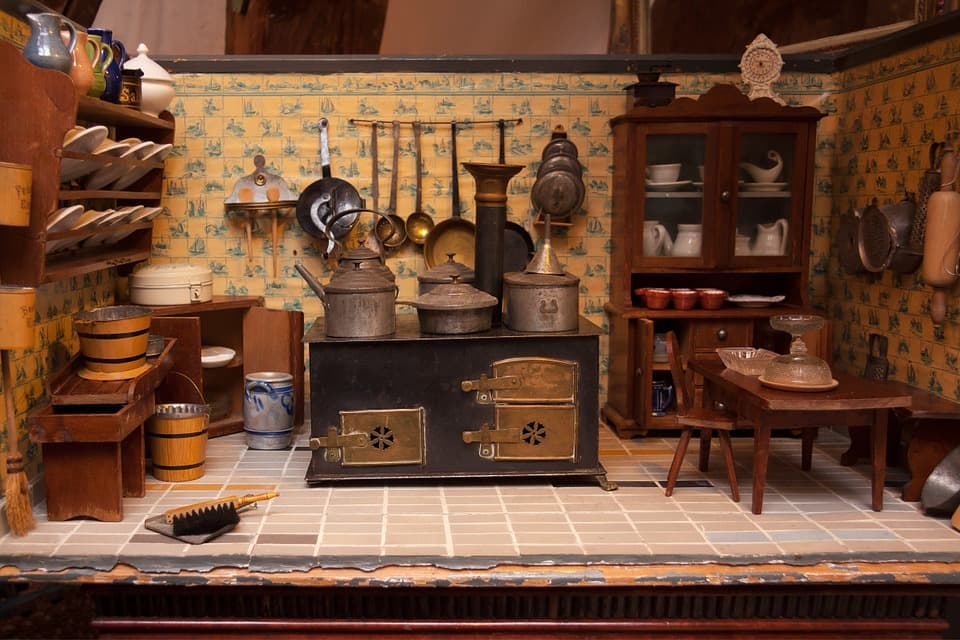
A space for gatherings and lively conversation, the kitchen has always been considered the heart of any dwelling. Since cooking is a time-consuming calling—and for that reason alone—it’s without a doubt why this particular part of a home has witnessed the most amount of change throughout the years.
Get Your Project Started Today
Submit your details and receive three free quotes from trusted contractors.
Whether it be for enhanced ergonomics or to perfect the appliances already in place, how has yesterday’s kitchen evolved into today’s design?
18th and 19th Century Kitchen Designs
18th Century Kitchen: Hearth-Focused

If a home with a chimney is no longer an absolute, it was entirely different at the time. The chimney was the main source of heat one used to avoid the throes of the winter cold, and it was often situated in the middle of the house or toward one of the extremities.
Everything revolved around it, like meals and meal prep. Note that using a traditional fireplace (with a chimney) was really common during that time period, on the other hand, using a freestanding stove was beginning to take traction during the last quarter of the century, although the whole had already been possible for 50 years or so.
Furniture and food preservation
As for furniture, it’s by all means, modest. The whole would often come down to a small cupboard (or pantry), as well as a table and chairs. During this time period, the kitchen also enclosed the main bathroom. As such, there was often a small cabinet where one would store razors, mirrors, and combs.
If the dry food and non-perishables were stored in a pantry (typically vented), one obviously had to come up with an alternative to preserve meat.
The latter was stored in a large artisanal cooler (or icebox), within which were placed huge chunks of ice. The walls of the cooler were insulated with sawdust to maintain its internal temperature. The refrigerator’s ancestor was positioned near the front or back doors. Incidentally, note that meat was first salted or smoked to enhance its preservation. In certain instances, the icebox was even buried in the ground outside the home. When it comes to fresh foods, it was stored in pantries. And, for water supply, it came directly from a well.
Silverware and everyday things
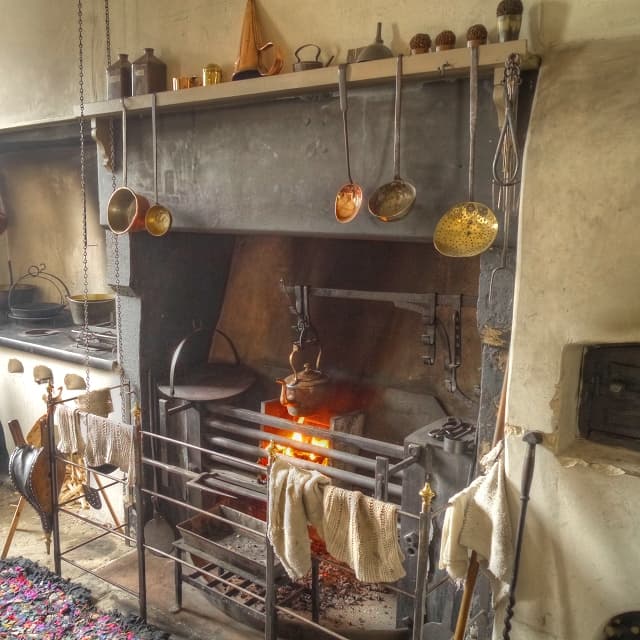
If our cutlery is now stored directly in a drawer, back then, they adorned the walls, suspended by way of little hooks. They were also, at times, kept near the hearth. A lot of dishes, lanterns, and even little lamps were laid about on narrow shelves lining the walls. In proximity to the chimney, one could spot a hutch or shelves, these were traditionally used to store other kitchen articles.
Near the hearth, one also found a good amount of skewers to roast meat, a shovel for ash, a bucket, and pots. Our ancestors often used a pilaster (metal bar) onto which pots and pans were hung inside the fireplace. Fun fact, the use of bracket support (andirons) was also common.
This kitchen apparatus is a horizontal wood or metal structure onto which wooden logs were laid. Said tool was used to support logs to allow the fire to breathe so it wasn't stifled. Also, let’s not forget about a churn, a tool used to beat milk to make butter. One also found a mangle iron, the clothing iron’s predecessor.
19th Century Kitchen
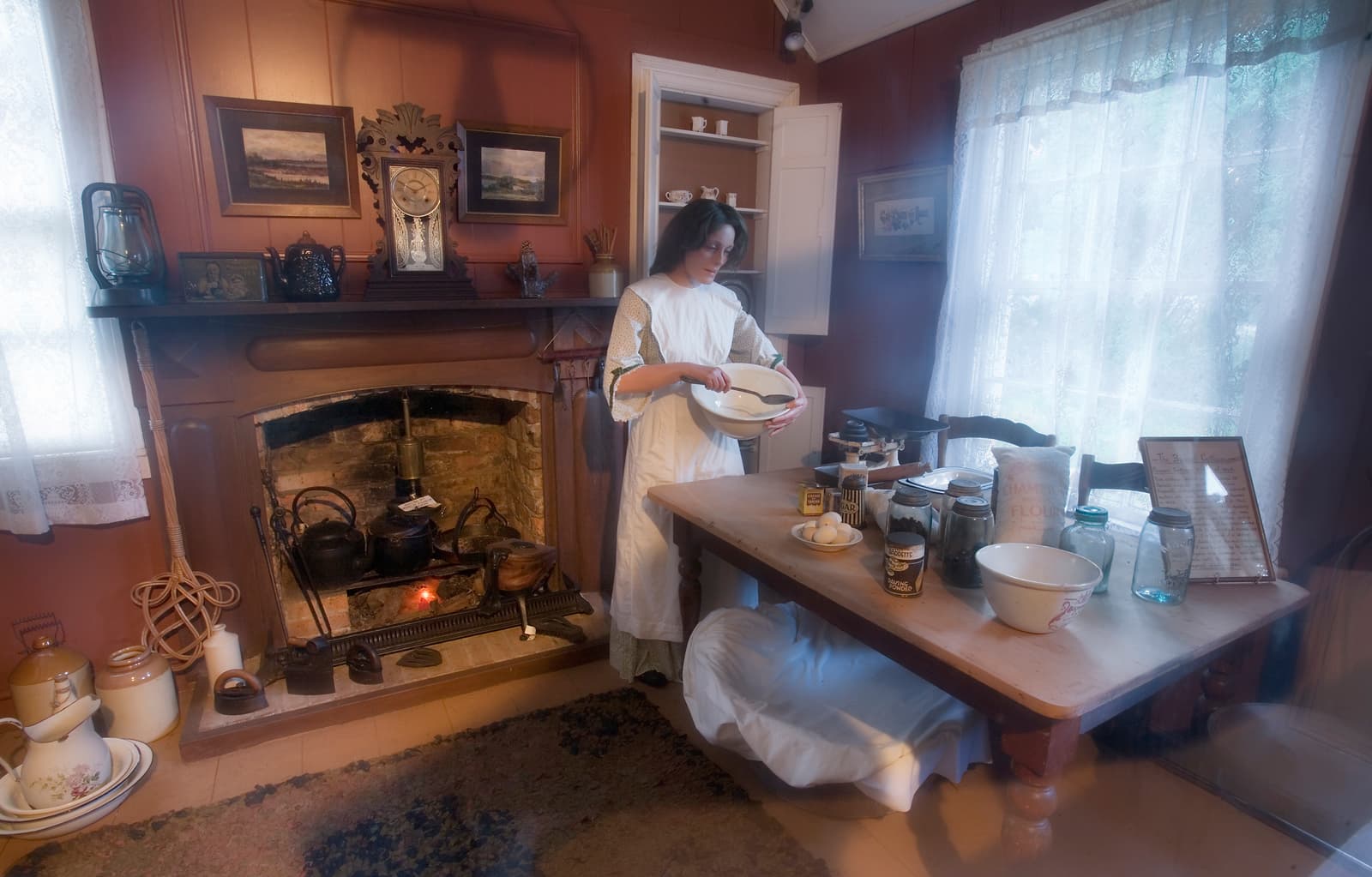
If during the 19th century, food was preserved similarly to that of the previous century, changes were still being seen as far as the general kitchen went. The first of these changes concerned the area’s overall dimensions, and that of the dining room, which was a lot bigger now.
More so, the room’s layout is all the more important. One would look to position the fireplace in a more strategic way, the same with the icebox and the sink. Thereby ensuring that the fireplace is located as close to the front door as possible to minimize the back and forth when bringing in wood.
What about the sink during this time period? It consists simply of a wooden box covered with sheet metal and a tank, or it was shaped out of a rock which drained toward the house. If refrigerators have yet to come about, food can now be stored in a cooler (or icebox) that’s made much more practical than the one previously used.
The Evolution of Stoves and Stovetops
Using a freestanding stove continues to gain momentum as are its numerous benefits as a kitchen appliance. That being, this main feature in the kitchen becomes even bigger. The cast-iron stove is increasingly used and experienced its heyday between 1830 and 1880.
Note that we owe the emergence of the first coal fireplaces and stoves to the British, though these appliances took a while to fit into our dwellings in a durable manner. That said, one had to wait until the second half of the 19th century to make it happen. Naturally, the electric stove will simply be a game changer.
Looking for something else?
Related articles
The latest industry news, interviews, technologies, and resources.
Cynthia Pigeon
•16 Jun 2026
It's the kind of thing that might seem like such a small detail during a major kitchen renovation, but without cabinet door handles, boy are you in trouble! Sure, there are some cabinet doors that don't require any handles to open or close. However, most often, cabinet hardware, either handles, pulls, or knobs is required to open cabinets and drawers.

Editorial Team
•12 Aug 2025
Whether for the kitchen, the bathroom, or other rooms in the house, ceramic is a material known for its various colours, shapes, and patterns. Typical properties of ceramic material include wear resistance, heat resistance, high hardness, good electrical insulation, and a certain lightness.

Cynthia Pigeon
•08 Nov 2023
While thermal insulation is a top priority for most homeowners, proper roof ventilation is also critical to keeping your roofing system in tip-top shape. A roof vent cap is key to achieving this goal.
Editorial Team
•08 Nov 2023
There are plenty of things that go into designing a home and planning its interior design, including aesthetic appeal, comfort levels and the space available. Generally, when homeowners start designing the layout and choosing interior furniture, they tend to consider form over function. How furniture and materials function inside the home will have a huge impact on long term comfort level and appeal, and this consideration is referred to as ergonomics.
Editorial Team
•22 Jun 2026
As the winter season approaches, ensuring warmth in your home is very important. Dozens of studies indicate that windows can represent a significant fraction of the total energy consumption of a building. Therefore they are an important subject of efforts of window companies Halifax to reduce energy losses. In this article, we are going to look at techniques for insulating the windows, how to regulate them, and how to cover the gaps to secure your house for the winter season.