
Renovating a kitchen is one of the most valuable and unifying residential projects for Quebec homeowners. The addition of a large central island equipped with a sink and dishwasher has become a highly sought-after layout for improving both the conviviality and ergonomics of the living space. However, bringing drinking water — and especially draining wastewater — to the middle of a room creates major logistical challenges.
Unlike traditional cabinets placed against a wall, a kitchen island does not offer a direct vertical partition to conceal the drainpipe and plumbing vent. Whether you live in a suburban bungalow, an urban condo, or a heritage home, modifying a residential plumbing system requires careful planning to avoid unpleasant budget surprises. Let’s take a transparent look at the real costs, physical constraints, and regulatory requirements that apply in Quebec.
What Is the Average Cost to Connect Plumbing to a Kitchen Island?
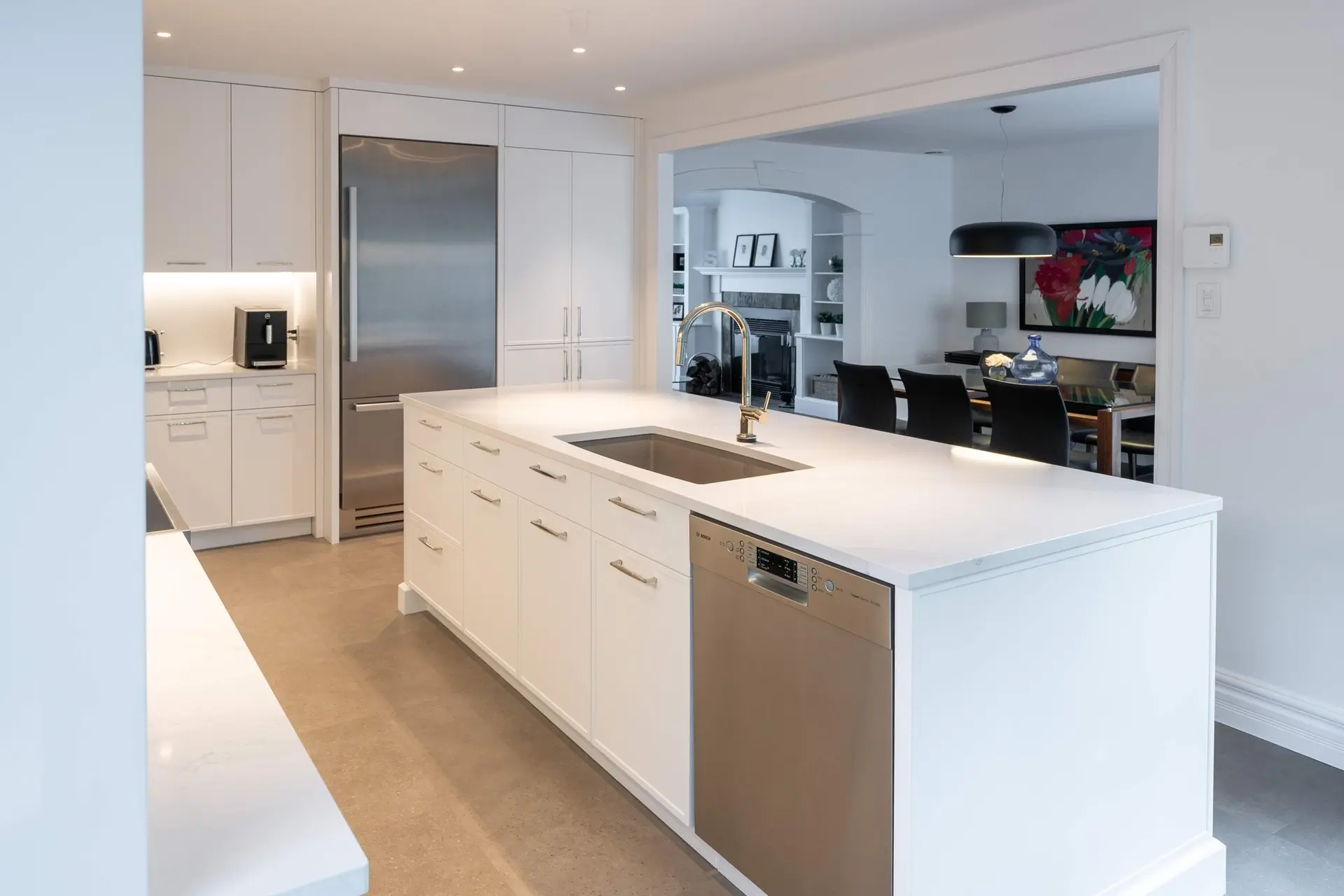
Source: Rénovation Jean Poitras inc
To build a realistic kitchen renovation budget, it is important to first understand that pricing varies depending on how easily the home’s structure can be accessed. In Quebec, the cost to connect a central island to the drainage and water supply system generally ranges from $2,000 to $5,500 for professional work.
In an ideal scenario — for example, a kitchen located directly above an unfinished basement with exposed wooden joists — a plumbing contractor can run PEX supply lines and an ABS drain with relative ease. Connecting the sink and related pipes may then take anywhere from a few hours to a full day of work, keeping the invoice in the lower range, between $1,500 and $2,500.
Conversely, if your kitchen sits on a poured concrete slab, as is often the case for a ground-floor condo or a home built without a basement, the work will require more invasive operations. In this scenario, the bill quickly rises to between $3,200 and $4,500 because of the time needed to break the floor and restore the surface after the pipes are embedded.
Here is a breakdown of the average estimated costs in Quebec for the different plumbing tasks related to a central kitchen island:
Type of Plumbing Work | Estimated Price Range, Materials and Labour Included |
Basic connection, accessible wooden joists, distance under 5 feet | $1,500 – $2,200 |
Intermediate connection, medium distance, partially finished basement | $2,200 – $3,200 |
Complex connection, concrete slab excavation and major reconfiguration | $3,200 – $4,500+ |
Dishwasher connection, hot water supply and drain connection | $250 – $500 |
Faucet installation and sink mounting | $250 – $700 |
When these amounts are compared with the average budget for a full kitchen renovation, it becomes clear that this invisible modification to the technical network represents a significant upfront investment, but one that is essential for ensuring the durability and resale value of the property.
Factors That Influence the Cost of Plumbing Work
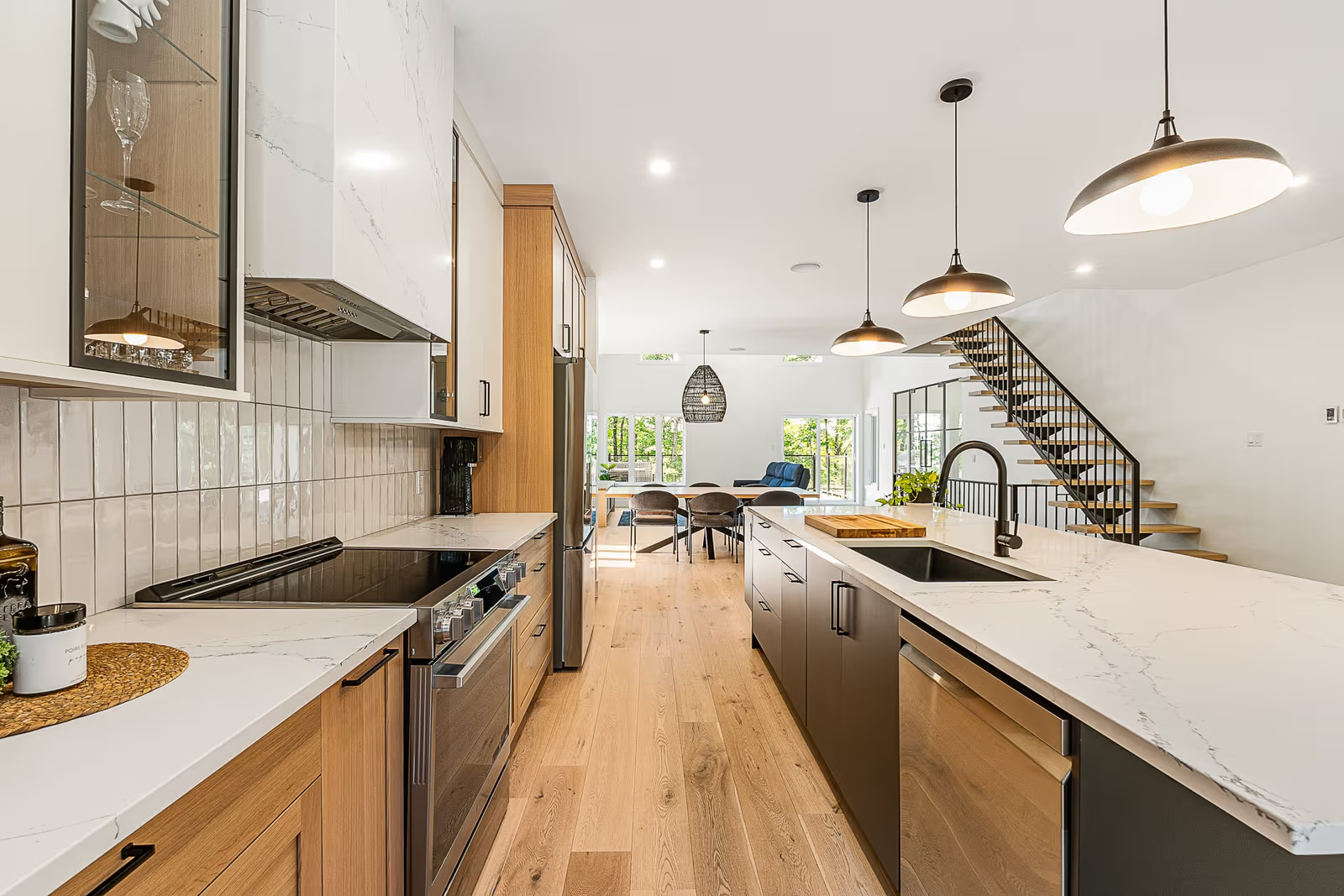
Source: Peinture toiture du Québec
The plumber’s hourly rate is only one part of the overall equation. Several architectural and material variables affect the number of hours required to complete the project.
Type of Structure: Ground Floor vs. Basement or Slab
This is the main financial factor. When the kitchen floor is supported by wooden joists or engineered open-web floor trusses, the tradesperson can work relatively quickly. They can make code-compliant holes in the wood to run the ABS plastic drainpipe and potable water lines. The most common obstacle is the presence of a finished drywall ceiling in the basement, which requires opening work beforehand and subsequent plastering and painting costs, usually at the client’s expense.
The situation changes completely when dealing with a concrete slab. To conceal the island drain, the expert must cut a linear trench in the concrete from the future island location to the nearest main waste stack. This requires using a water-cooled diamond saw to cut the concrete, followed by a jackhammer to break the slab, removal of compacted soil, installation of the piping with the proper slope, and finally the pouring of new finishing concrete. This accumulation of physical steps explains why costs can easily double in this type of configuration.
Distance From the Main Waste Stack
Physics and gravity dictate the rules of residential plumbing. To prevent frequent blockages and allow food debris to drain properly, the Quebec Construction Code requires a minimum drainage slope of 1/4 inch per linear foot, or about 2%, for kitchen sink waste pipes.
The farther your kitchen island is from the main waste stack, the lower the drain must descend along its horizontal path. For example, if the island is 12 feet from the vertical stack, the pipe will need to drop by 3 inches. In a finished basement, this technical constraint can sometimes force the tradesperson to build a drywall bulkhead to hide the visible piping, which creates additional carpentry costs. Greater distance also requires more supplies, long-radius elbows, and sturdy fasteners to prevent the drain from sagging over time.
RBQ and CMMTQ Requirements: Why Hire a Professional?
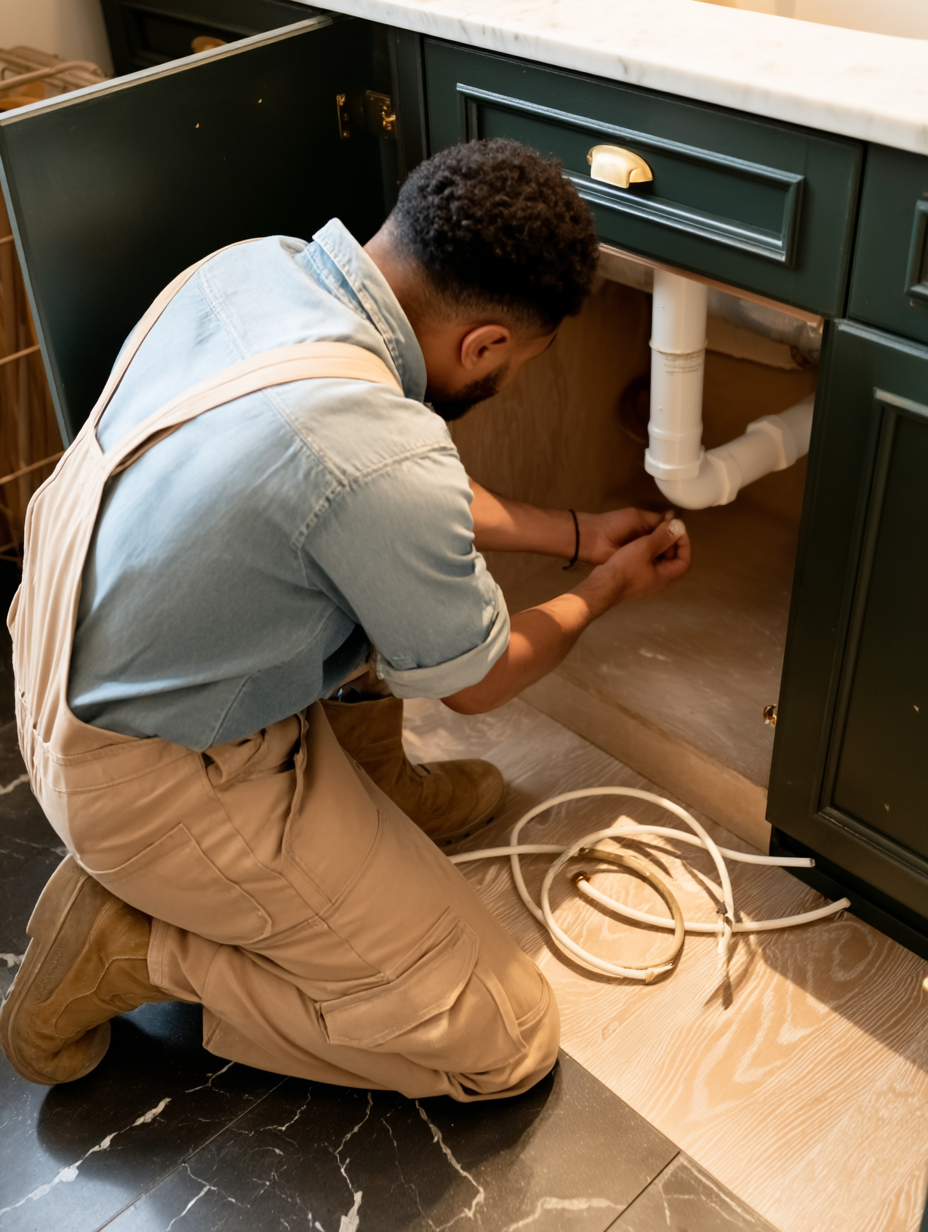
Source: RenoQuotes
Quebec’s residential building legislation is among the most regulated in North America, mainly to protect public health and the integrity of structures. Unlike cosmetic work, the law is strict, and plumbing work is generally entrusted to a licensed plumber.
All pipe connections and relocations must be carried out exclusively by a plumbing contractor holding a valid licence from the Régie du bâtiment du Québec (RBQ) and generally a member of the Corporation des maîtres mécaniciens en tuyauterie du Québec (CMMTQ).
Some households may be tempted to cut costs by turning to the underground market or hiring an uncertified handyman. This decision carries major financial and legal risks:
Insurance refusal: In the event of a break, crack, or improperly glued fitting hidden behind a wall, water damage can amount to tens of thousands of dollars. If an expert investigation shows that the work was performed by an unlicensed person, insurance companies generally refuse to compensate the affected homeowners.
Health risks: Poor sealing or an incorrect connection can cause toxic sewer gas to seep into the living space.
No recourse: Working with a company recognized by the CMMTQ provides access to mandatory licence security through the RBQ, protecting consumers against defective work or job abandonment.
By hiring a certified expert, you are paying for specialized technical skills and long-term peace of mind. The hourly plumber rate recommended by the CMMTQ for a journeyperson generally ranges between $120 and $160 per hour. Professional travel fees, assembly parts, and applicable taxes (GST and QST) are added to this hourly base. Although this represents a significant upfront expense, it is the only way to obtain a durable installation. To track the fine evolution of skilled labour costs in your area, you can consult the plumbing renovation cost guide, which is updated regularly.
Technical Challenge of Ventilation: Loop Vent
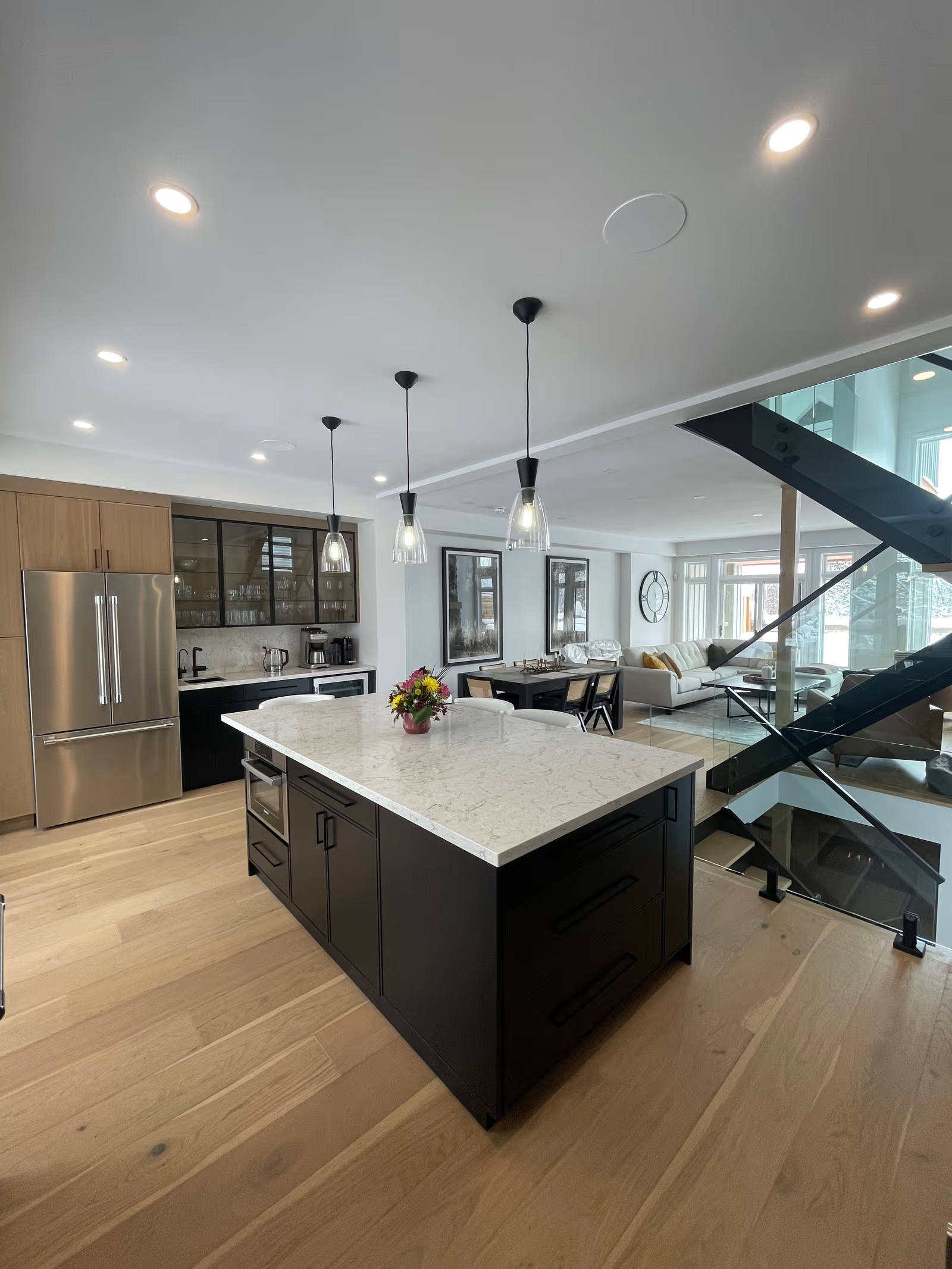
Source: Northridge Renovations Group
Managing pipe ventilation is the technical element most often overlooked during improvised renovations. When water flows in volume through a drainpipe, it creates a suction effect and negative pressure behind the flow. Without adequate air supply, this suction would instantly empty the standing water reserve contained in the P-trap installed under the sink, allowing foul and potentially dangerous sewer gases to rise freely into your home.
For a counter installed against a standard kitchen wall, the ventilation pipe, or vent, rises vertically inside the wall cavity to connect to a roof outlet. In the case of a central island, the absence of a direct wall eliminates this simple option.
The Quebec Construction Code, Chapter III – Plumbing, regulates this issue very strictly. The installation of automatic mechanical air admittance valves, sometimes called “cheater vents,” is allowed under certain conditions in Quebec or restricted to very specific access and maintenance conditions, because these devices contain moving parts that may fail or become blocked over the years.
The regulatory method recognized by municipal inspectors and the RBQ is the installation of a loop vent, also known as an island vent.
This specialized technique requires the vent pipe to rise inside the island cabinet to the highest point possible under the countertop, above the maximum flood level of the sink basin, then descend vertically to form a complete loop. The pipes then run horizontally under the floor until they reach a perimeter wall, where the vent pipe can finally rise toward the roof. This approach requires twice as much ABS piping and the use of specific fittings to ensure continuous airflow, even if temporary water backup occurs in the drain. This invisible level of complexity is precisely what explains the number of labour hours billed by your plumber.
How to Get Accurate Quotes for Your Kitchen Project

Source: RenoQuotes
To control costs and successfully complete your kitchen renovation project without major budget overruns, a sound administrative approach is required before work begins. Never authorize the opening of a floor or the relocation of supply lines based on a verbal agreement or a price scribbled on a piece of paper.
Follow these concrete recommendations to optimize your quote requests from local contractors in Quebec:
Provide clear layout plans: Specify the projected dimensions of your island, the exact location of the sink basin and dishwasher connection, and mention any optional water-consuming additions, such as a reverse osmosis filtration system, built-in ice maker, or pot filler. The more detailed your design drawings are, the more accurate the estimate for materials and labour hours will be.
Document the condition of existing structures: Specify in advance whether the ceiling below the kitchen is open, suspended, or made of closed drywall that will require cutouts. If concrete excavation is unavoidable, determine with the contractor who will handle debris removal and the restoration of the finished slab. Coordinating these tasks with your general contractor helps prevent duplicate billing.
Require a detailed written quote: A professional document must clearly show the applicable plumber's hourly rate, the detailed cost of supplies (ABS, PEX lines, shut-off valves), flat-rate travel fees, and a clear list of included tasks, such as the final pressure test, and excluded tasks, such as rebuilding opened walls.
Verify legal accreditations: Use the public registry of the Régie du bâtiment du Québec to make sure the selected company does, in fact, hold an active licence in the appropriate subclass, 15.5 - Plumbing contractor.
To simplify your shopping process and get an accurate view of market prices in your municipality, you can use specialized matching platforms to find a certified contractor. Taking the time to request and compare at least three separate written quotes will help ensure you obtain a fair rate while properly protecting the overall value of your property.
Looking for something else?
Related articles
The latest industry news, interviews, technologies, and resources.

Cynthia Pigeon
•08 Nov 2023
A building's structure is either made of wood, concrete, or steel. To finish this structure and give a business, facility, or home an eye-catching look, opting for masonry siding is a definite possibility. And, a bricklayer-mason hired by a contractor will be qualified to carry out this type of project.
Editorial Team
•02 Aug 2024
Installing a French drain correctly is crucial for managing water flow and preventing costly moisture damage to your property. By understanding and avoiding these common mistakes, you can ensure your French drain system works efficiently and protects your home for years to come.

Cynthia Pigeon
•27 May 2026
Bathroom renovations, kitchen backsplash upgrades, and basement floor finishing projects can all add significant value to a Canadian home. Durable, attractive, and easy to maintain, porcelain and ceramic tiles are, to this day, common choices for homeowners across the country.

Editorial Team
•29 Sep 2026
In Quebec, summertime is short-lived. Since we want to enjoy it as much as possible, we rarely hesitate to make our backyards a full-on, outdoor living space. No matter the design or layout, a patio or deck remains the centrepiece. This versatile space can be used as a living room, a dining room, and a remote office. Six months out of the year, it’s a household fan favourite. Since it has an expiration date, your deck might have lost its charm or is no longer suitable in size or location.

Editorial Team
•19 Mar 2026
Whether you’re gearing up for a busy summer in downtown Vancouver or preparing crews for rural builds in Alberta, technology has become essential to staying organized and competitive during peak season. As demand ramps up, successful contractors rely on more than their tools and crew—they depend on software to streamline operations, respond quickly to incoming leads, keep clients informed, and maintain steady cash flow.