Renovation Tax Credits and Grants in Quebec in 2026
By Cynthia Pigeon
Updated on July 31, 2026
Whether you are an owner-occupant, investor, or senior preparing your home for the future, Quebec’s economic conditions and climate requirements demand rigorous budget management. With harsh winters, repeated freeze-thaw cycles, and continually rising energy costs, residential renovations represent a strategic decision.
Fortunately, households have access to a range of financial assistance programs in 2026. Between Hydro-Québec incentive programs, provincial grants supporting the energy transition, and tax measures offered by both levels of government, the total cost of your renovations could be reduced by several thousand dollars.
To optimize every dollar invested, these programs should be approached methodically from a financial perspective, beginning with an understanding of the fundamental differences between reimbursement mechanisms. To get your project off to a good start and secure the best possible costs, it is often advisable to request free quotes from certified professionals.
Tax Credits and Direct Grants: Understanding the Difference
Source: H Man Reno
To build a solid financing plan, the first step is to distinguish between the different forms of assistance you may receive. Homeowners frequently confuse tax credits with direct grants, even though their administrative processes and effects on cash flow differ considerably.
Direct grants: Administered by public organizations or energy providers, such as Hydro-Québec or the Ministère de l’Environnement, these forms of assistance are generally paid by cheque or direct deposit after the work has been verified for compliance. Unlike non-refundable tax credits, these grants are generally not calculated according to the amount of income tax you owe. However, eligibility requirements vary from one program to another.
Tax credits: These are claimed when filing your annual income tax return with Revenu Québec or the Canada Revenue Agency (CRA).
A refundable tax credit, such as the credit for upgrading residential wastewater treatment systems, is paid to you by the government even if you do not owe any income tax.
A non-refundable tax credit, such as the Home Accessibility Tax Credit, reduces the amount of tax you owe, but any portion exceeding your tax payable will not be issued as a refund.
Major Tax Credits Available Through Revenu Québec and the CRA
Source: DUOCO inc.
The Quebec and Canadian governments provide financial support for specific renovation projects that address major societal issues, including family housing, environmental protection, and helping seniors remain in their homes.
The Multigenerational Home Renovation Tax Credit
Introduced at the federal level by the Canada Revenue Agency, the Multigenerational Home Renovation Tax Credit (MHRTC) allows families to create a secondary unit within a principal residence.
MHRTC financial details:
Applicable rate: 14.5% of eligible expenses for the 2025 tax year
Maximum eligible expenses: $50,000
Maximum refundable tax credit: $7,250
Note: The federal rates shown above apply to the 2025 tax year, for which the income tax return is generally filed in 2026. The amounts applicable to the 2026 tax year should be verified when filing your return.
To qualify, the renovations must create a self-contained living space that includes a private entrance, kitchen, bathroom, and sleeping area. The unit must be intended for a senior family member aged 65 or older or an adult with a disability. If you are planning a home addition or basement renovation for this purpose, consider submitting your renovation project to receive proposals that comply with the program’s requirements.
Tax Credit for Upgrading Residential Wastewater Treatment Systems
To qualify, the agreement with the qualified contractor must generally be entered into before April 1, 2027. The maximum cumulative tax credit available for an eligible dwelling is $5,500 for the 2017–2027 period.
Home Accessibility Tax Credits for Seniors and People with Reduced Mobility
Adapting homes to address an aging population is supported through targeted tax measures. At the federal level, the Home Accessibility Tax Credit (HATC) covers improvements intended to make a home safer and more accessible.
Annual eligible expense limit: $20,000
Maximum amount: Up to $2,900 for the 2025 tax year, representing 14.5% of up to $20,000 in eligible expenses
Eligible work: Replacing a bathtub with an accessible shower, widening door frames, and adding access ramps or grab bars
Other provincial measures may also support seniors who wish to remain in their homes. However, their eligible expenses, conditions, and calculation methods differ from those of the federal Home Accessibility Tax Credit.
Essential Direct Grants That Can Be Combined in 2026
Source: Avant-garde reno
Beyond income tax returns, Quebec provides significant direct financial assistance for improving building energy efficiency.
The Rénoclimat Program: Insulation, Airtightness, and Windows
Administered by the Quebec government, Rénoclimat remains the leading program for improving a building’s overall envelope. It is intended for homeowners who want to reduce air leakage and improve the insulation of their roof, basement, or exterior walls.
Rénoclimat grants can amount to several thousand dollars for comprehensive insulation upgrades. The program also provides a fixed amount, such as $150 per opening, for replacing windows with ENERGY STAR®-certified models.
Hydro-Québec’s LogisVert Program: Heat Pumps and Energy Efficiency
In 2026, Hydro-Québec centralizes its incentives for high-performance heating systems through the LogisVert portal. Heat pumps, particularly models designed for Quebec’s cold climate, are a key component of the program.
Financial assistance is calculated according to the unit’s heating capacity at −8°C:
ENERGY STAR®-Certified Equipment Type | Financial Assistance per 1,000 BTU/h | Indicative Amount |
Standard Air-Source Heat Pump | $50 per 1,000 BTU/h at −8°C | Varies according to size |
Cold-Climate Heat Pump (High Efficiency) | $120 per 1,000 BTU/h at −8°C | Varies according to the unit’s eligible capacity |
Geothermal Heat Pump | $750 per 1,000 BTU/h of capacity | Based on system sizing |
Unlike Rénoclimat, an application for heat-pump assistance is submitted directly through the LogisVert online portal. It must be filed within 9 months of the installation date. No preliminary energy evaluation is required for this specific measure.
Important note regarding the low-income stream: > The financial assistance rates listed in the table above apply to the regular LogisVert program (partial rebates accessible to all homeowners). If you are looking for information on the 100% financial assistance stream offering a free heat pump for low-income households (formerly linked with the Éconologis program), please note that new registrations for this specific stream are fully suspended for the 2026–2027 season by Hydro-Québec due to an unprecedented volume of applications. The regular LogisVert rebate program remains fully active and accessible.
End of the Chauffez Vert Program for Oil and Propane
Financial assistance for converting a central oil- or propane-fired heating system ended on March 31, 2026. The work had to be completed and the application submitted by that date. No new applications have been accepted since April 1, 2026.
How Can You Maximize and Combine Financial Assistance for Your Project?
Source: RenoQuotes
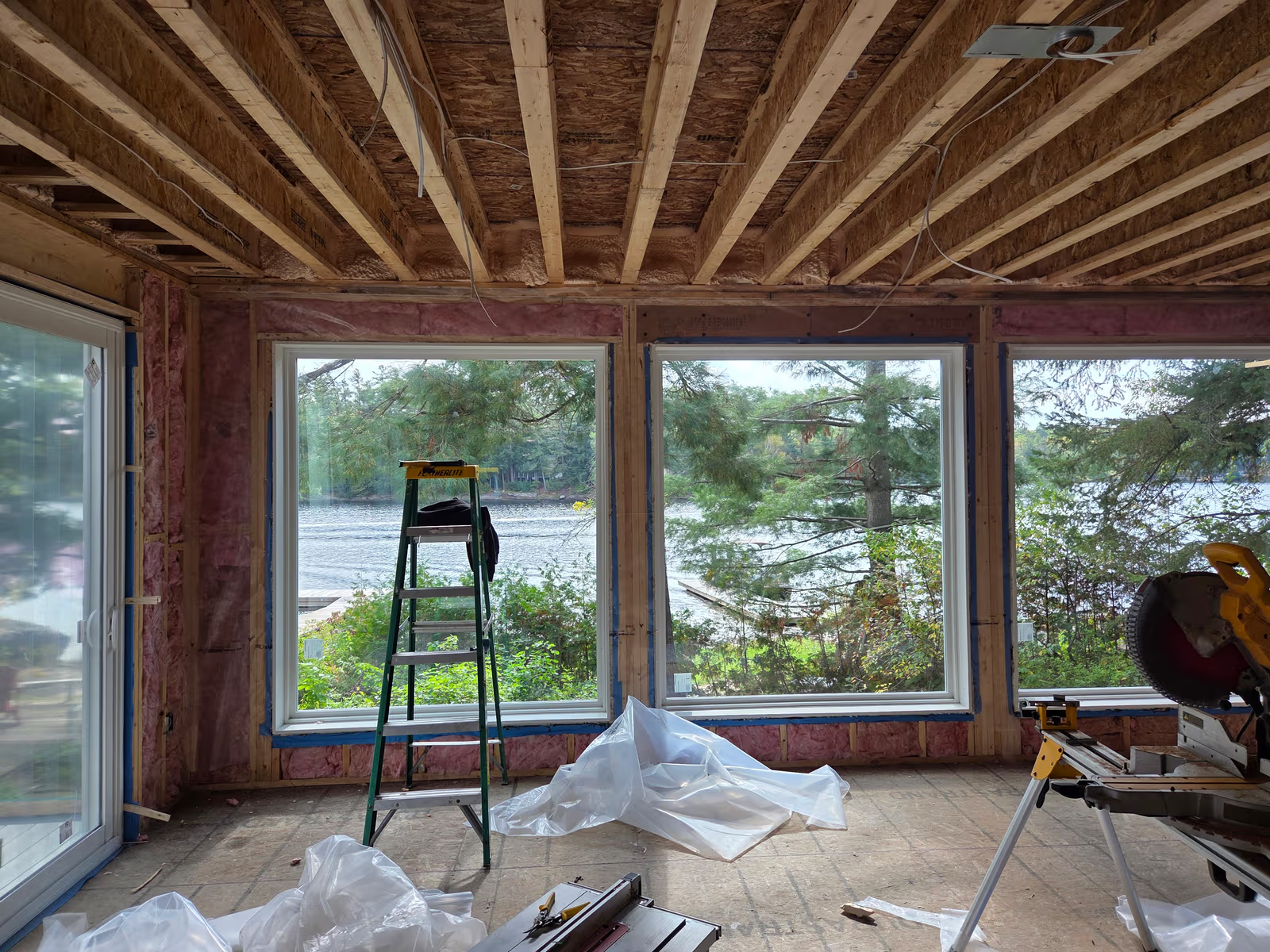
The key to a cost-effective renovation project lies in coordinating the different programs methodically. It is entirely legal to combine direct grants and tax credits for the same building, provided that you comply with the requirements established by each organization.
Examples of Work That May Qualify for Different Programs
Consider the example of a homeowner in Lévis undertaking a major renovation of a single-family home:
Replacement of an outdated septic system: $18,000.
Attic insulation and window replacement: $12,000.
Installation of a 36,000 BTU/h central cold-climate heat pump at −8°C: $13,500.
Ideal Timeline to Avoid Losing Financial Assistance
To combine these programs successfully and reduce the risk of a tax or administrative refusal, follow these steps carefully.
Step 1: Find a contractor. Do not authorize any work without first verifying the specialist’s qualifications. Compare qualified contractors who hold the appropriate licence subclasses.
Step 2: Complete the pre-renovation evaluation for Rénoclimat. Schedule an appointment with an energy-efficiency advisor before opening walls or beginning demolition.
Step 3: Carry out the work. Have your heat pump and other equipment installed by your licensed contractor.
Step 4: Submit the LogisVert application. Upload your invoices and photographs of the equipment nameplates to the LogisVert portal within nine months of completing the work.
Step 5: Complete the post-renovation Rénoclimat evaluation. Have the final test performed to receive the insulation grant.
Step 6: File your income tax return. When filing your income tax return the following spring, report your eligible expenses for CRA and Revenu Québec tax credits and include the required official documents.
Mandatory Requirements: RBQ Licences and Invoice Retention

Source: RenoQuotes
Administrative compliance plays a decisive role in whether your application for financial assistance or a tax credit is accepted.
Formal RBQ Licence Requirements
Depending on the program and the nature of the work, the company must be registered with the Registraire des entreprises du Québec and hold the applicable licences, certifications, or professional qualifications, including an RBQ licence when required. The requirements must be verified separately for each financial assistance program or tax credit.
Before signing a renovation quote or contract, search the official Régie du bâtiment du Québec licence registry. To avoid unpleasant surprises, use a trusted network to find a qualified contractor whose credentials have been reviewed.
Rigorous Document Management
Keep both digital and physical copies of all supporting documents for at least six years. Your records should include:
Every detailed invoice clearly detailing the contractor’s RBQ licence number, GST/HST and QST numbers, an exact description of the work, and the completion date.
Complete proof of payment, such as credit card receipts, processed cheques, and bank statements showing that the amounts were paid in full during the applicable year.
Technical data sheets and proof of equipment certification, such as the model numbers of ENERGY STAR®-certified heat pumps.
Official tax forms, such as form TP-1029.AE.A for wastewater treatment systems.
By approaching your renovation projects with this level of financial and technical rigour, you can turn renovation expenses into a lasting, high-performing, and substantially subsidized investment.
Looking for something else?
Related articles
The latest industry news, interviews, technologies, and resources.

Cynthia Pigeon
•31 Jul 2026
Given the harshness of Quebec’s climate, where temperatures drop drastically in winter and humidity rises sharply in summer, keeping your home comfortable is a constant financial challenge. In 2026, the financial assistance landscape has changed, particularly with the closure of the main federal programs to new applications and the growing importance of provincial and municipal programs.
Cynthia Pigeon
•25 Jun 2026
Bathrooms are one of the most important rooms in a home, but it is also one of the areas where household accidents are most likely to happen. With humidity, slippery surfaces and often limited space, the risk of falls is especially high for seniors and people with reduced mobility.
Cynthia Pigeon
•24 Apr 2026
For Canadian homeowners—whether you own a mid-century bungalow, a modern detached home, or an urban multiplex—replacing a flat roof is one of the most important investments you can make to protect your property long term. With increasingly unpredictable winters and frequent freeze-thaw cycles across many regions of Canada, the question is no longer just whether your roof leaks, but how to optimize waterproofing while meeting updated 2026 energy efficiency standards.
Cynthia Pigeon
•30 Sep 2026
Installing a Level 2 EV charger at home allows Canadian homeowners to charge their electric vehicles faster and more conveniently than with a standard 120 V outlet. In 2026, a practical budget for a typical residential installation is approximately $1,500 to $4,500 before taxes, including the charging unit and professional installation. However, major electrical upgrades, extensive wiring or excavation can increase that cost considerably.

Editorial Team
•08 Nov 2023
Finally, the renovation you’ve been dreaming about for months is underway. You’ve taken the time to carefully choose materials, design the new layout and hire a trusted contractor and team. Now, before any work actually takes place, it's crucial to consider a major step in any home renovation; signing the official contract.