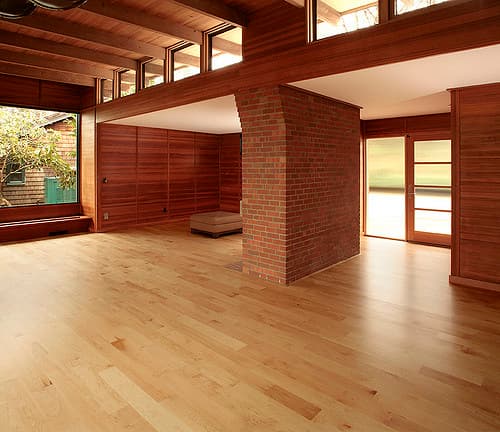
Wood varnishes are in place to protect the natural textures and colour of the hardwood while adding an additional attractive shine and finish. However, it is only natural for your hardwood floor varnish to wear over time, as floors come up against constant movement leading to the potential for scuffing and stains. Of course, a hardwood floor can easily be re-stained with a little bit of time and a fair amount of elbow grease.
There are several possible methods for homeowners to follow to refinish their floors. If you’re ready to take on the task yourself and looking for a step-by-step guide to follow, search no further. Below, you’ll find everything you need to strip and refinish your hardwood floors!
Here's how to strip and refinish hardwood floors!
Strip your hardwood floor

source: Flickr, gregoryswan
The first step to stripping your hardwood floors is to apply a paint stripper to remove the old varnish. If your floor has been painted for whatever reason, use a liquid stripper instead. Apply this with a paintbrush instead of pouring the stripper directly onto the floor, as wood is very porous and sensitive to saturation.
An alternative is to use a spray stripper, which will come in an aerosol can, and this method can be applied directly to the surface of the floor. It is important to note that homeowners should only use a gel stripper if looking to remove the varnish as well as the paint, as gel strippers work to remove several layers.
Remove and Clean Off the Varnish
The next step to stripping your hardwood floors is to remove the varnish from the surface of the floor. The varnish will have loosened by way of the paint stripper that was previously applied, and therefore, will be relatively easy to scrape off. You can scrape off the varnish using one of two methods: either by way of a chemical-resistant scrapper blade or using a damp mop.
Make sure that if you choose to remove the stripper using a mop that it isn’t soaked. Regardless of the method you choose, complete this process carefully and vacuum the floor directly afterwards.
Sand the Surface
If you find that the varnish has not disappeared, you may have to sand down your floors. To complete this step, you will need the aid of a belt, disk or drum sander with a coarse sandpaper. Before you begin sanding, make sure to put on protective eyewear in order to shield against small flying debris as well as a large amount of dust that will accumulate.
To start the sanding process, work from the centre of the room, turn the sander on and tilt it upwards. Sand across the room in the same direction as the grain on your hardwood floors. Further, make sure to always keep the sander in motion during the process. Make your way towards the wall, and once you reach it, return the sander to the centre of the room and move on to the next section until the entire floor has been sanded.
Finish the Job

source: Flickr, Garth
Following the sanding process, vacuum the area to rid of any dust that the sander created. Once the floor is clean, sand it again using fine sandpaper, as this will smooth out the floor while providing the finishing touches. Make sure that no varnish remains on the surface of the hardwood floor surface.
If you are still finding patches that haven’t been removed, these can be removed with an electric paint remover, which will heat the varnish to remove it. Following this, scrap the varnish from the floor with the previously mentioned paint scraper.
Get 3 renovation quotes for your hardwood flooring refinishing project
RenoQuotes.com can help you get quotes for your hardwood flooring renovation project. If you submit your project to us, we’ll put you in contact with top-rated contractors. Fill in the form on the homepage (it only takes a few minutes), and you will get estimates from trusted professionals.
Dial 1-844 828-1588 to speak with one of our customer service representatives
Looking for something else?
Related articles
The latest industry news, interviews, technologies, and resources.
Léa Plourde-Archer
•04 Mar 2026
A home extension or addition is a significant upgrade that can add value and square footage to your property. However, what questions should you ask to ensure your project is executed flawlessly? How can you ensure the extension or addition blends with the rest of your house’s style? What should you know about materials, building permits, and associated costs?

Editorial Team
•09 Sep 2024
Are you looking for an electric heating system, but aren't sure which brand to turn to? Well, look no further, Chromalox is the answer! With over 100 years of expertise, Chromalox is a full-service technology-based company that provides a complete line of electric heaters to customers worldwide. Read on to find out everything there's to know about its various heating systems, their prices, and features.

Léa Plourde-Archer
•08 Nov 2023
When we talk about decor or design on the blog, we usually focus on home decor. This allows our readers to find sources of inspiration to create the perfect layout for their home. But what about those who are looking for ideas for their business?
Cynthia Pigeon
•12 May 2026
Replacing a bathtub with a shower in Canada is a strategic renovation that generally costs between $5,000 and $12,000, depending on the materials, the existing plumbing, and the complexity of the work. This upgrade can improve the functionality, comfort, and perceived value of a home, especially when it supports accessibility, aging in place, or a more modern bathroom layout. Given that this type of project may involve plumbing, drainage, waterproofing, ventilation, and sometimes floor preparation, it is important to plan carefully. Depending on the province or municipality, plumbing work may need to be completed by a licensed plumber or qualified contractor. In many bathtub-to-shower conversions, the existing drain may also need to be assessed or upgraded to meet the requirements of the new shower installation.

Editorial Team
•03 Nov 2025
When it comes to a home, the roof is one feature that is rarely given pause. However, it is the one part that shelters from the elements and, if properly insulated, prevents cold drafts from seeping in. Yet, you may want to change your roof. In such a case, we are looking at changing the roof's structure to then alter the slope. Although this might seem like an impossible task, it is definitely doable.