How to Become a Security Systems Electrician
By Editorial Team
Updated on October 8, 2025
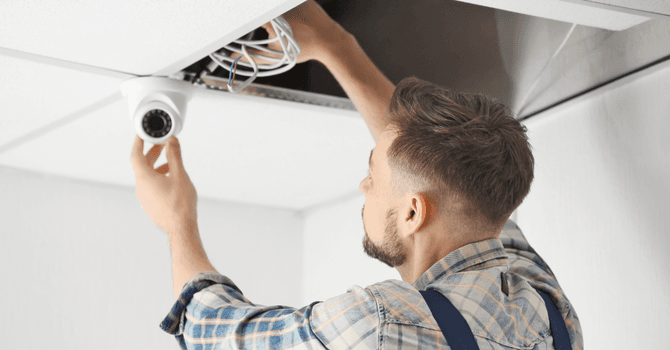
Are you passionate about computers, electronics, and new technologies? Are you drawn to manual work, in which the words "build," "repair," or "install" sound like true challenges to you? Electricity, intricate components, and problem-solving don't scare you?
Well then, maybe you should consider a career as a security systems electrician. This complex and wide-ranging trade offers excellent job prospects and is eagerly awaiting your candidature!
Security Systems Electrician Tasks

Source: Canva
Also known within the industry as “installers,” “technicians,” or “electronic maintenance technicians,” these experts are tasked with fitting, configuring, verifying, and maintaining various security systems:
Fire alarm
Anti-theft
Access control
Video surveillance
Telecommunication
Emergency communication
Control unit
Sprinkler supervision
These specialists can work either in private residences or in commercial, institutional, or industrial sectors.
Aside from the above-mentioned tasks, academic training and on-the-job experience will teach future electricians to:
Make equipment and work areas safe for employees and the general public;
Drive and maintain a service vehicle;
Interpret plans, quotes, technical books, and diagrams (in English and French);
Understand direct and alternative currents circuits, logic circuits, and semiconductors;
Connect and install cables and connections;
Activate and connect all types of systems to a central unit;
Carry out quality control, identify defects, and replace equipment;
Fill in maintenance, repair, or test reports.
The Skills Required to Become a Security Systems Electrician
Logically speaking, students and prospective candidates alike have similar profiles. Overall, these individuals enjoy concrete tasks: Part of their DNA is drawing on theory and analytical evidence to solve problems on-site. Their judgment and deductive logic will be especially useful throughout their careers. It goes without saying that a sharp, critical mind, self-reliance, and unparalleled attention to detail are sought-after qualities by employers.
They're always keen on learning and further developing their digital, IT, and electrical knowledge, as well as being rigorous and retentive.
Since they'll be working with small tools or hazardous components on a daily basis, having excellent dexterity and coordination are essential skills for security systems electricians.
Lastly, eyesight also plays a crucial part in successfully accomplishing tasks; perfect 20-20 vision, selective attention, and a quick grasp of colours are therefore essential qualities.
How to Become a Security Systems Electrician

Source: Canva
To perform security systems installation or repair-related duties, one must obtain a DVS in Security Systems Installation and Maintenance (official name in Quebec: Installation et entretien de systèmes de sécurité)—electrotechnology and the duration of the training is 1,485 hours.
This training is available in the 5 following establishments:
ÉMOICQ (CSS de la Capitale – Capitale-Nationale)
Construc-Plus Vocational Centre (CSS des Miles-Îles – Laurentides)
C.F.P. Qualitech (CSS du Chemin-du-Roy – Mauricie)
C.F.P La Prairie (CSS des Grandes-Seigneuries – Montérégie)
C.F.P. Léonard-De Vinci, Édifice Thimens (CSS Marguerite-Bourgeoys – Montréal)
You can also access these functions by completing a DVS in a related field, for example, in electronics engineering technology, or by going through the CSD Construction’s labour pool shortage openings (bassin de main-d’œuvre, info-pénurie [French only]) made available for non-graduates.
Job Outlooks in Security Systems Maintenance and Installation Field
The employment rate for graduates is high. The demand for blue-collar occupations is increasing and there's a labour shortage.
The construction industry is, without a doubt, always looking for labourers, but one can still find work outside of this sector. For example, some private or retail companies as well as electronic equipment distributors or manufacturers hire and offer installation, repair, and maintenance services.
Note that some employers might require that you join the Ordre des technologues professionnels du Québec (Order of Professional Technologists of Quebec, OTPQ [French only]), complete general health and safety on construction sites course (ASP Construction [French only]), or obtain a Journeymen Competency Certificate (JCC).
In Quebec, the median wage for this trade is $25 an hour, however, it can go as high as $40/hr. The salary varies with years of experience and according to the sector of employment. The beauty of being a security systems electrician is that you can find contracts year-round.
Looking for something else?
Related articles
The latest industry news, interviews, technologies, and resources.

Cynthia Pigeon
•08 Oct 2025
Welding is a creative trade, the likes of which few blue-collar trades still encompass. Skilled welders can work in any environment with a variety of materials and techniques. From skills to salary to job opportunities, learn everything there is to know about welding.
Editorial Team
•08 Oct 2025
Being a pipefitter is an extremely technical trade that requires specific skills and training. Learn all about it to find out whether or not it’s the right trade for you.

Editorial Team
•24 Mar 2025
Are you the proud owner of a home with a basement, but said space is still unfinished? Looking to turn it into a bedroom, playroom, or fully-loaded apartment? Here’s what you need to know before jumpstarting a basement finishing project.

Editorial Team
•20 Nov 2023
Do you have to change your old kitchen sink? The models available on the market are just as wide-ranging as they are diverse, meaning finding the right sink for the job can be quite tricky! To help guide your decision, here’s a rundown of the leading sink models.
Editorial Team
•22 Apr 2026
Installing a septic system for a chalet in Quebec is rarely a “catalog purchase.” Two homeowners may choose a similar system and pay very different amounts simply because their land, site access, and municipal requirements don’t tell the same story. Before even talking about concrete, polyethylene, or capacity, one thing must be understood: the price depends primarily on the treatment solution your land allows, and what will be required to install it properly.