Exterior Insulation Under Siding in Canada: Prices in 2026
By Cynthia Pigeon
Updated on September 4, 2026
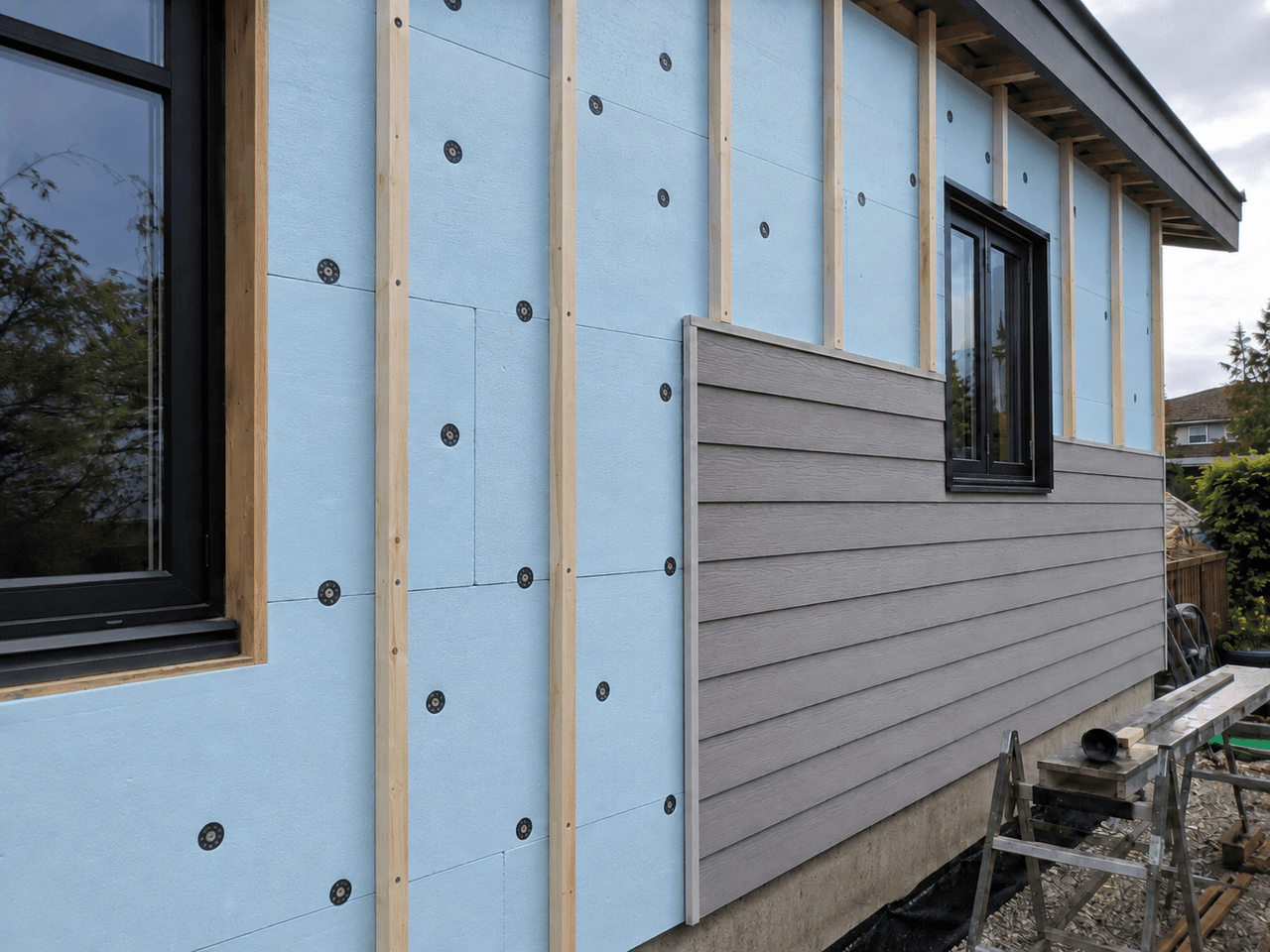
Replacing the exterior siding on a single-family home, a 1970s bungalow, or a century-old house is an ideal opportunity to improve the building’s energy efficiency. Instead of limiting the project to a cosmetic upgrade, removing old vinyl, CanExel, or aluminum siding provides direct access to the exterior wall assembly.
Adding continuous exterior insulation before installing the new siding effectively wraps the home in an insulating layer. In Canada’s climate, where temperatures can fluctuate significantly between winter and summer, this approach reduces thermal bridging and, when combined with a properly sealed continuous air barrier, can also reduce air leakage and improve indoor comfort.
As a general guideline, for 1,200 to 1,500 sq. ft. of exterior wall area, an additional cost of $3 to $10/sq. ft. would represent approximately $3,600 to $15,000, before the cost of the new siding. Actual project conditions can affect overall pricing considerably. The final budget depends on the target R-value, the insulation material selected, and the complexity of doors, windows, and other openings.
How Much Does Exterior Insulation Under Siding Cost per Square Foot?
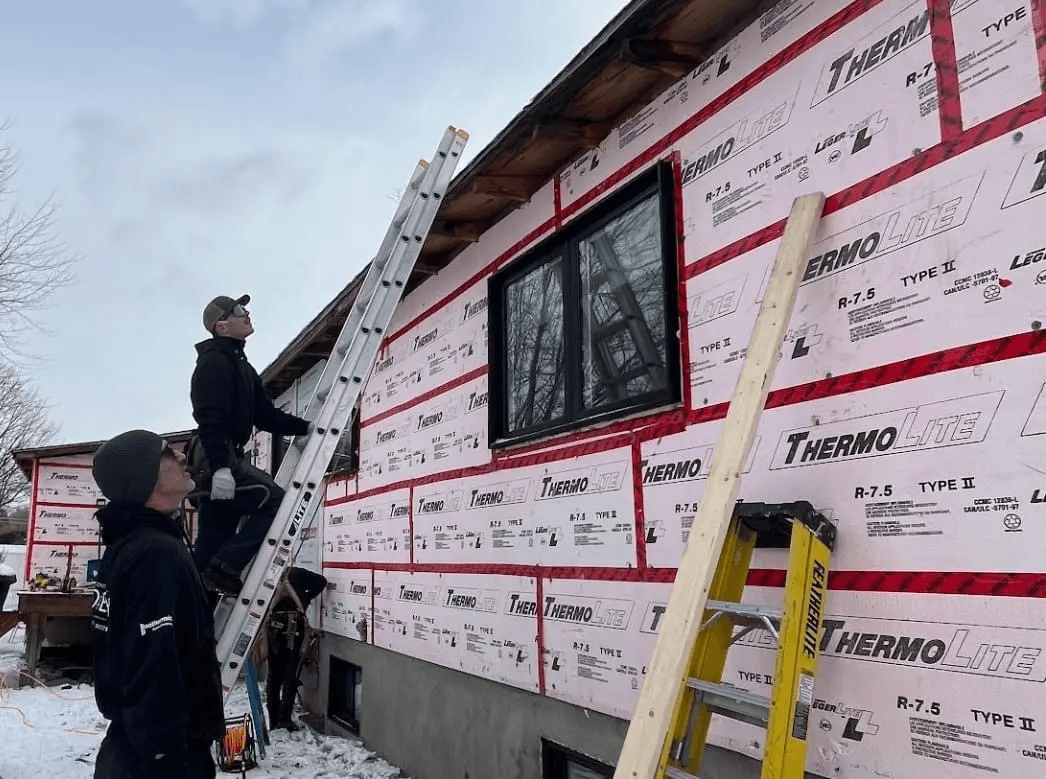
Source: Construction ADEXY inc.
Continuous insulation under siding is generally priced per square foot. As a general guideline, some projects may cost between $3 and $10/sq. ft. for insulation and related work, excluding the new exterior siding. A local quote is still necessary to obtain an accurate price.
The table below summarizes typical cost ranges based on the insulation system selected:
Type of Exterior Insulation | R-Value per Inch | Average Cost per sq. ft. Installed | Main Advantages |
Expanded polystyrene (EPS) / extruded polystyrene (XPS / ISOCLAD) | R-4 to R-5 | $3 to $6/sq. ft. | Affordable, moisture-resistant, lightweight |
Rigid mineral wool (e.g., ROCKWOOL Comfortboard) | R-4 to R-4.2 | $4 to $7/sq. ft. | Non-combustible, sound-absorbing, vapour-permeable |
Closed-cell spray polyurethane foam | R-6 to R-6.5 | $6 to $10/sq. ft. | High air-sealing potential, high R-value |
For an accurate estimate based on your building’s configuration, you can request an exterior siding quote that includes continuous insulation options.
ISOCLAD and Rigid Polystyrene Panels (XPS/EPS)
In Quebec, rigid polystyrene panels are commonly used for residential renovation projects. The two main types are expanded polystyrene (EPS) and extruded polystyrene (XPS).
Specialized products such as ISOCLAD combine expanded polystyrene (EPS) insulation with an integrated air- and weather-barrier membrane.
Average cost: $3 to $6 per square foot installed.
Thermal performance: Approximately R-4 to R-5 per inch of thickness. A 2-inch panel adds roughly R-8 to R-10 across the exterior wall surface.
Disadvantages: Polystyrene is a combustible synthetic material; therefore, adhering to proper clearances from chimneys, heat-producing appliances, and other high-temperature components is highly important.
Rigid Mineral Wool Panels (e.g., ROCKWOOL Comfortboard)
Rigid mineral wool, commonly sold under product lines such as ROCKWOOL Comfortboard 80 or IS, is increasingly used by contractors specializing in energy-efficient renovations in Quebec.
Made primarily from melted basalt rock, mineral wool is a durable material that maintains its shape over time.
Average cost: $4 to $7 per square foot installed.
Thermal performance: Approximately R-4.2 per inch for Comfortboard 80.
Key properties:
Fire resistance: Non-combustible material with a melting point of approximately 1,177°C according to ROCKWOOL.
Sound absorption: Helps reduce exterior noise from sources such as traffic and dense neighbourhoods.
Vapour permeability: Allows the wall assembly to dry toward the exterior, which can help reduce risks associated with moisture accumulation.
Closed-Cell Spray Polyurethane Foam
Applied directly over the existing sheathing or appropriate exterior membrane, closed-cell spray polyurethane foam provides a high level of thermal resistance per inch of thickness. When installed according to the manufacturer’s specifications, it can form a continuous insulation layer and contribute to the air tightness of the wall assembly.
Average cost: $6 to $10 per square foot for approximately 1.5 to 2 inches of material.
Thermal performance: Approximately R-6 to R-6.5 per inch.
Main advantage: Depending on the product, installation thickness, and assembly details, it may also serve as an air-control and vapour-control layer. It can be particularly useful when a project requires both a high R-value and significant improvements to airtightness.
To compare the technical options available for your building envelope, take the time to compare residential insulation quotes.
What Factors Affect the Cost of Exterior Insulation?
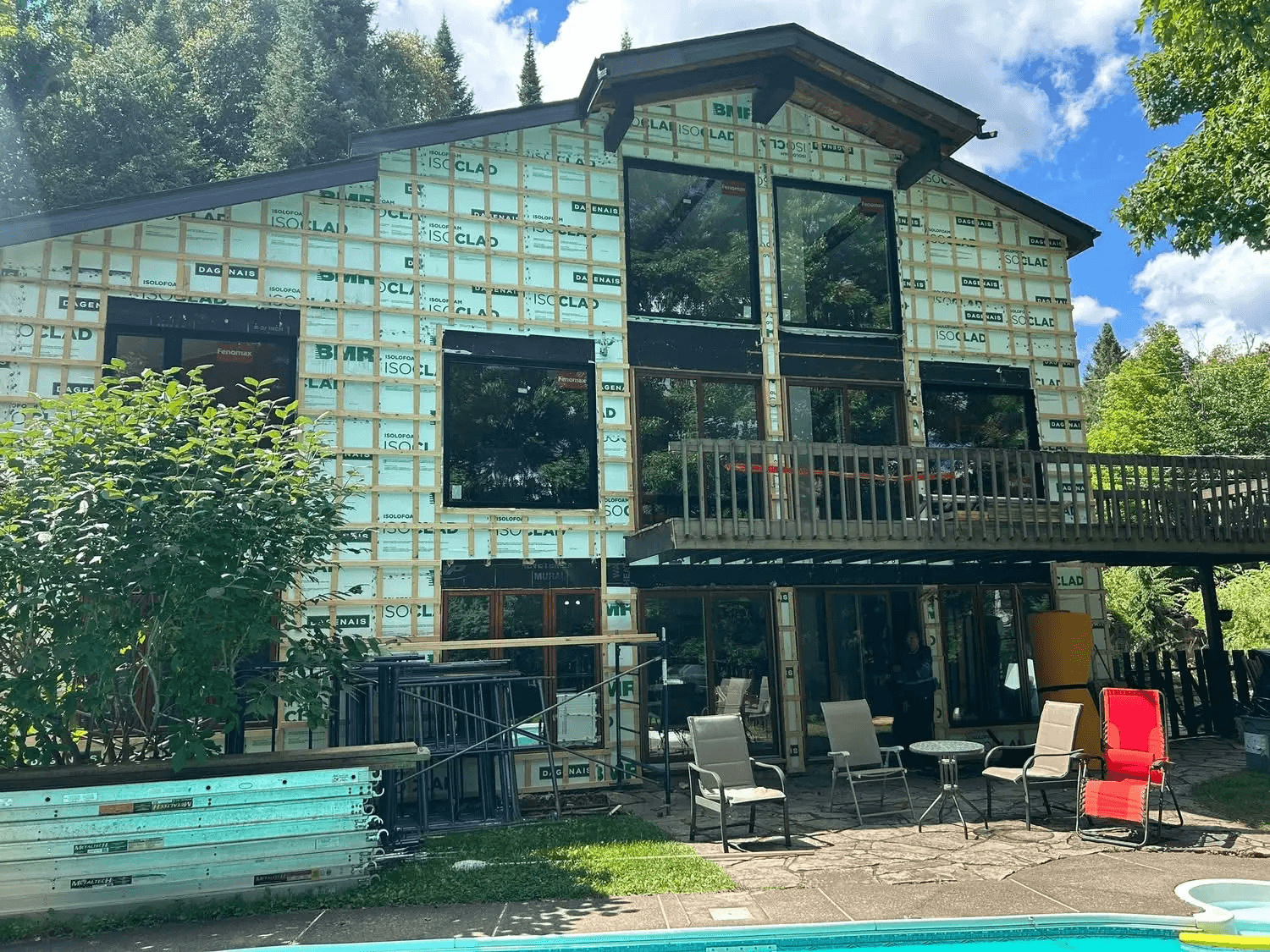
Source: Fenomax
Several technical factors influence the final price of an exterior renovation project.
Factors that can affect the total cost include:
Total exterior wall area (sq. ft.)
Number of storeys, dormers, and gables
Thickness of the selected insulation (1 in., 2 in., or more)
Need to replace damaged or rotted plywood or sheathing
Type of structural strapping required to secure the new siding
If you choose a heavier exterior finish such as stone or solid wood siding, the contractor may need to install wood strapping, like 1x3 or 2x2 furring, or thermally broken fastening systems that extend through the insulation and anchor the cladding securely to the wall structure.
Air-Barrier Preparation, Flashing, and Window Extensions
One of the most commonly underestimated costs when adding exterior insulation is the work required around doors and windows.
When the thickness of the exterior wall increases, the details around windows and doors must be adapted accordingly. Depending on the configuration, this may require jamb or frame extensions, new trim, and modifications to flashing and waterproofing membranes.
Typical modifications around openings include:
Extending window frames or jambs (wood or aluminum)—adjusting the depth to meet the new siding plane.
Installing custom metal flashing—head flashing above doors and windows to direct water away from the opening.
Sealing around openings with self-adhered membranes—sealing transitions and joints with high-adhesion tapes.
Treating each opening adds costs for membranes, flashing, trim, and other necessary adjustments. These costs can vary considerably depending on the size and configuration of the opening. Improper flashing can lead to serious water infiltration inside the wall assembly.
To estimate the total project cost, including the exterior finish, learn more about the cost of installing CanExel or vinyl siding.
Why Add Continuous Insulation Under New Siding?
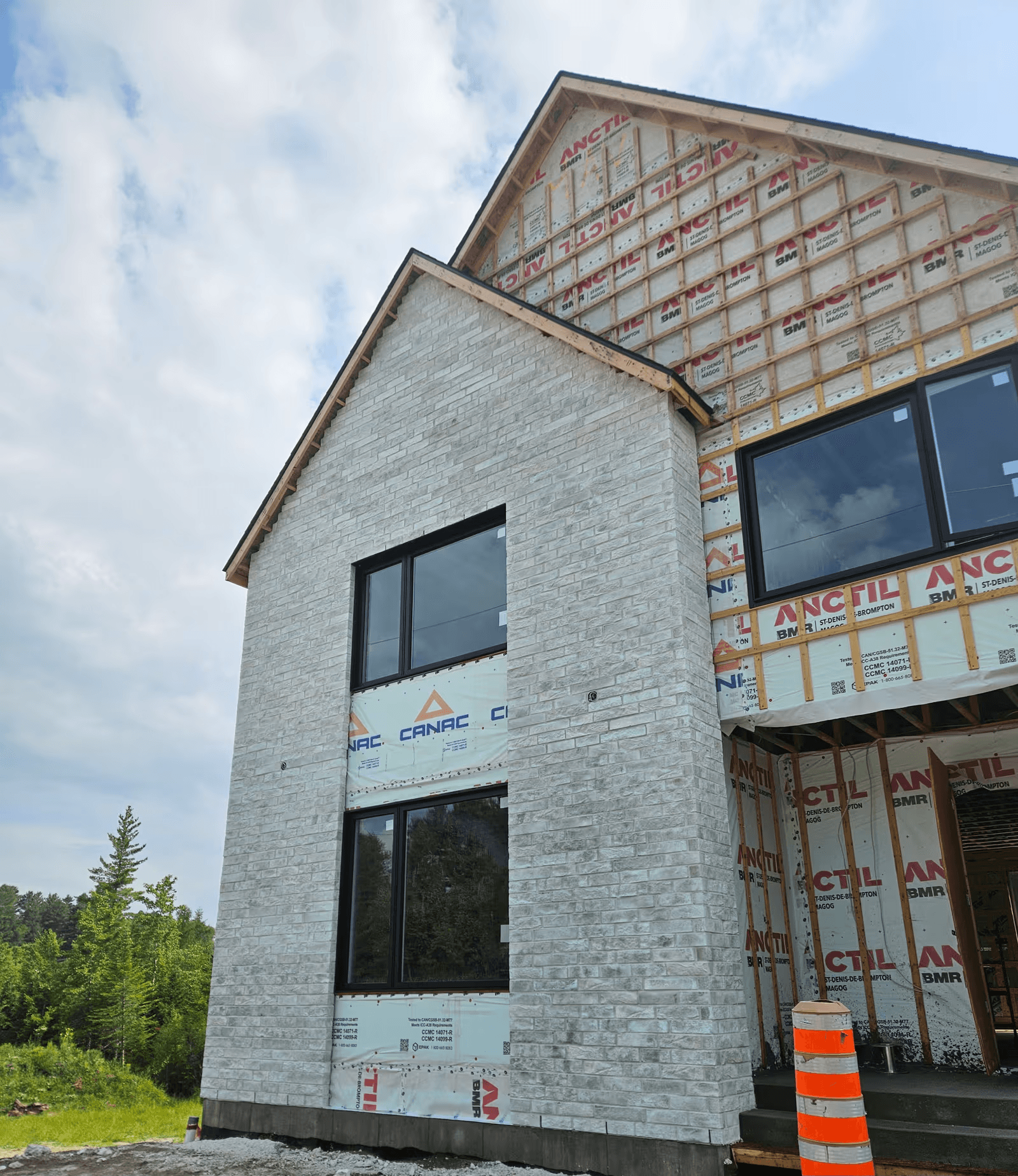
Source: FJ maçonnerie inc.
In a traditional Quebec home, exterior walls are often built with 2x4- or 2x6-inch wood studs spaced 16 or 24 inches on centre. Fibreglass batt insulation is installed between the studs.
Wood, however, conducts heat much more readily than insulation. The framing can account for roughly 15% to 25% of the total exterior wall area.
Thermal bridging in a wall assembly:
Without continuous insulation
Interior → R-20 insulation → wood stud → R-20 insulation → heat loss
Thermal bridge: The wood transfers heat more readily through the wall assembly
With continuous insulation
Interior → insulation → wood → insulation → continuous insulation panel → better heat retention
This phenomenon is known as thermal bridging. In winter, wood studs conduct more heat than the insulation installed between them, creating areas of greater heat loss.
Installing rigid insulation continuously over the exterior can:
Cover the wood framing and significantly reduce thermal bridging through the studs.
Keep more of the wall structure on the warm side of the building envelope, which can reduce the risk of condensation when an assembly appropriate for the building and climate is used.
Reduce heat loss through the walls and potentially lower the building’s heating demand. Actual savings vary depending on the existing insulation, building airtightness, wall area, and heating system.
Government Grants and Financial Assistance in Quebec

Source: RenoQuotes
To encourage energy-efficient renovations, provincial governments and Crown corporations offer financial incentives for certain building-envelope improvements.
Financial assistance programs available in Quebec include:
Rénoclimat Program (Government of Quebec)
Municipal grants, including certain local tax credits or incentive programs offered by individual municipalities
The Rénoclimat Program
The Rénoclimat program is a Government of Quebec program that provides financial assistance for certain energy-efficient renovations, including improvements to exterior wall insulation.
Key requirement: A Rénoclimat energy evaluation must be done before work begins. This evaluation includes a blower door test.
Financial assistance: For exterior wall insulation, at least 20% of the total exterior wall area must be insulated. The amount of financial assistance depends in part on the area insulated and the improvement in insulation value and can currently range from $450 to $3,750.
Hiring a Contractor with the Appropriate RBQ Licence

Source: RenoQuotes
Exterior insulation directly affects the structural integrity and water resistance of your home. Poor installation of air-barrier membranes or flashing can lead to concealed water infiltration, mould growth on the sheathing, and thousands of dollars in damage.
In Quebec, companies carrying out building-envelope renovation work must be registered with the Régie du bâtiment du Québec (RBQ).
Recommended checks before signing a contract include:
A valid RBQ licence covering the appropriate work, such as subclass 7.0 – Insulation, Waterproofing, Roofing and Exterior Siding Contractor, or an applicable general subclass such as 1.2 or 1.3, depending on the scope of the project.
Verify that the contractor carries adequate liability insurance for the planned work, in addition to the surety bond required for their RBQ licence.
If the contractor employs workers, verify that they comply with their CNESST registration and coverage obligations.
Liability under Article 2118 of the Civil Code of Québec for certain losses of work occurring within five years after completion.
The Civil Code of Québec provides, among other protections, a warranty against certain defects or deficiencies that exist when the work is accepted or are discovered within the following year, as well as separate liability for certain serious defects that may result in the loss of the work. To protect your renovation project and help ensure the work is completed according to industry standards, make sure you hire a contractor with the appropriate RBQ licence.
Looking for something else?
Related articles
The latest industry news, interviews, technologies, and resources.

Karine Dutemple
•10 Sep 2026
Any amateur or professional landscaper will love shrubs, which have a remarkable number of advantages. Whether they are appreciated for their ability to enhance the façade of a house or for their ability to create an area away from prying eyes, they are always a sure bet.

Editorial Team
•07 Feb 2024
Should you be lacking inspiration when it comes to planning your home improvement project, there is no reason to put so much pressure on yourself because you are definitely not alone in the boat! That is why, nowadays, there are several different platforms on the internet that are dedicated to providing different inspirational ideas for any given project.

Editorial Team
•08 Nov 2023
More and more people are foregoing the services of a general contractor and building their homes themselves. It’s a long-term project that requires one to partake in training and be properly informed in regard to everything related to home building.

Editorial Team
•17 May 2024
Digging a hole isn’t as easy as it might seem. Hence the reason for excavation standards, which must be adhered to. Abiding by such standards can literally save your life, or that of labourers working alongside you.

Christine Simard
•08 Nov 2023
While any good kitchen must be both practical and aesthetically pleasing, achieving both these goals might seem difficult when we're stuck with a smaller kitchen. However, this doesn't mean you have to give up on giving this room a makeover. With this is mind, here are some useful tricks to inspire you.