
Thinking of renovating your old basement soon? If you already have a fairly precise idea of the main objective of this project, it is possible that some questions still remain.
Perhaps you are hesitant about choosing your future flooring? Here are some of the options available to you!
The Ideal Basement Floor: Exploring the Best Options
1) Carpet

Source: Canva
Known for the great comfort it provides under the feet, this type of flooring has clearly fallen out of style after its glory years when it was even installed in bathrooms! Although the latter option is certainly not desirable (for reasons we now understand), carpeting is an interesting choice as flooring in the basement.
Apart from the heat it provides to those among us who can't stand the cold, it also has a very good capacity to absorb sound. This is a definite asset for all movie fans who want to enjoy their favourite hobby in their new basement! Moreover, carpet is also able to retain dust that accumulates at ground level, unlike smoother flooring that is unable to do so.
While it is very annoying to spill liquids on a carpet, this material is still very effective in absorbing shocks. It should be noted, however, that the carpet should be placed on a perfectly smooth surface to ensure a high-quality installation.
2) Floating Floor
This flooring, which is highly appreciated for its good value for money, is often a top choice when it comes to renovating the basement, although some criticize its lack of moisture resistance.
However, this problem can be overcome by installing a vapour barrier membrane during installation. In fact, it is more of an obligation than a recommendation if one considers that without its installation, the guarantee offered by the manufacturer is no longer valid. Also, it should be noted that the temperature transfer between the flooring and the concrete slab is small, making it a relatively warm and comfortable flooring.
3) Ceramic
Source: Canva
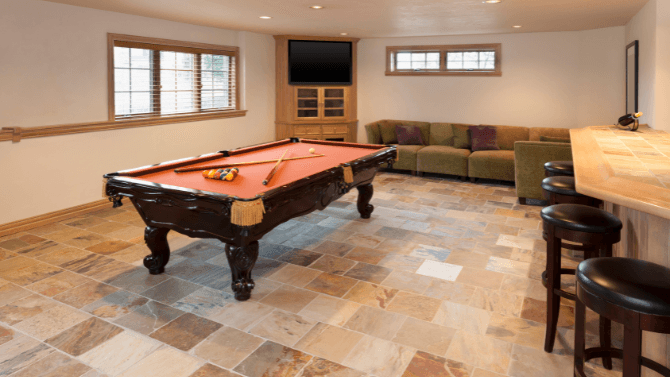
As a moisture-resistant material, ceramics are a perfect choice for a basement floor renovation project. On the other hand, it is important to keep in mind that ceramics offer a cold surface, which can make the floor especially uncomfortable in winter.
Therefore, if you want to install it in this room because of its high durability, adding a heated floor may be something to consider. It should be remembered that the installation of ceramic flooring requires certain skills and that in the absence of the expertise required to carry out quality work, it is important to hire a professional.
4) Vinyl
This type of flooring is considered suitable for the basement because of its high resistance to water and humidity. In addition to this significant advantage, it should be mentioned that this flooring is easy to install and can even be placed directly on various materials such as wood, ceramics and even concrete.
Also, vinyl does not offer a high-temperature transfer (which avoids walking on cold ground), as well as easily absorbing sound and requiring little maintenance. Unfortunately, the durability of this material is not optimal, which implies the probability that the vinyl will tear over time.
To limit the chances of this happening, it is best to opt for higher quality vinyl. Regardless of the type of vinyl purchased, the price of the vinyl should not exceed $3/square foot. This is why it is a very economical choice, which can imitate the finish of other more expensive materials such as wood and ceramics.
5) Engineered Wood
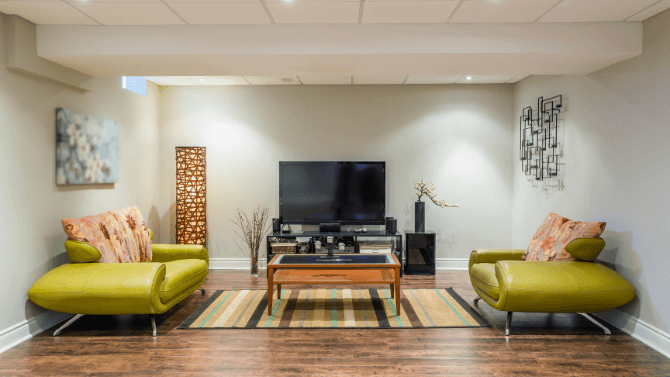
While the installation of hardwood flooring in the basement is usually discouraged, engineered wood is not. Given its similar appearance, this material is often presented as an alternative to consider. Indeed, it has a high resistance to moisture, which makes it possible to install it in the basement.
This resistance is mainly due to the presence of 5 to 7 layers of plywood between the first and last layers of the floor (these are made of real wood). These limit the propensity of the floor to contract or expand.
FAQ
What type of flooring is best for a basement?
While all of the flooring mentioned in this article is suitable for a basement, vinyl—especially luxury vinyl—is the overall best choice. As previously mentioned, it is resistant to water and humidity, easy to install, but also mould-resistant and affordable. Furthermore, it comes in a wide range of designs, making it the ideal choice.
Vinyl or laminate: which is recommended?
When choosing between laminate and vinyl for basement flooring, vinyl is generally the better option. Unless your basement is completely dry, laminate is not ideal due to its susceptibility to moisture and mould. Laminate, with its wood byproduct core, can easily suffer from water damage, causing it to warp and deteriorate. For basements, it's best to opt for vinyl flooring, which, as previously mentioned, is more resistant to moisture and provides better durability in damp conditions.
What is a good basement sub-floor option?
There are many good options available when deciding on a sub-floor. One that stands out in particular, however, is the DRICORE sub-floor—an engineered sub-floor designed specifically for basements. It features a raised moisture barrier that protects against the constant moisture released from basement floors, covering the cold, damp concrete. With an insulation rating of R-Value 1.7, DRICORE not only safeguards and cushions the finished floors using air gap technology but also helps to raise their temperature by up to 3.2°C / 6°F, enhancing overall comfort.
Will you soon be undertaking a basement floor renovation project? Here are some articles you might be interested in:
Need to estimate the cost of your flooring renovation project? Don't hesitate to use our cost estimator!
Get 3 renovation quotes for your flooring project
RenoQuotes.com can help you get quotes for your flooring project. When you submit your project, we’ll connect you with top-rated contractors. Fill in the form on the homepage (it only takes a few minutes) to receive estimates from trusted professionals.
Dial 1-844 828-1588 to speak with one of our customer service representatives.
Looking for something else?
Related articles
The latest industry news, interviews, technologies, and resources.

Editorial Team
•24 Mar 2025
Are you the proud owner of a home with a basement, but said space is still unfinished? Looking to turn it into a bedroom, playroom, or fully-loaded apartment? Here’s what you need to know before jumpstarting a basement finishing project.
Editorial Team
•13 Aug 2024
Do you find yourself looking down on your vinyl floor, figuratively and literally, and wondering why it looks so worn out? If so, your first thought might be to head straight to the nearest hardware store to buy new flooring. While vinyl isn’t an especially costly material, letting it wear instead of restoring it would be such a waste.
Cynthia Pigeon
•13 Apr 2026
In 2026, the cost to replace the roof of a standard single-family home in Canada generally ranges from $10,000 to $18,000 for asphalt shingles. For a metal roof, the budget typically falls between $25,000 and $50,000, depending on the surface area, slope, accessibility, and complexity of the project. These estimates typically cover the removal of the old roofing, debris disposal, new materials, and labour by a qualified contractor holding the appropriate provincial licences—ensuring your roof can withstand Canada’s demanding climate.
Cynthia Pigeon
•17 Aug 2026
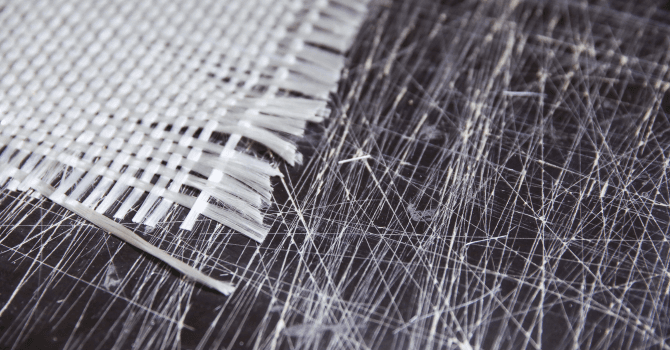
Fibreglass is a material made from extremely fine glass fibres. In construction and home renovation, those fibres are mainly used as glass wool for thermal and acoustic insulation or as reinforcement inside plastics, concrete, roofing materials, and other composite products.
Editorial Team
•24 Jul 2025
Thinking about turning your basement into a legal apartment? Many Toronto homeowners are considering this renovation as a way to increase property value, generate extra income, or create independent living space for family. But how do you convert a basement into an apartment, and is it really worth the investment?