How to Choose Between a Fibreglass or Concrete In-Ground Pool?
By Paul Riopel
Updated on March 17, 2026
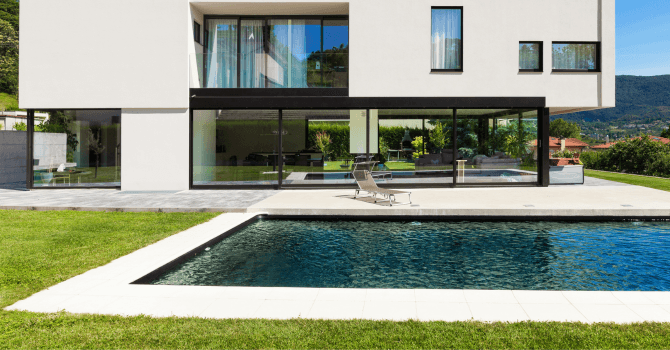
So, you're considering getting an in-ground pool? That's a refreshing idea that is sure to delight the entire family for years to come!
You've chosen the location and size, and you've already planned the landscaping that will turn your backyard into a true oasis. However, you still need to choose the pool itself. Fibreglass or concrete? With a liner or without a liner? Those are important questions.
Instead of diving headfirst into the project, here are the things to consider before making your choice.
In-Ground Pool: Fibreglass or Concrete - Which is the Better Material?
A pool is a long-term investment, and its purchase shouldn't be made on a whim. To make a choice that will satisfy you for years to come, it's best to learn about the advantages and disadvantages of the different styles of in-ground pools available on the market.
The Pros and Cons of Concrete Pools
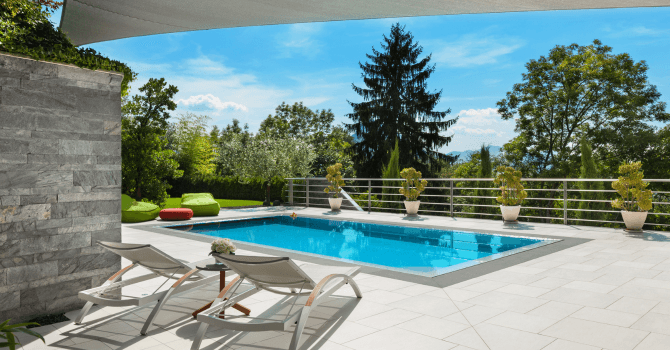
When looking for something unique and personalised, worthy of what you see on Instagram or what you pin on a Pinterest board, a shotcrete concrete pool is undoubtedly the best option. Embracing your creative instincts, it provides access to an infinite choice of shapes, sizes, depths, and designs.
The Advantages of Concrete Pools
The biggest advantage of a concrete pool is its durability, which is generally far superior to that of similar products.
Concrete is custom formwork, allowing for creativity in terms of shape, size, depth, etc. Even a very small yard can benefit from the installation of a pleasant swimming pool!
It can be made of simple concrete, but also of insulating formwork.
Concrete withstands the rather extreme temperature variations of the Quebec climate.
With its structure reinforced with iron, the pool is self-supporting. It is therefore not essential to surround it with a concrete sidewalk. Once again, this leaves room for creativity and allows for meeting the requirements of more restricted spaces.
The filtration system can be chlorine or salt.
As everything is adjustable at will, a waterfall or overflow can be integrated very naturally.
Concrete allows you to choose from a wide selection of different pool linings.
You can paint the concrete in a colour of your choice, or apply custom designs.
The Disadvantages of Concrete Pools
The installation of a concrete pool requires more labor, which can result in high costs.
Sometimes you have to wait a long time between the start and the end of the work.
Due to the porous nature of the material, a concrete pool requires more maintenance to avoid the growth of algae and bacteria.
Concrete is not recommended in a seismic zone.
The paint must be redone every five years.
The Pros and Cons of Fibreglass Pools
Source : Canva
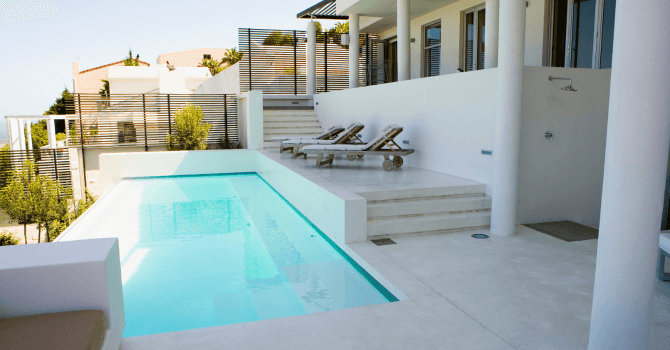
The fibreglass pool generally has a linear and clean style that gives it a trendy and timeless look. Its popularity is probably due to the fact that it is both affordable and elegantly beautiful.
The Advantages of Fibreglass Pools
The fibreglass pool can be installed in 24 hours, regardless of weather conditions.
The concrete coping only requires a few extra days, so the yard can be landscaped in record time.
The fibreglass shell is resistant, durable, waterproof, and suitable for the Nordic climate.
The staircase is molded into the shell; there's no need to install it every spring, and dirt doesn't embed behind it.
With its smooth walls, it is easy to maintain: no sunscreen traces, no embedded dirt, or waterline marks.
No liner is necessary.
While it's unnecessary to paint it, you can do so after a few years to refresh the colour.
Since fibreglass is insulating, the water remains warm longer and can reach a temperature 8 degrees higher than other types of pools in the same conditions.
The pool can also be insulated with urethane, which will reduce the energy costs associated with using a water heater.
You can customise the pool by integrating a relaxation basin, water games, a waterfall, etc.
The material is easy to repair if needed.
In seismic zones, a fibreglass pool is recommended because it is unlikely to crack or break.
The Disadvantages of Fibreglass Pools
The material is only available in a few colours predefined by the manufacturer.
Designs are also predefined. Although several options are available, the pool cannot be customised.
Although easy, cleaning must be done properly.
What Cost to Expect for the Purchase and Installation of an In-Ground Pool?
Source : Canva
The price of an in-ground concrete pool will vary between $50,000 and $100,000 depending on the chosen specifications.
You should expect to pay between $30,000 and $60,000 for the purchase and installation of a fibreglass in-ground pool, sometimes more.
In addition to size, the various options chosen will affect the cost:
the chosen shape and configuration,
the choice of options (waterfall, diving board, water games),
the colour of the pool,
the materials composing the sidewalk, etc.
You should also take into account the specificities of the land and the final landscaping of the yard (sod, landscaping, fence). You should expect to incur expenses each season for pool maintenance (painting the concrete, purchasing chlorine or salt, cleaning products, etc.)
The lifespan of an in-ground pool
Beyond the pool itself, the in-ground pool comes with different components whose parts can break. Thus, some elements will need to be repaired or replaced after a few years, while others will have a lifespan of up to 20 years.
The materials composing the shell of a concrete pool, whether with or without a liner, often reach the end of their useful life after 25 years, while the lifespan of a fibreglass pool is generally superior. Moreover, the increase in popularity of fibreglass pools in recent years is partly explained by the fact that they do not require the installation of a liner.
Although resistant, the liner is made of thin vinyl and can be torn by sharp objects and animal claws. Over time, UV rays and maintenance products will also weaken the liner, gradually reducing its elasticity and impermeability. When properly maintained, the pool liner generally needs to be replaced after 12 to 15 years.
Here are some additional indications regarding the durability of the different elements:
Pool pump and motor: 8 to 10 years;
Filter: 10 years;
Water heater: 8 to 10 years.
Six Tips for Installing an In-Ground Pool in Quebec
Check with your municipality for regulations regarding the installation of an in-ground pool (permits, required distances, easements, fences, etc.).
Ensure that the chosen location for the pool is optimal: prolonged sunlight, absence of trees and roots that could damage the structure, presence of electrical wires, distance from the house (minimum of 5 feet) or accessory buildings. Also, plan for the necessary space for a sidewalk with a minimum width of 3 feet, surrounding the pool.
Provide storage space for equipment and accessories such as the heat pump, skimmer, vacuum, etc. If preferred not to be visible, but still within reach.
In preparation for pool installation, clear a path for heavy machinery (if necessary, remove fences, vegetation, etc.). If you need to encroach on a neighbor's property during construction, be sure to inform them and assure them that you will restore everything afterward.
Consult an electrician to ensure that your electrical installation meets standards and reserve their services to finalise connections once the work is complete
Inform the installer of the planned location for burying the water return.
Get quotes for your exterior renovation or landscaping project
RenoQuotes.com can help you get quotes for your exterior renovation project. If you submit your project to us, we’ll put you in contact with top-rated contractors. Fill in the form on the homepage (it only takes a few minutes), and you will receive quotes from companies that are specialized in home renovations.
Dial 1-844 828-1588 to speak with one of our customer service representatives.
Looking for something else?
Related articles
The latest industry news, interviews, technologies, and resources.
Editorial Team
•15 May 2026
If you plan on renovating your house, whether it’s a transformation, remodel, or extension, checking whether you need to apply for a building permit with the city is paramount.
Editorial Team
•07 May 2026
A fibreglass balcony is a popular choice in Canada because it can resist moisture, weather exposure, and freeze-thaw conditions. Over time, however, the surface may lose its shine, crack, fade, or show signs of wear. In many cases, a small repair or resurfacing job can extend the life of the balcony without replacing the entire structure.

Editorial Team
•08 Nov 2023
In Montréal alone, it’s estimated that approximately 300,000 residents are affected by a high level of lead in their water, in particular, due to the pipe connecting their home to the city’s water system. In 2007, the City of Montréal, therefore, committed to changing all of its lead water pipes in the public sector, totalling around 48,000 by 2030, recently investing about $557 million to accelerate the project.
Editorial Team
•08 Nov 2023
Electrical work is extremely intricate and complex, as various wires and connections must be in their rightful place for electricity to run successfully. Electricians are trained to know exactly how these connections work, completing electrical work correctly and efficiently. Although there are several renovation projects that homeowners can attempt to DIY, electrical work should be left up to the professionals.

Editorial Team
•08 Nov 2023
Trying to manage the items of multiple family members is one of the many difficult tasks that running a household entails. Since the bathroom is generally the smallest room in the home, keeping it neat and tidy is a part-time job.