Choosing the Right Floating Floor: Characteristics
By Editorial Team
Updated on November 8, 2023

Now that you’ve narrowed down the type of floating floor you’d like installed, it’s time to choose the characteristics of your flooring. First things first, pick a type of floor wood. There are a lot of options available, and it goes without saying, but there’s something suited to all likings and budgets!
Characteristics to Consider When Choosing Your Floating Floors
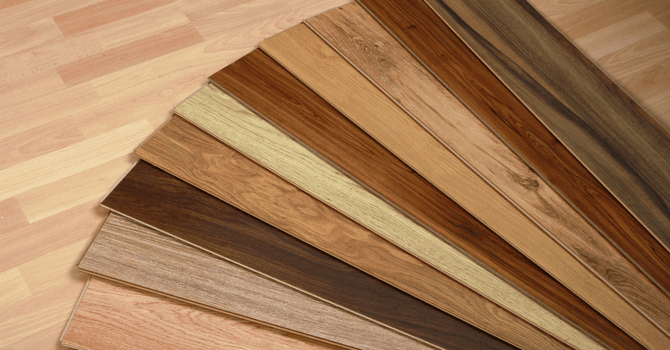
Source: Canva
Wood sourced from deciduous trees will typically give floors a more conventional result. However, should you opt for coniferous wood, like fir, you’ll get a farmhouse look. Note that some of the most commonly used floating floor woods are oak, pine, maple, cherry, and silver (silky) oak.
For those with a bigger budget at their disposal, you can also steer more toward exotic species such as aged ash vinyl, old oak, barnwood vinyl, and sugar (hard) maple vinyl. In any case, it ultimately comes down to personal taste.
Pro Tip
If you’re hemming and hawing between a few, ask the manufacturer if you can grab a few take-home slat samples, that way you can see which type of wood works best depending on the room you plan to install the flooring, while also keeping in mind natural and artificial lighting.
Wood Flooring Grades
Wood slats are typically categorized according to a grade. Every type of wood has a distinct coloration, even if it’s been treated or stained, there can still be some recognizable wood-specific knots and stains. Manufacturers will categorize wood according to colour uniformity and whether there’s knotting. Since wood is a natural material, it’s perfectly normal that not all slats are exactly the same.
Such detail can add a genuine feel to the floor. And, to achieve a bit more of a rustic look, or maybe more so for a chalet, you can opt for extra knotted slats.
Positioning the Wood Slats
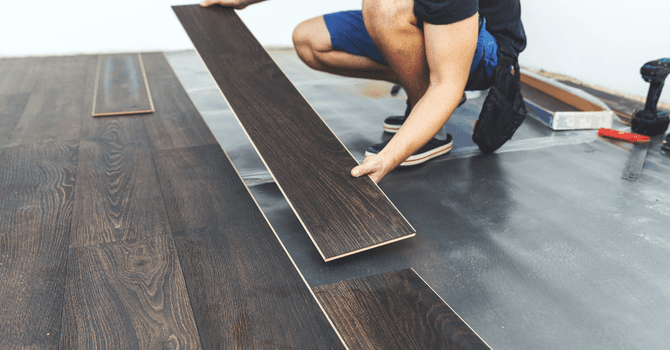
Source: Canva
Depending on the size of the room, the direction in which the wood slats are positioned can make the room appear bigger or smaller than it actually is. Whether they’re laid length- or width-wise, don’t underestimate the power of disposition. For example, if you’re standing in a long but narrow room, avoid positioning the flooring slats width-wise. Doing so would result in too many slats, and the outcome wouldn’t necessarily be appealing.
Don’t hesitate to ask for help from a sales associate to make sure that you’re making the right choice; a lot of stores have a customer service department! Note that the width of the slats themselves will also have an impact on the room's final outcome. Too small or too wide slats can very much alter the overall look.
Floating Floor Finish
Unlike a hardwood floor, applying a finishing coat (glossy, semi-gloss, or matte) won’t necessarily prolong the floor’s durability. There are several reasons why polishing a floating floor won't result in any beneficial improvement. But, for starters, let's just say that, compared to traditional wood, floating floors are an entity instead of a real substance.
Floating Floor Maintenance
Source: Canva
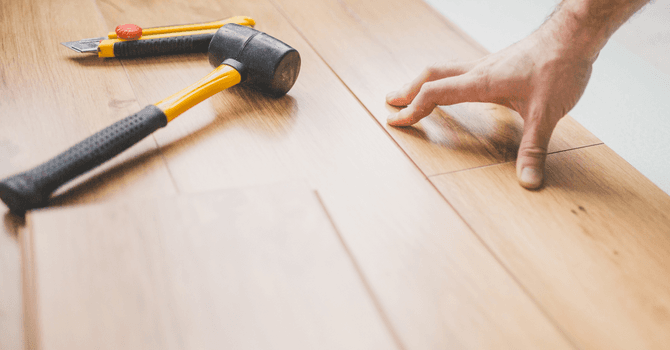
There’s a cleaning product that’s sold over the counter in all department and retail stores that gives floors that nice, sought-after sheen. However, it’ll be a short-lived result. Floating floors are really easy to maintain. And, with specially-made products, your floors will maintain their appeal and condition for years to come.
Prior to the installation, feel free to do some quality control by taking out each and every floor slat from their packaging and ensuring they have a certain uniformity. Doing so could prevent unforeseen twists and turns.
To learn more about floating floor installation, or floors in general, check out the following:
Get 3 quotes for your floating floor installation project
RenoQuotes.com can help you get quotes for your flooring project. By submitting your project, we’ll put you in contact with top-rated contractors. Fill in the form on the homepage (it takes only a few minutes) and get estimates from trusted professionals.
Dial 1-844 828-1588 to speak with one of our customer service representatives.
Looking for something else?
Related articles
The latest industry news, interviews, technologies, and resources.
Editorial Team
•03 Jun 2025
Whether you want to modernize your home, reclaim some living space, create a unique partition, or accommodate a family member with reduced mobility, installing sliding doors is a smart choice — they’re both practical and timeless.

Christine Simard
•08 Nov 2023
Whether you live in a small apartment or a large family home, the organization of your space is the key to keeping your household neat and well kept together.
Editorial Team
•31 Mar 2025
Even if your kitchen is user-friendly and suitable, aesthetically speaking, you can make it a lot more modern and appealing by refacing your cabinetry. Residential renovations are very on-trend in Canada, more specifically in Quebec, especially when it comes to kitchen makeovers.

Editorial Team
•24 Sep 2024
Do you live in a rural area or have a summer home that isn't connected to a local water system? If so, you probably have a functioning septic system. How can you make sure your conventional on-site disposal system is working properly? What are the best practices to uphold to extend the service life of your sanitary installation and prevent damages? The key to a system's longevity is understanding its inner workings, whether your property is equipped with a conventional or non-conventional system.
Editorial Team
•06 Feb 2025
When designing a luxury kitchen, nothing is done haphazardly. From material to colours, with layout and finishes in between, everything is thoughtfully crafted. From the most minute detail, everything counts when building a dream kitchen. Are you looking for ideas for designing your custom-built, high-end kitchen? Keep reading for key insight!